
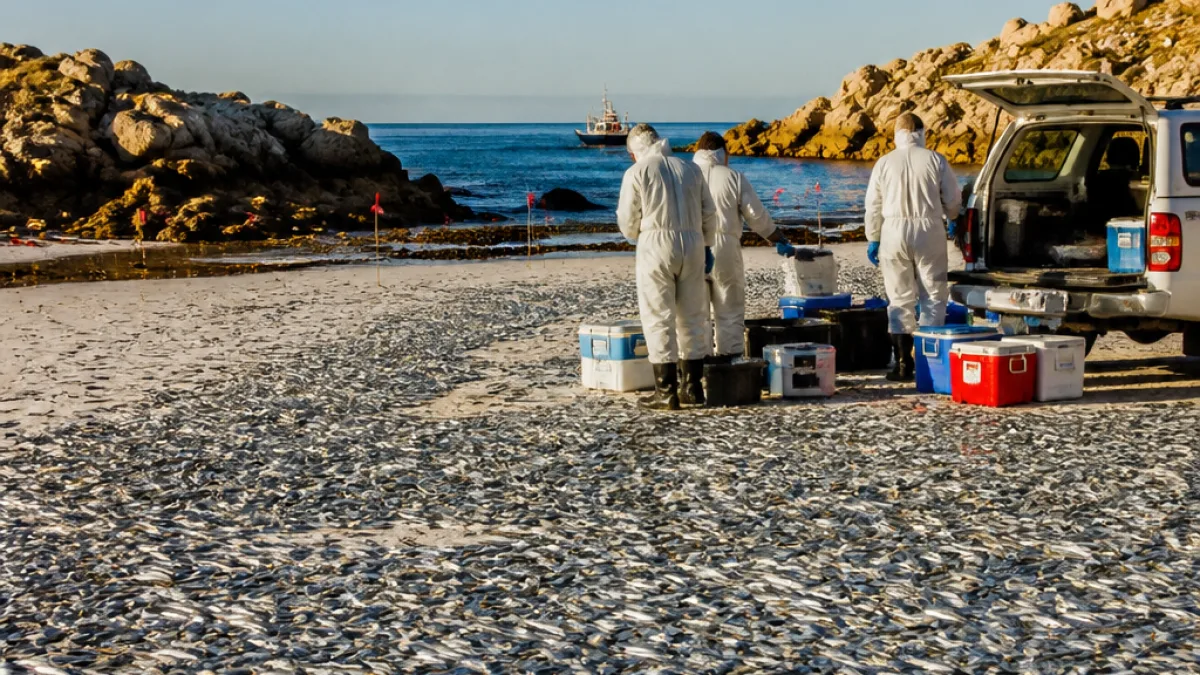
Laboratory sequencing has confirmed the presence of pilchard herpesvirus (PHV) in sardines sampled after a recent mass mortality event along the Western Cape’s West Coast, the national Department of Forestry, Fisheries and the Environment (DFFE) said on Friday. The virus has not previously been reported in South African sardines, commonly known locally as pilchards.
Where the mortalities were reported
The DFFE began investigating at the start of the month after reports of large-scale sardine deaths at several coastal locations between Saldanha Bay and Gansbaai. Samples were collected from those areas, including the Cape Canyon, and submitted for laboratory analysis.
| Location | Sampling Notes |
|---|---|
| Saldanha Bay | Harmful algal bloom present; biotoxin tests conducted |
| Cape Canyon | Samples taken for laboratory sequencing |
| Gansbaai | Mortality reports and sampling conducted |
The DFFE said PHV was detected in both dead sardines and at lower levels in some apparently healthy individuals. At the same time, testing for paralytic shellfish toxins linked to the algal bloom in Saldanha Bay found no paralytic toxins in the fish sampled from the three locations.
"There is no evidence that it infects people or other animals," the department said, while noting the detection does not by itself justify a blanket suspension of fishing or canning.
What the findings mean for fisheries and consumers
The department emphasised that the presence of PHV in samples alone does not indicate that healthy sardines caught commercially or canned products are unsafe. It also said the biotoxin results were reassuring, though not a general clearance of all commercial catches. The DFFE advised that normal monitoring and food-safety controls should continue.
- Public health: No evidence currently links PHV to infection in humans or other animals, according to the DFFE.
- Commercial fishing: The DFFE said detection does not currently justify a general suspension of fishing or canning operations.
- Monitoring: A task team will be established to formulate a response plan and continue investigations.
Context and next steps
PHV has not been reported previously in South African pilchard stocks. The DFFE said it would set up a task team to assess the significance of the finding and guide further action. Monitoring of catches and routine food-safety checks remain in place while the department develops its response.
Other algal toxins — domoic acid and yessotoxin — were detected at low levels in the samples, with the highest concentrations reported in an apparently healthy comparison sample. The department noted these detections were low and did not indicate a broader food-safety risk, but underlined that they do not amount to an across-the-board clearance of commercial catches.
For fishing communities and retailers along the West Coast, the finding will raise concerns about stock health and market access. The DFFE’s position, as communicated in its statement, is cautious: the presence of PHV is notable and requires follow-up, but does not yet translate into immediate human health risk or an automatic halt to commercial activity.
Local authorities, scientists and fishing industry representatives will be watching the task team’s work closely. Further sequencing and wider sampling will be necessary to understand the distribution and potential impacts of PHV on pilchard populations and, by extension, on predators and fisheries that depend on this small pelagic species.
Sardines are a keystone species in our coastal ecosystem and important to local economies; establishing the cause and extent of the mortality event is therefore a priority both for conservation and for livelihoods. In the short term, fishers and processors should continue to follow existing monitoring and food-safety protocols while awaiting the task team’s recommendations.
Further updates are expected as the DFFE completes sequencing work and the task team outlines its response plan.










