
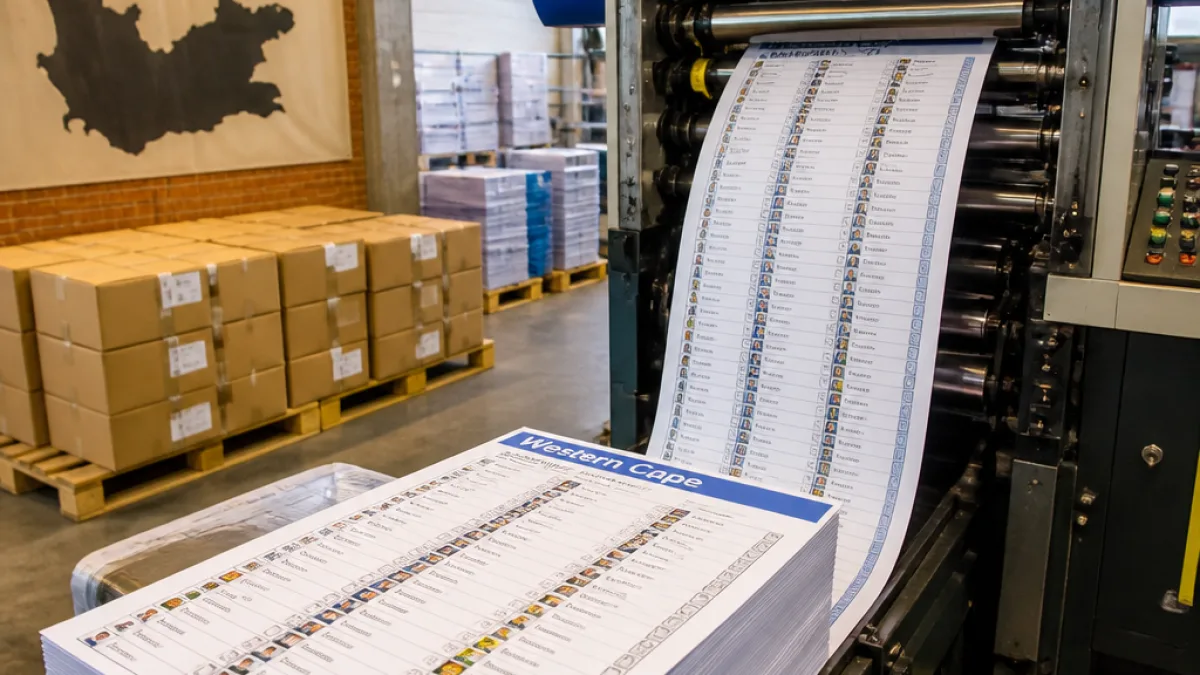
The Electoral Commission (IEC) will begin printing about 8 million ballots for the Western Cape from Monday, the provincial electoral office confirmed, as the province prepares for a crowded and competitive local government election campaign.
High numbers, many parties
Election administrators say the ballot run follows the registration of 14,348 candidates competing for just 868 municipal seats across the province. A total of 106 political parties and 33 independent candidates will contest these seats.
The number of parties and candidates, especially in the City of Cape Town metro, will make voting logistically complex. The IEC’s provincial electoral officer, Michael Hendrickse, warned that some ballots will feature long candidate lists and a two-column format will be used where needed.
“The contest will be intense amongst each other, and within that contest let’s respect one another,”
Hendrickse said candidates were issued certificates of compliance and that parties had signed the electoral code of conduct on Friday. He urged participants to abide by that code through the run-up to voting.
What voters in the Western Cape will receive
The ballot configuration will differ depending on where a voter is registered. The IEC said:
- Voters in the metro will receive two ballots: one for a ward candidate and one for proportional representation (PR).
- Voters outside the metro will receive three ballots: a ward ballot, a PR ballot for the municipality and a third ballot for the district council.
The commission will produce 446 different ballots for the province after a national draw determined the order of parties on the ballot paper. The Freedom Front Plus came out top in that draw for the province.
Ballot lengths and logistics
In the metro there will be 55 contesting parties, requiring a two-column ballot in some wards. Hendrickse said the longest ward ballot will have 46 contestants while the shortest ward ballot will have 38 contestants. That density will require careful printing, handling and polling station procedures to ensure voters can find and mark their preferred candidates accurately.
| Metric | Western Cape |
|---|---|
| Seats contested | 868 |
| Candidates | 14,348 |
| Parties | 106 |
| Independent candidates | 33 |
| Different ballots to be produced | 446 |
| Estimated ballots to print | ~8,000,000 |
Practical implications for voters
The mix of many parties and long ward lists means voters should arrive at their voting station prepared. The IEC recommends that voters bring identification as required and take time to find their preferred candidate on potentially lengthy ballots. The two- and three-ballot systems mean voters outside the metro will need extra time to mark each ballot.
Election administrators will need to ensure adequate printing quality and sufficient ballot-paper stock, and that the distribution to remote voting stations is secure and timely. The production of 446 different ballot types increases the demands on storage, packing and verification ahead of polling day.
What the provincial IEC emphasised
Hendrickse appealed to parties to respect the electoral code of conduct during what he described as an intense contest. The commission’s steps — issuing compliance certificates and concluding the ballot-order draw — are part of the statutory process to ensure the election proceeds on schedule.
As the ballot printing starts, political parties and independent candidates will move into the final phase of campaigning. Voters and stakeholders will be watching how the IEC manages the logistical challenge posed by so many candidates and ballot variations.
Further details about voting stations, voting times and what to bring on voting day will be published by the IEC as they finalise operational plans for the election period.













