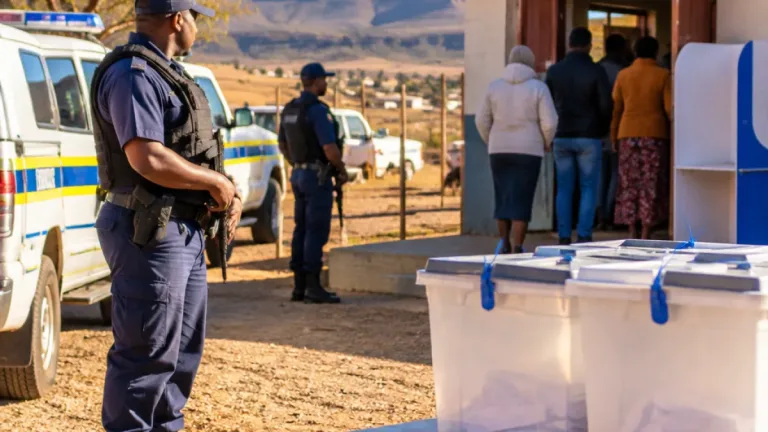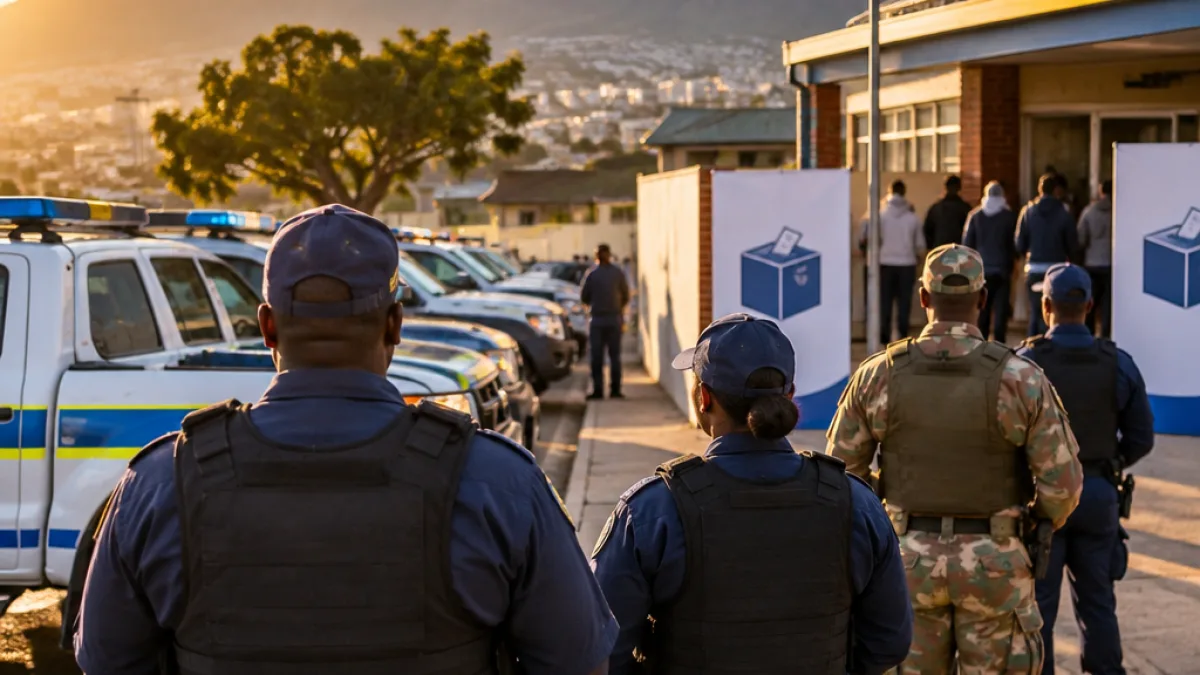
Western Cape police have deployed law-enforcement personnel across the province to protect voters and voting stations during Wednesday’s local government elections, with additional attention being given to 33 areas classified as high risk.
Provincial police commissioner Major General Sizakhele Dyantyi gave the assurance at Belhar early on Wednesday, 4 November 2026, while addressing hundreds of integrated law-enforcement officials preparing to begin their election-day duties.
Dyantyi said there should be no part of the province where residents were unable to exercise their right to vote safely. His comments came as voters prepared to make their way to stations across the Western Cape, following the logistical difficulties reported during the first two days of special voting.
“We will not allow any lawlessness. Because we feel that people of South Africa and this Province deserve to exercise their right. We will address any threat that emerges.”
A multi-disciplinary security operation
The operation involves more than ordinary visible policing. According to Dyantyi, the deployment includes law-enforcement agencies working alongside visible police, detectives, crime investigators and crime-intelligence personnel. The Hawks, the country’s elite investigative unit, are also part of the operation.
The commissioner said personnel had been allocated to each voting station, although the number and type of officials assigned would depend on the needs of the relevant community and the classification given to that station. This means security arrangements will not necessarily be identical across the province.
Police deployments are being structured according to three broad categories: high-risk, medium-risk and low-risk stations. The classification is intended to guide the level of resources available at a particular voting venue and to ensure that areas assessed as more vulnerable receive an appropriate response.
| Security feature | Details provided |
|---|---|
| Provincial coverage | Law-enforcement operations across the Western Cape |
| Stations covered | Personnel deployed at every voting station, according to local needs |
| High-risk areas | 33 areas identified for additional security planning |
| Participating disciplines | Visible policing, detectives, investigations, crime intelligence and the Hawks |
How high-risk stations are identified
Dyantyi said the identification of high-risk voting stations was based on a process involving the intelligence community. Previous crime incidents in particular environments are considered when authorities determine whether a station requires a higher level of security.
The classification is therefore linked to the history and circumstances of an area, rather than being applied uniformly across the province. Police will use that assessment to determine the nature of the deployment required on election day.
The commissioner did not provide a breakdown of the 33 areas in the available briefing, nor did he specify how many officials had been assigned to individual stations. The stated approach, however, is to match deployments with the assessed level of risk and the requirements of each community.
Assurance after election-related concerns
The security announcement follows a period in which the electoral process has faced practical challenges. Printing delays left more than 200 voting stations without ballot papers on the morning of Monday, causing elderly and vulnerable voters to wait for extended periods. The IEC in the Western Cape subsequently said logistical backlogs affecting special voting had been cleared.
Police security and electoral administration are separate responsibilities, but both affect whether voters can participate in the elections without unreasonable obstacles. The police operation is focused on preventing disorder and responding to threats, while the IEC remains responsible for the conduct and administration of voting.
Dyantyi also referred to a shooting incident in Manenberg on Tuesday, 3 November 2026, while addressing the assembled officials. The available briefing did not provide further details about that incident or indicate whether it had affected the election-day deployment.
Protecting the vote
Addressing the officials, Dyantyi urged them to carry out the commitment made to the public. He said the operation was being implemented throughout the Western Cape and that the various policing disciplines would be present on the ground.
- Residents should be able to approach voting stations without intimidation or lawlessness.
- Security resources will vary according to the classification and needs of each station.
- Police have warned that threats emerging during the voting process will be addressed.
The commissioner’s message places the emphasis on visible protection, but the operation also relies on investigative and intelligence capacity. That combination is intended to provide an immediate response at stations while allowing authorities to deal with information about possible threats in a structured way.
For voters, the central assurance is that security arrangements are in place across the province, including in communities identified as more vulnerable. The final measure of the operation will be whether residents can cast their ballots safely and whether voting stations remain orderly throughout the day.