
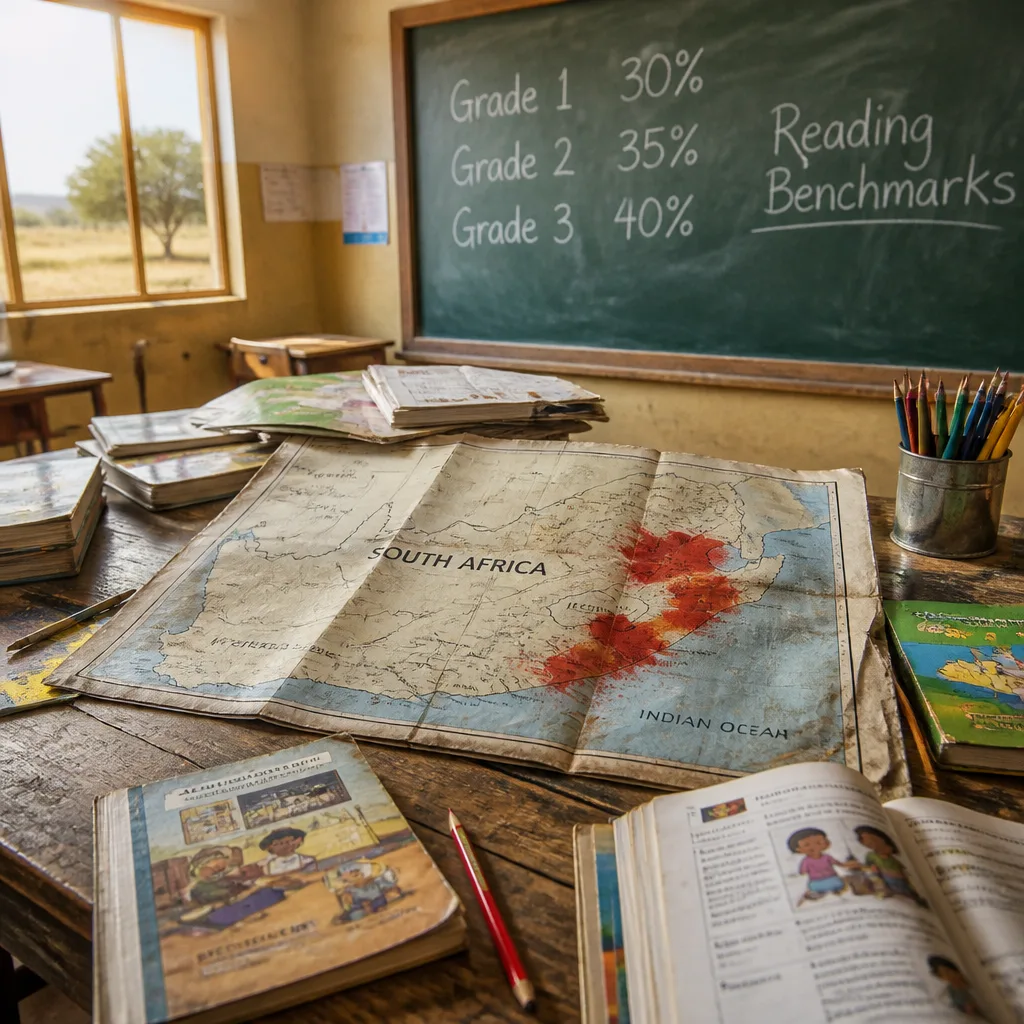
South Africa’s struggle with literacy remains deep and geographically uneven, according to recent analyses released as the country marks National Literacy Month and International Literacy Day.
Key findings and where the problem is worst
Statistics South Africa (Stats SA) said the spatial distribution of adult illiteracy has improved overall since 1996, but that significant pockets of high illiteracy persist. The most concentrated and persistent hotspot is in north‑eastern KwaZulu‑Natal, broadly aligning with the uMkhanyakude District. Additional high‑illiteracy clusters are found in other parts of KwaZulu‑Natal and in sections of the Eastern Cape.
“In summary, the comparison shows that the overall extent of high‑illiteracy clustering declined substantially between 1996 and 2022,” Stats SA said, adding that there is nevertheless “both continuity and change” in the geographical pattern of illiteracy.
By contrast, the strongest clusters of relatively low adult illiteracy remain in Gauteng and the Western Cape, with Gauteng’s low‑illiteracy cluster spreading into neighbouring provinces.
Foundational reading for children: worrying baseline
The Department of Basic Education’s Funda Uphumelele National Survey provided the first nationally representative baseline for foundational reading across South Africa’s 11 official languages. The survey assessed around 28,000 learners across 710 schools.
Results point to weak progress in early grades. Only 31% of Grade 1 learners achieved the Home Language Reading Benchmark. For learners in Grades 2 and 3, just over 30% reached their respective benchmarks. Alarmingly, the survey found that 15% of Grade 3 learners were unable to read a single word.
| Grade | % meeting reading benchmark |
|---|---|
| Grade 1 | 31% |
| Grade 2 | ~30%+ |
| Grade 3 | ~30%+ (and 15% unable to read a single word) |
Implications and what the data signals
The two sets of analysis together sketch a country where adult and learner literacy problems overlap with geography and inequality. Improvements since 1996 show progress, but the sustained presence of high‑illiteracy clusters in some rural and marginalised areas means many residents remain excluded from the basic skills required for schooling, employment and civic participation.
Experts and policymakers will face pressure to target resources where they are most needed. Measures likely to be considered include expanded early‑grade reading programmes, teacher support for multilingual classrooms, and intensified community literacy initiatives in persistent hotspots such as parts of KwaZulu‑Natal and the Eastern Cape.
- Spatial targeting: The findings point to the need for district‑level interventions, not only national programmes.
- Early intervention: Low foundational reading rates in Grades 1–3 underline the urgency of strengthening early learning.
- Language and resources: Delivery in home languages and better training for teachers in multilingual pedagogy are likely priorities.
Stats SA warned that while the scale of high‑illiteracy clustering has declined, the persistence of specific hotspots means that national averages mask local realities. The DBE baseline offers officials a clearer measure of early reading performance, a necessary step for monitoring progress and allocating funding.
Officials have yet to announce specific new funding packages or targeted plans in response to the combined findings. Further detail on provincial and district‑level results from the DBE survey may be released in follow‑up reports.
This is a developing story and additional reactions from provincial education departments and civil society groups are expected as the data is digested and policy responses are formulated.














