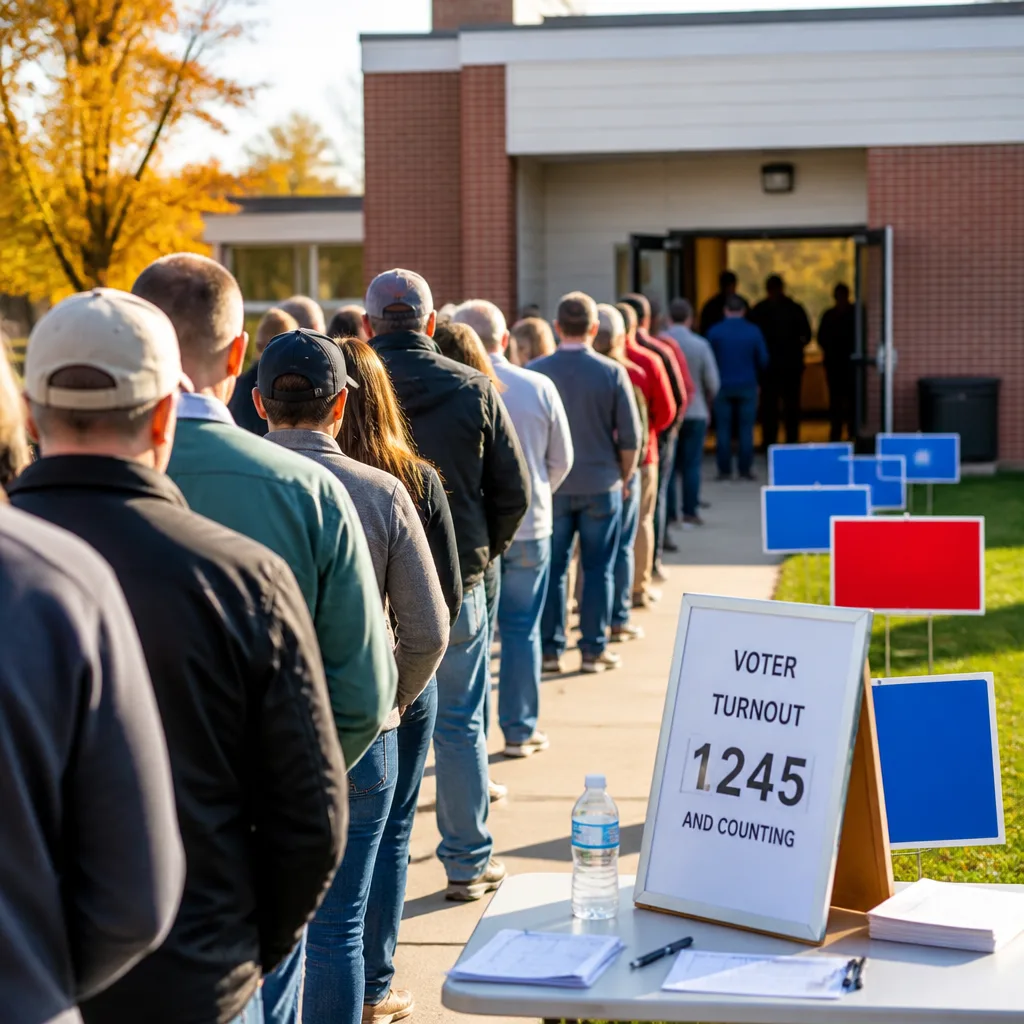
More than 2.5 million Michiganders cast ballots in the state’s recent primary, a turnout level that has prompted fresh analysis of what the numbers mean for the US general election in November. Election observers said the imbalance between Democratic and Republican voters on primary day will change how both national campaigns plan their fall operations in the state.
What happened on primary day
State election administrators reported total participation of over 2.5 million voters in the primary. Independent coverage by Michigan Public outlined a substantial gap in the numbers of Democrats and Republicans who voted, a difference that was large enough to draw commentary from political scientists and campaign operatives.
Analysts noted three immediate takeaways:
- Enthusiasm advantage: Democratic voters showed stronger turnout during the primary, suggesting higher mobilisation among that party’s base at this stage.
- Primary versus general electorate: Primary voters are not a perfect mirror of the November electorate; many general-election voters skip primaries altogether or cross party lines.
- Strategic recalibration: Campaigns on both sides will adjust advertising, field operations and resource allocation in Michigan as a result of the turnout pattern.
What experts say
Michigan Public invited Corwin Smidt, an associate professor of political science at Michigan State University, to discuss the results. Smidt offered context on how mid-summer primary behaviour can differ from autumn voting patterns and which demographic groups campaigns should watch as they prepare for the general election.
Political scientists emphasise caution in translating a single primary’s numbers into definitive forecasts for November. Primary electorates are often smaller and more partisan than the general electorate, and factors such as candidate dynamics, turnout initiatives, and late-breaking events can all reshape the landscape in the weeks ahead.
Who benefits and who pays
The immediate beneficiary of higher Democratic turnout is, plainly, the Democratic Party’s perceived momentum — a commodity that helps with fundraising, volunteer recruitment and media narratives. That momentum can translate into financial gatekeeping: donors and national committees often divert funds to states where a party appears energised.
On the other hand, a demonstrated enthusiasm gap can be costly for Republicans who now face pressure to increase turnout, particularly in competitive counties and among swing constituencies such as suburban and working-class voters. The cost here is practical and monetary: more spending on field operations and targeted advertising will be necessary to close the gap.
Both parties will also be assessing whether the primary turnout reflected structural trends — for instance, heightened engagement among young voters or specific racial and ethnic groups — or whether it was a tactical response to local races and issues. That distinction matters because structural advantages are more durable, while tactical spikes can fade by November.
Practical consequences for campaigns
Campaign strategists told state and national operatives to consider the following adjustments after the primary:
- Refocus ground game investments on counties where the turnout gap was widest.
- Increase voter-contact operations targeted at infrequent or new voters whose participation could swing key districts.
- Tailor messaging to address the specific concerns that drove local turnout surges, rather than relying solely on national themes.
| Metric | Value |
|---|---|
| Total primary turnout | 2.5 million+ |
Michigan is widely treated as a swing state in US presidential contests. Whatever the final November outcome, the primary’s turnout pattern has already changed the arithmetic for both parties: Democrats can point to current mobilisation as evidence of a competitive edge, while Republicans must decide whether to counter with an aggressive push to recover ground.
For international observers, the practical import is straightforward. A state that tilts one way or another can influence electoral college math and the balance of power in Washington, with downstream effects for trade relations, foreign policy and global markets. For now, commentators advise watching the next weeks of voter-contact efforts, ad buys and internal polling to see whether the primary’s signal persists into the general election season.