
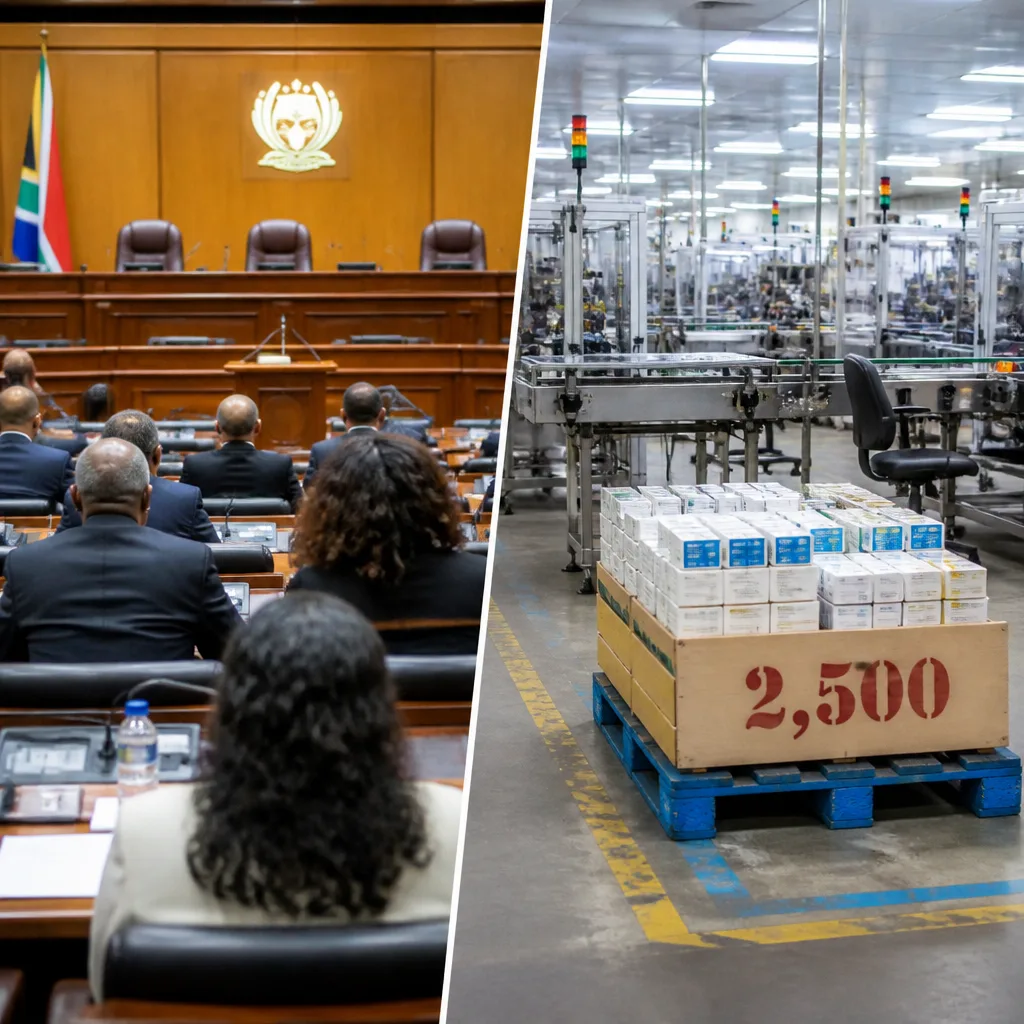
The national Department of Health has defended its public procurement practices after a pharmaceutical industry group attributed job losses among local manufacturers to the department’s emphasis on price in medicine tenders.
Industry figures and government response
Pharmaceuticals Made in South Africa (Pharmisa) told Parliament’s portfolio committee on trade, industry and competition that procurement decisions had contributed to approximately 2,500 job losses in the past 18 months. The industry body, whose membership includes Aspen Pharmacare, Adcock Ingram, Biovac, Sandoz, the National Bioproducts Institute and Fresenius Kabi, also presented data it said showed a long-term decline in the local share of major medicine tenders.
| Product tender | Local share (year) | Local share (later year) |
|---|---|---|
| HIV/Aids drug tender (by value) | 72% (2008) | 28% (2025) |
| Tablets and capsules tender (by value) | 56% (2014) | 18% (2026) |
Pharmisa also drew attention to the health minister’s decision to grant a below-inflation increase for private sector medicine prices in 2026 — an adjustment of 1.47% — as well as the effects of rising input costs linked to global conflicts.
“South Africa needs a mature discussion about how to strengthen local pharmaceutical manufacturing. It does not benefit from sensationalism or the selective use of procurement data to create the impression that public procurement has failed,”
The department issued a forceful rebuttal at the weekend, saying the figures presented to MPs by Pharmisa painted a distorted picture and failed to account for important market developments putting pressure on manufacturers. It highlighted factors such as evolving regulatory requirements and an increasingly competitive global market.
Competing pressures: price, local industry and regulation
The dispute exposes a long-running tension in government policy: balancing support for domestic industry and ensuring affordable medicine procurement amid tight budget constraints. Local manufacturers have in recent years criticised public tenders favouring cheaper imports, arguing this undermines South Africa’s ability to produce essential medicines domestically.
The health department said a fall in the value of contracts awarded to particular manufacturers does not, by itself, demonstrate a policy failure. Instead, it described the development as part of a dynamic market response.
- Pharmisa argues local manufacturers’ tender value shares have fallen sharply over time.
- The department counters that stricter regulation and market competitiveness have altered contract awards.
- Both sides point to economic pressures — including input costs and low price increases — as weighing on the sector.
Neither Pharmisa nor the department set out detailed, reconciled contract-value analyses in the public record seen by this paper. The statistics cited to Parliament show long-term shifts in the composition of awarded contracts, but do not isolate the effects of procurement policy from other market forces.
What this means for patients and the sector
For patients, procurement decisions determine which suppliers provide medicines to public health facilities and, ultimately, affect medicine availability and affordability. For manufacturers, tender awards shape production planning, employment and investment decisions. The debate is therefore both economic and clinical in consequence.
Health economists and sector observers note that sustaining a viable local pharmaceutical industry often requires a mix of measures, including:
- Transparent procurement processes that balance price with quality and local capacity;
- Targeted support measures to boost manufacturing competitiveness; and
- Regulatory certainty and predictable pricing frameworks.
The health department urged stakeholders to engage in a constructive national conversation about strengthening local manufacturing rather than relying on selective data to make broad claims. Pharmisa’s presentation to Parliament raises questions that will likely prompt further scrutiny by lawmakers, industry and health policy experts.
Patients and health workers are reminded to consult clinics or a medical practitioner about medicine availability or concerns rather than self-diagnose. The outcome of this dispute could influence future tender rounds, employment in the pharmaceutical sector and the security of medicine supply to public facilities.











