
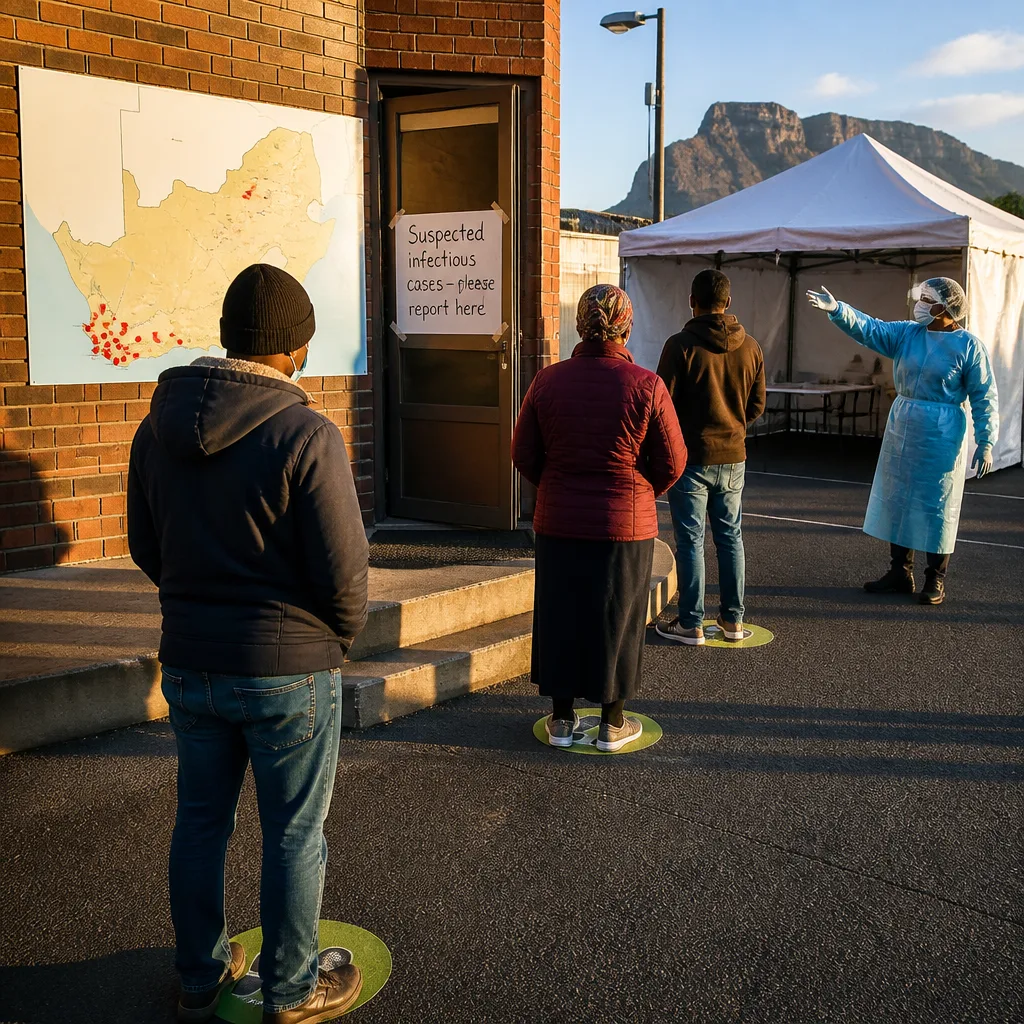
The national Department of Health has warned the public and clinicians to be alert for signs of mpox after a recent cluster of laboratory-confirmed infections, saying the pattern suggests rapid local transmission in parts of the country.
Case numbers and recent trend
To date, the department said 19 confirmed cases have been reported, the majority — 15 — in Cape Town, Western Cape. The remaining cases include three in Gauteng and one in KwaZulu‑Natal. Of particular concern to health officials is that 13 of the 19 cases were diagnosed between 13 August and 17 September, indicating a recent increase in spread.
| Province | Confirmed cases |
|---|---|
| Western Cape (City of Cape Town) | 15 |
| Gauteng | 3 |
| KwaZulu‑Natal | 1 |
Who is affected and possible importation
The department reported the age range of cases is between 23 and 50 years, with a median age of 36.5 years. Eighteen of the cases were male and one was female. One of the most recent cases involves an individual who travelled to Spain and returned to South Africa on 14 September; that person was tested in Spain after being notified of a probable infection, and South African health authorities are liaising with Spanish counterparts to confirm laboratory results.
Symptoms, transmission and public health advice
Health authorities reminded the public that mpox commonly begins with non‑specific symptoms such as fever, headache, muscle aches, back pain and fatigue, followed by a rash or skin lesions. These lesions may appear on the face, hands, feet, genitals or other parts of the body and typically evolve from flat red spots to bumps, then fluid‑filled blisters, pus‑filled lesions and finally crusted scabs. The incubation period is usually 6 to 13 days, but can range from 5 to 21 days.
“Continued surveillance, early detection, and public cooperation cannot be overemphasised in preventing further transmission,” the department said.
The department emphasised that mpox spreads mainly through close physical contact with an infectious person, including direct skin‑to‑skin contact. It advised anyone who develops compatible symptoms — particularly people who have had close contact with a confirmed or suspected case — to seek medical assessment straight away and to avoid close contact with others while awaiting advice.
- When to seek care: If you have fever, new rash or unexplained skin lesions and recent close contact with a suspected or confirmed case.
- Reporting and testing: Health services are conducting testing and contact tracing where cases are identified.
- Prevention: Minimise close physical contact with people who have unexplained rashes or lesions and follow infection‑prevention guidance from health workers.
Context and implications
The current cluster underscores the need for ongoing surveillance and prompt clinical recognition of mpox symptoms by frontline health workers. Rapid identification and isolation of cases, together with contact tracing, are central to interrupting chains of transmission. The age and sex distribution of this cluster reflect the profiles reported in other countries during recent waves, but the disease can affect anyone regardless of demographic group.
Health officials are also tracking the travel history of cases to distinguish between imported infections and local spread. Authorities said they are engaging with international counterparts in relation to the traveller who was tested in Spain.
Members of the public with concerns or symptoms should consult their nearest clinic or speak to a health professional rather than self‑diagnose. Clinical management and testing guidance is available from provincial health departments and the national Department of Health.
Accurate and timely reporting to health services helps protect contacts and communities; the department urged continued cooperation with testing, isolation and contact‑tracing efforts.
If you are uncertain about symptoms or how to access care, contact your local healthcare facility or provincial health helpline for guidance.











