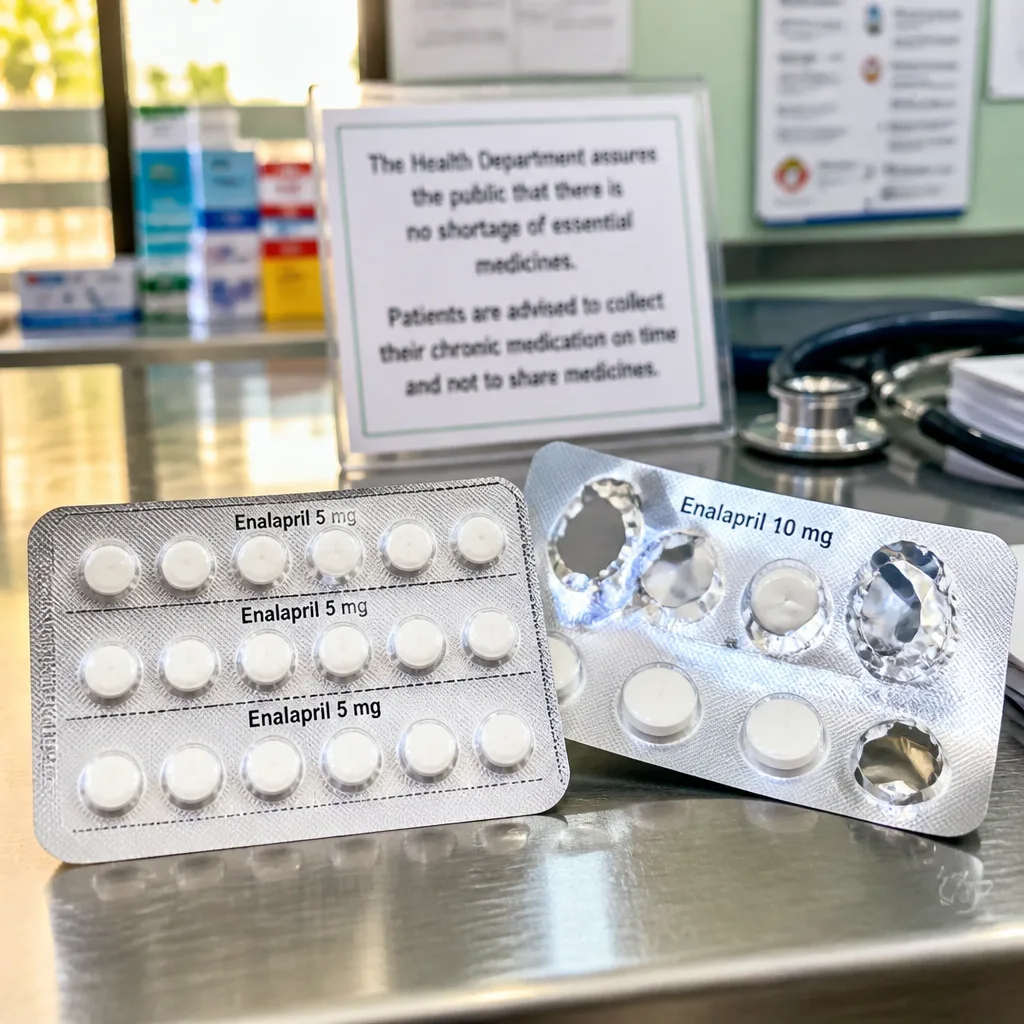
The Department of Health has reassured patients and healthcare workers that Enalapril 5mg tablets supplied to the public sector remain safe and authorised, following a recall of four batches of Enalapril 10mg products by the South African Health Products Regulatory Authority (SAHPRA).
What was recalled and why
SAHPRA announced on 16 August that it had removed four batches of Enalapril 10mg tablets manufactured by Arya Pharma after post-marketing surveillance identified out-of-specification results. The recall applies specifically to those 10mg batches and does not extend to other strengths or manufacturers unless otherwise stated by the regulator.
“The department has confirmed with SAHPRA that the Enalapril Arya 5mg tablets may be used and distributed in the country, and all batches supplied to the public health sector have been confirmed to meet the required quality and registration standards.”
Public-sector supplies and clinical guidance
The department said the public health system is currently being supplied with Enalapril 5mg tablets after a temporary arrangement to source an alternative product while the regular contractor, Austell Pharmaceuticals, completed quality checks of its 5mg product. That temporary supply has been assessed and cleared by SAHPRA.
Patients who are taking Enalapril should not stop their medication because of the 10mg recall. The health department and SAHPRA have advised that healthcare professionals may continue to prescribe and dispense the 5mg formulation in line with existing clinical protocols for hypertension and heart failure.
- Do not discontinue treatment without consulting a clinician or clinic: stopping antihypertensives abruptly can be harmful.
- Check medication labels and batch details if you have concerns; report any adverse effects to your facility or to SAHPRA.
- Healthcare workers should follow facility protocols for substitution or dose adjustment if a patient was taking a 10mg tablet and needs to be converted to 5mg tablets.
Practical implications and supply chain note
The department clarified that the Arya-supplied 10mg product had been used as a stop-gap measure while Austell's 5mg product underwent SAHPRA verification. That verification process led to the reintroduction of the 5mg formulation into public facilities, and those batches have been confirmed to meet regulatory standards.
| Product | Manufacturer | Current status |
|---|---|---|
| Enalapril 10mg | Arya Pharma | Recalled (four batches) — SAHPRA post-marketing out-of-specification findings |
| Enalapril 5mg | Arya Pharma / Austell Pharmaceuticals (context-specific) | Cleared for use in public sector — batches meet quality and registration standards |
For clinicians, the immediate task is to ensure continuity of care. Where patients were dispensed a 10mg tablet, clinical teams should verify dosing and, if necessary, provide appropriate counselling on switching to equivalent 5mg dosing regimens or splitting tablets as per standard protocols. Pharmacists and facility managers should check stock and batch numbers and follow recall procedures for any affected product still on site.
Reporting concerns and next steps
SAHPRA remains the competent authority for assessing product quality and advising on recalls. Patients or clinicians who suspect an adverse reaction or quality issue should report it through the regulator’s channels and inform their healthcare facility so the incident can be recorded and investigated.
Maintaining uninterrupted antihypertensive therapy is critical for preventing complications such as stroke, heart attack and worsening heart failure. If you have questions about your medication, speak to your treating clinician or visit your nearest clinic rather than stopping treatment on your own.