
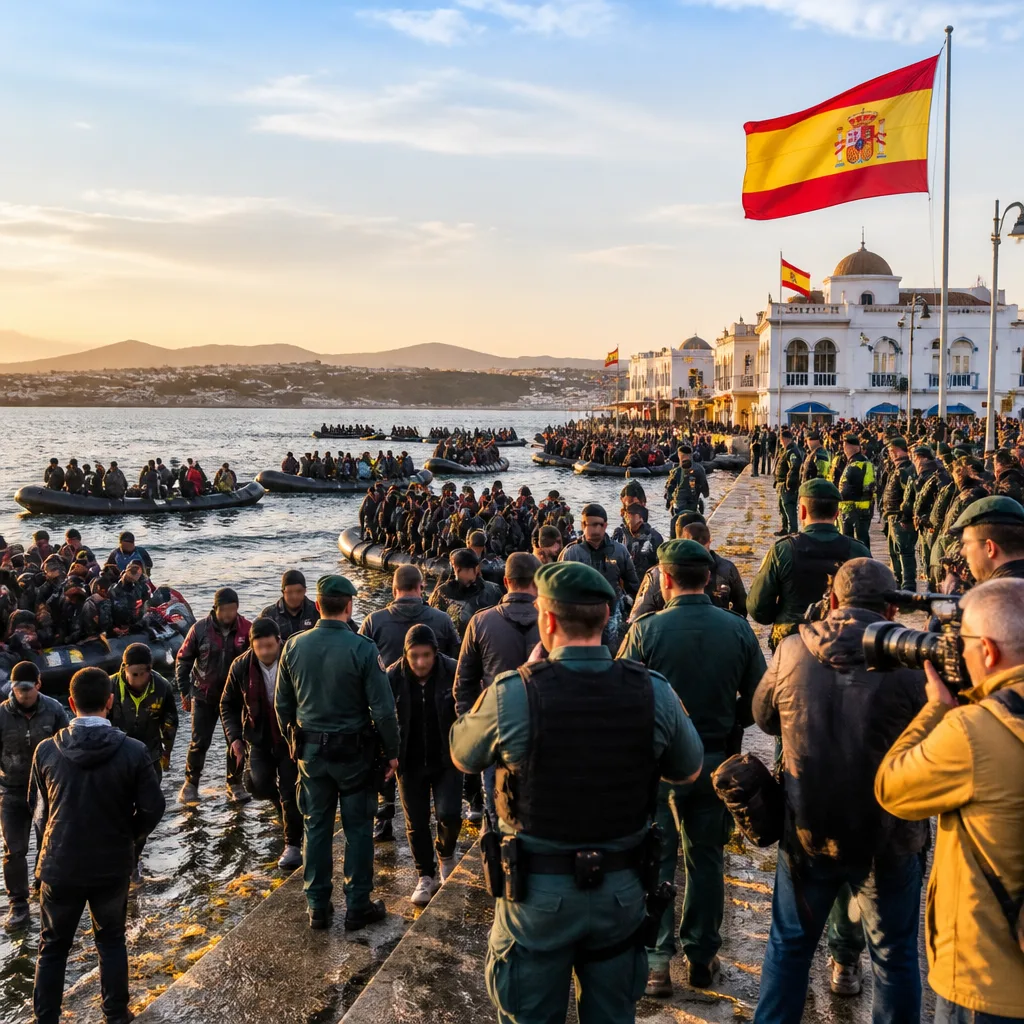
Morocco’s long-standing territorial claims over the Spanish exclaves of Ceuta and Melilla helped create the circumstances for the dramatic arrival of migrants in late July, a former Spanish ambassador and ex-head of Spain’s intelligence service told Euractiv.
Background to the surge
Jorge Dezcallar, who served as Spain’s ambassador to Morocco from 1997 to 2001 and later directed the Centro Nacional de Inteligencia (CNI), said Morocco has “never abandoned” its claims on the two North African cities and that those unresolved tensions were part of the backdrop to a sudden, large-scale movement of people into Ceuta.
“In a way, Morocco is testing the waters at a moment when it perceives a weak government in Madrid,” Dezcallar told Euractiv.
Reports cited by Euractiv put the number of arrivals at the tiny Spanish city at least 72,000 migrants in late July. The influx triggered political shock waves in Spain and reverberated across Europe, reopening debate about border management, bilateral relations with Rabat, and the leverage that migration can confer in diplomatic contests.
Territorial claims and political context
Dezcallar argued the territorial issue remains alive in Rabat’s political discourse. Moroccan ministers and media close to the monarchy have, he said, increasingly asserted claims over Ceuta and Melilla—territories that have belonged to Spain for centuries. The former envoy suggested these assertions were not merely rhetorical but part of a strategic posture.
That posture was reflected in public comments from Moroccan officials. Justice Minister Abdellatif Ouahbi told Asharq News that the sovereignty question is raised in bilateral meetings and is "an issue we will resolve through negotiation and with patience," according to Euractiv’s reporting.
Spanish authorities responded forcefully. Defence Minister Margarita Robles, speaking from Ceuta, declared the enclaves “thoroughly Spanish” and said they were “off limits,” Euractiv reported. The political temperature around the episode highlights the tension between historical sovereignty claims and contemporary imperatives—trade, counterterrorism and migration cooperation—that bind the two countries.
Who benefits and who pays
Dezcallar characterised Rabat’s approach as partly opportunistic. He said Morocco was “testing the waters” because it perceived a weakened Spanish government under Pedro Sánchez—hampered by corruption scandals within his inner circle and criticised for migration policies that some see as permissive. The implication is clear: when bilateral relations fray, migration can be used as a lever.
The consequences are immediate and tangible:
- Spain faces domestic political fallout and pressure to secure its borders and reassure voters in the enclaves.
- Morocco retains leverage in negotiations over migration, trade and security cooperation.
- Migrants bear the human cost: disorderly arrivals, overcrowded reception facilities and uncertain legal outcomes.
Facts on the table
The episode has exposed a complex, interdependent relationship in which pragmatic cooperation on migration and security sits uneasily alongside contested historical claims. Euractiv’s account cites statements from Moroccan officials and Spanish ministers that underscore both the diplomatic friction and the strategic calculation.
| Item | Detail |
|---|---|
| Reported migrant arrivals | 72,000 (late July) |
| Key actors | Morocco, Spain, migrants |
| Notable voices | Jorge Dezcallar; Abdellatif Ouahbi; Margarita Robles |
For European capitals, the Ceuta episode is a reminder that migration pressure often has geopolitical roots. It also underlines the fragility of arrangements that rely on close cooperation between neighbouring states with unresolved territorial disputes.
Moving forward, the challenge for Madrid and its partners in Europe will be to manage immediate humanitarian and security needs while insulating migration cooperation from episodic diplomatic friction—an objective made harder when sovereignty questions remain on the agenda.












