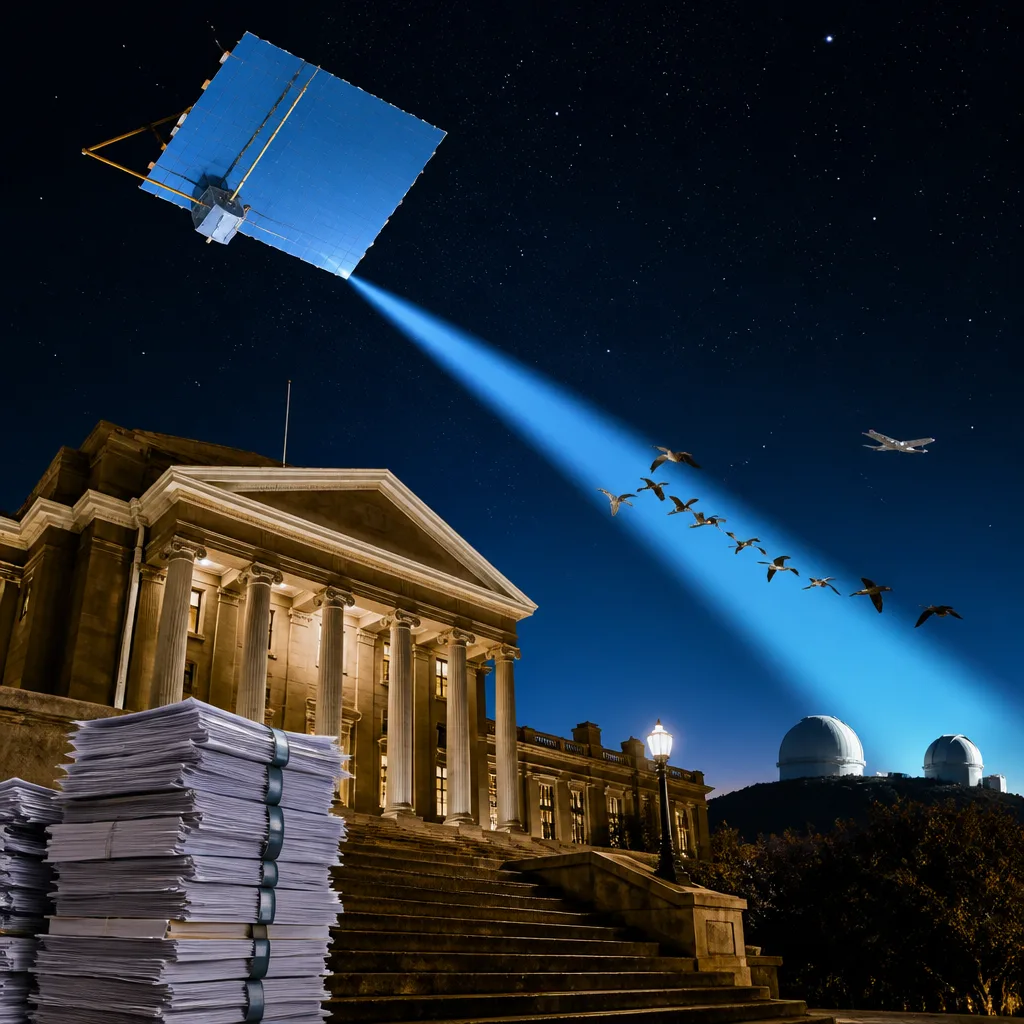
The full Federal Communications Commission (FCC) has been asked to revisit its approval of a test satellite that would carry a steerable solar reflector into low Earth orbit, after environmental groups argued the agency sidestepped a statutory environmental review.
DarkSky International, together with the American Bird Conservancy, Environment America and Public Employees for Environmental Responsibility (PEER), filed an Application for Review through the environmental law firm Earthjustice. The petition contends the FCC’s Space Bureau erred when it authorised Reflect Orbital Inc.’s Eärendil-1 demonstration satellite without conducting an environmental impact assessment under the National Environmental Policy Act (NEPA).
Regulatory dispute over scope of review
The challenge targets a July 9, 2026 order in which the FCC’s Space Bureau granted radio frequency (RF) spectrum authorisation for the experimental payload while deciding that non‑RF effects — notably light pollution and interference with astronomy — were outside the bureau’s required environmental review. The petitioners say that ruling rests on a categorical exclusion originally intended for conventional communications satellites and is therefore inappropriate for a device designed to reflect and concentrate sunlight toward specific locations on Earth.
Public comment on the matter was substantial: the commission received nearly 1,900 submissions, the petition notes, many from astronomers, aviation stakeholders and environmental organisations opposing the proposed demonstration.
What the Eärendil‑1 test involves
The Eärendil‑1 prototype is described by Reflect Orbital as a small, demonstrator-class spacecraft. Key technical details provided in the petition include:
- Mass: 142 kilograms
- Reflector size: an 18 m × 18 m deployable thin‑film mirror
- Orbit: low Earth orbit between 600 km and 650 km
- Launch plan: a SpaceX rideshare mission in late 2026
| Parameter | Value |
|---|---|
| Prototype mass | 142 kg |
| Reflector dimensions | 18 m × 18 m |
| Operational altitude | 600–650 km |
| Planned launch | SpaceX rideshare, late 2026 |
Concerns cited in the petition
The filing asserts the reflector’s capacity to steer concentrated sunlight raises multiple environmental and safety risks that the Space Bureau failed to evaluate. Among the issues highlighted are:
- potential effects on nocturnal ecosystems and species that navigate or forage at night;
- impacts on migratory birds that may be disoriented or attracted to intense, artificial light sources;
- risks to aviation safety if concentrated beams intersect flight paths or create glare for pilots;
- interference with ground‑based optical astronomy, including imaging and long‑exposure observations.
Petitioners argue that concentrated optical illumination is materially different from the incidental optical signatures produced by conventional communications satellites and therefore warrants a tailored NEPA assessment rather than a blanket categorical exclusion.
Wider implications and next steps
The petition seeks for the full commission to reverse the Space Bureau’s order and to require a full environmental review of the proposed demonstration and any similar future proposals. If the FCC declines to rehear the matter, the filing could provide grounds for subsequent judicial review in federal court.
The dispute is part of a growing international debate about human activities in low Earth orbit and their terrestrial consequences. South African astronomers and conservationists are among those watching regulatory developments abroad because precedent‑setting rulings can shape how orbital light sources are assessed globally. Ground‑based observatories, including facilities used by South African scientists, have in recent years raised concerns about satellite constellations and other spaceborne technologies that can impede astronomical research.
How the FCC responds will determine whether Reflect Orbital can proceed with its demonstration under the existing authorisation while the broader legal and regulatory questions are settled.