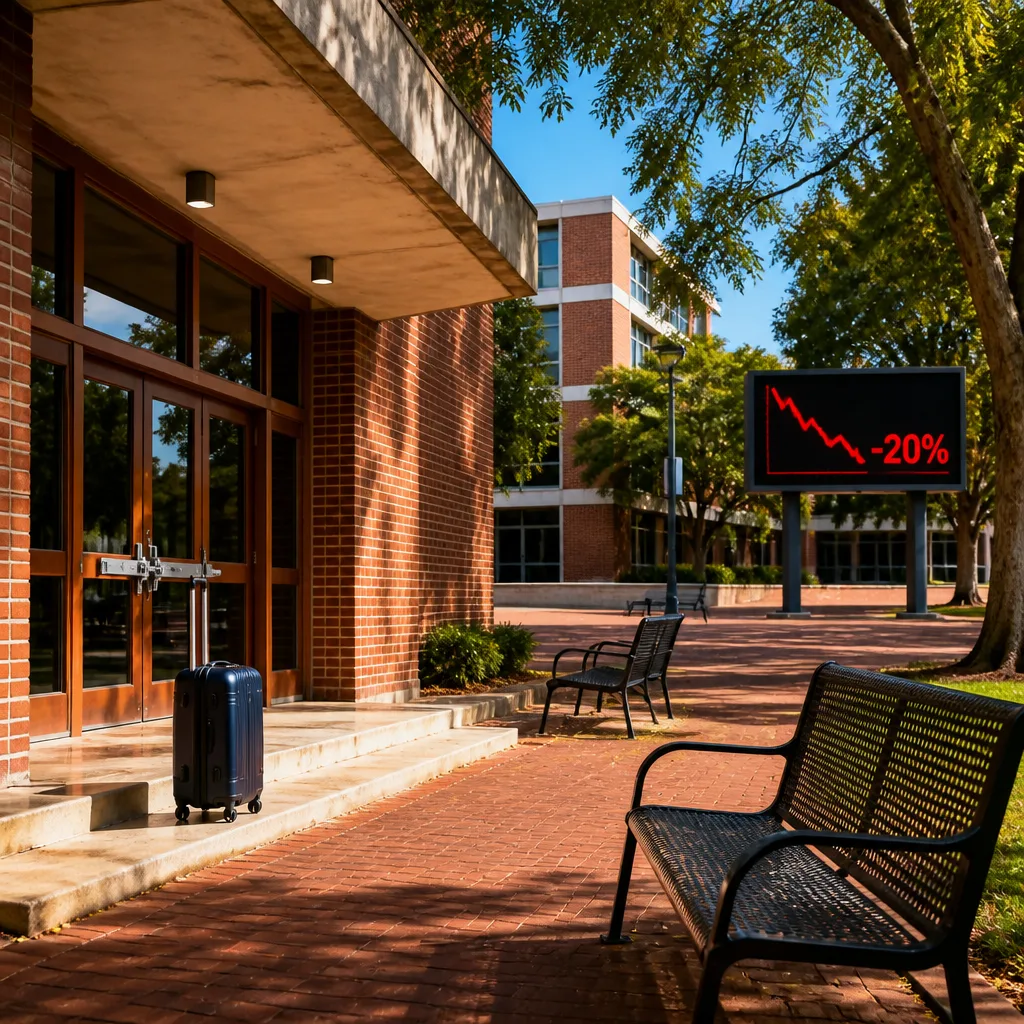
A moderate fall in revenue from international students would significantly worsen the financial position of Australia’s public universities, with an analysis indicating that a 20% reduction in overseas fee income could almost double the number of institutions in deficit and imperil teaching in regional and suburban campuses.
Uneven exposure across the sector
The study, which examined the accounts of the country’s publicly funded universities, found that income from non‑domestic students is concentrated among a few large institutions, leaving many others operating with thin margins. Data analyst Mark Rahimi, a senior research fellow at the University of Melbourne’s Centre for the Study of Higher Education, described the variation between institutions as stark.
“Some universities have substantial financial buffers, while others are operating close to break-even or…already in deficit. The same revenue shock can have quite different consequences across institutions.”
The uneven recovery from the pandemic has accentuated this concentration of foreign earnings among the highest‑earning universities, increasing the vulnerability of smaller or regionally focused campuses to shocks in international enrolments.
Multiple pressures on international demand
The analysis comes as several factors weigh on future demand for study in Australia. Visa issuances for applicants from China — a major source of international students — fell by 23% in the last financial year, a decline that has a significant bearing because students from China account for about 35% of total earnings at some universities. Other vulnerabilities include rising living and tuition costs, unfavourable currency movements and growing scepticism among prospective students about the return on investment in degrees amid rapid developments in artificial intelligence.
The federal government has also enacted a suite of measures intended to curb growth in international student numbers, which have the potential to constrain the sector further. Since mid‑2023, it has introduced 25 measures designed to reduce demand, including tightened visa eligibility, prioritised visa processing and repeated increases in visa fees. Officials have set a national planning level for public university student visas of 161,725 for the coming year, and visa processing may be slowed for institutions that approach that threshold.
- Scenario modelled: 20% fall in international fee revenue
- Immediate effect: Near doubling of universities running deficits
- Key vulnerabilities: Heavy reliance on students from China and thin margins at many institutions
The combination of policy tightening and market shifts therefore threatens not only financial health but also the geographic distribution of higher‑education delivery in Australia. Regional and suburban campuses, which tend to rely more heavily on international fee income and have smaller reserves, could be particularly exposed.
Implications beyond Australia
While the analysis focuses on Australia, the developments are pertinent to South African stakeholders. Changes in visa policy and international student flows in major destination countries can alter options for South African students seeking study abroad and affect competitive dynamics for universities that recruit internationally. Universities globally are reassessing recruitment strategies, scholarship allocations and partnership models in response to shifting demand and heightened policy scrutiny.
| Metric | Value |
|---|---|
| Modeled reduction in international income | 20% |
| Decline in Chinese visa issuances | 23% |
| Share of earnings from Chinese students (at some universities) | ~35% |
| Government measures introduced since mid‑2023 | 25 |
| National planning level for public university visas | 161,725 |
The picture the analysis paints is one of a system that is not uniformly fragile but is vulnerable in parts. Some universities possess strong financial buffers, while others could be pushed into deficit by relatively modest falls in fee income. Policymakers and university leaders will need to weigh trade‑offs between controlling migration and preserving the viability of tertiary education, particularly where regional access to higher education is at stake.
For South African students and institutions, the Australian experience is a reminder of how quickly international education markets can change and of the importance of diversified income streams and robust contingency planning.