
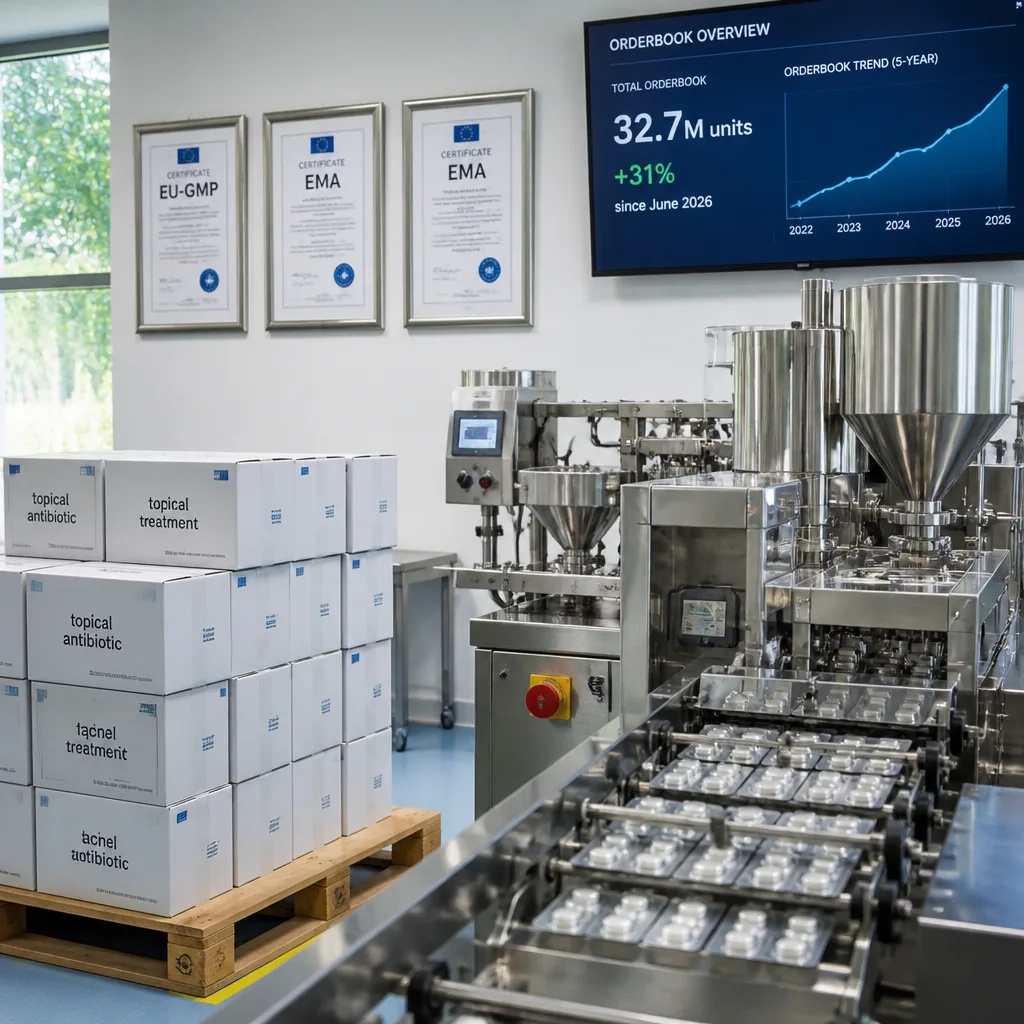
Cana Laboratories, a manufacturing arm of Cosmos Health, has signed five-year contract manufacturing agreements to produce roughly 5.2 million pharmaceutical units for Target Pharma, the company said in a statement. The deals add to a growing backlog of contracted production that the group says should improve visibility of future volumes and cash flow.
Scope of the contracts and production specifics
The agreements cover two products: Mupirocin, a topical antibiotic, and Tretin, an isotretinoin-based acne treatment. Under the terms, Target Pharma is expected to place orders totalling about 1.04 million units per year over the five-year period, according to the statement.
Cana operates a 54,000-square-foot facility in Athens that is licensed under European Good Manufacturing Practices and certified by the European Medicines Agency. The company said the contracts it has secured extend production visibility for up to ten years in some cases.
Orderbook growth and therapeutic expansion
Cosmos Health reported that the new Target Pharma agreements raise Cana’s total contracted orderbook to more than 32.7 million units. That figure represents a 31% increase compared with the level reported in June 2026.
The company also said it added 7.7 million contracted units in September through two separate deals and earlier announced a five-year contract with Viofar on 11 September. Cana’s product mix has broadened: the subsidiary now covers 11 therapeutic categories, up from nine in June 2026, with cardiovascular and anti-infective products newly included.
| Metric | Value |
|---|---|
| New units under Target Pharma contracts | 5.2 million |
| Annual orders from Target Pharma | 1.04 million |
| Total contracted orderbook | 32.7 million |
| Orderbook growth since June 2026 | 31% |
Investment in capacity and financial targets
The company said it has upgraded manufacturing equipment, IT infrastructure and quality systems, and installed a capsule-filling line at the Athens plant. Cosmos Health described these upgrades as supporting the higher contracted volumes and broader therapeutic coverage.
"We have added 7.7 million contracted units this month alone and grown the orderbook 31% since June," said Greg Siokas, CEO of Cosmos Health.
Cosmos Health has previously indicated that the division aims to generate substantial recurring profit when operating at full capacity. The contracts’ multi-year terms are intended to provide clearer production forecasts and improve predictability of cash flows for the manufacturing arm.
Context and implications for medicine supply
Contract manufacturing agreements of this nature can strengthen supply chain reliability for branded or private-label medicines by tying production volumes to long-term orders. For health systems and pharmacies, greater certainty around output may reduce risks of shortages for the covered products, particularly in regulated markets served by European‑GMP facilities.
- Production predictability: Multi-year contracts support planning of capacity and inventory management.
- Therapeutic breadth: Expansion into cardiovascular and anti-infective categories diversifies the product portfolio.
- Regulatory standards: EMA certification and EU-GMP licensing position the plant to supply regulated markets.
While the agreements were reported by the company to be material to its manufacturing pipeline, stakeholders such as health authorities, distributors and local procurement bodies will monitor whether increased contracted capacity translates into improved availability of the specific medicines in their markets. Patients and clinicians should continue to rely on established procurement channels and consult healthcare providers about treatment options rather than attempting to self-manage medication access.
Further details on timelines for deliveries, pricing, and which markets will receive product supplies were not disclosed in the statement.











