
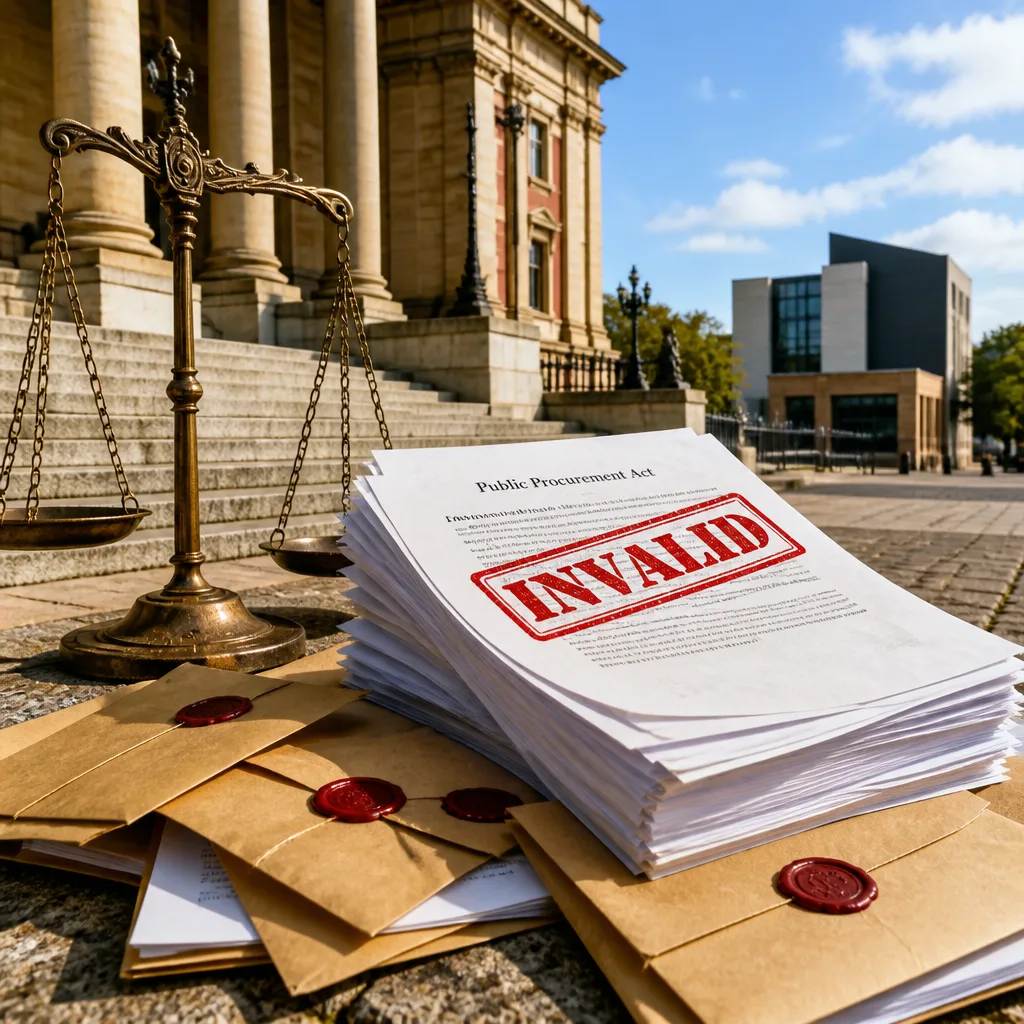
The Constitutional Court has declared the Public Procurement Act unconstitutional and invalid, finding that Parliament failed to meet its constitutional obligation to facilitate meaningful public involvement in the law-making process.
Government response: fairness, transparency and procurement challenges
Finance Minister Enoch Godongwana backed the judgment on Thursday, saying procurement laws must promote fairness and transparency. In a statement reported by Inside Politics, Godongwana emphasised that Section 217 of the Constitution requires a procurement system that is “fair, equitable, transparent, competitive and cost‑effective”, while allowing for measures to protect or advance people disadvantaged by unfair discrimination.
Godongwana listed persistent problems he says afflict public procurement, drawing on media reporting and various commissions of inquiry. Those challenges include:
- corrupt activities and fraud;
- financial loss and irregular expenditure;
- poor planning and inferior deliverables;
- weak institutional capacity;
- failure to sufficiently stimulate local industry.
The minister said these systemic weaknesses meant the objectives of the Act could not be realised in a weak procurement environment that is not supported by an effective legislative framework.
Why the law fell foul of the Constitution
The court found the Act was unlawfully enacted because Parliament did not comply with the constitutional duty to facilitate meaningful public participation under Section 59(1)(a) of the Constitution. The judgment also noted that material changes had been introduced to the Bill late in the parliamentary process and that the Bill was rushed through without proper consultation.
“In my view, it is inappropriate for this Court, in the present circumstances, to direct the process that Parliament must follow to remedy the defects. The appropriate order, in my view, is simply to declare the Act invalid, without suspending the declaration or giving directions on how Parliament is to remedy the defects.”
The court’s text, quoted in the reporting, signals a reluctance to micromanage parliamentary procedures while upholding constitutional standards for law-making.
Practical consequences and the path ahead
The immediate legal consequence is that the Act is of no force because it was invalidly enacted. The ruling places the onus on Parliament to correct the procedural defects and to produce procurement legislation that aligns with constitutional requirements. Godongwana said he would respond to the judgment and engage with parliamentary leadership; the reporting names the National Assembly Speaker as one figure the minister intends to involve.
How quickly Parliament moves to fill the legislative gap will be watched closely. Procurement underpins virtually all government spending on goods, services and infrastructure. Without a valid, effective statutory framework, supply chains, contracting practices and efforts to address state capture and maladministration may be disrupted or remain vulnerable.
The finance ministry’s catalogue of procurement problems underlines why lawmakers and officials face pressure to craft legislation that balances competitive, cost‑effective procurement with measures to advance historically disadvantaged South Africans and local industry.
| Constitutional provision | Role cited in reporting |
|---|---|
| Section 59(1)(a) | Obligation on Parliament to facilitate meaningful public involvement in legislation |
| Section 217 | Requirements for procurement: fair, equitable, transparent, competitive and cost‑effective; allows measures to protect disadvantaged groups |
Parliament will also have to guard against repeating the procedural errors the court identified — notably late material amendments and a rushed process — if it is to produce a constitutionally sustainable replacement.
The ruling is likely to re‑ignite debate about how best to reform South Africa’s procurement system: whether through a single consolidated statute, amendments to existing laws, or a phased set of measures that shore up institutional capacity while protecting constitutional principles.
For now, the judgment exposes a legal void and renews scrutiny on the interplay between executive objectives, parliamentary process and constitutional guarantees. The beneficiaries of a robust procurement regime would be taxpayers, honest suppliers and efforts to develop local industry; those who will pay are the institutions that must now invest political will and technical expertise to deliver a lawful and effective framework.












