
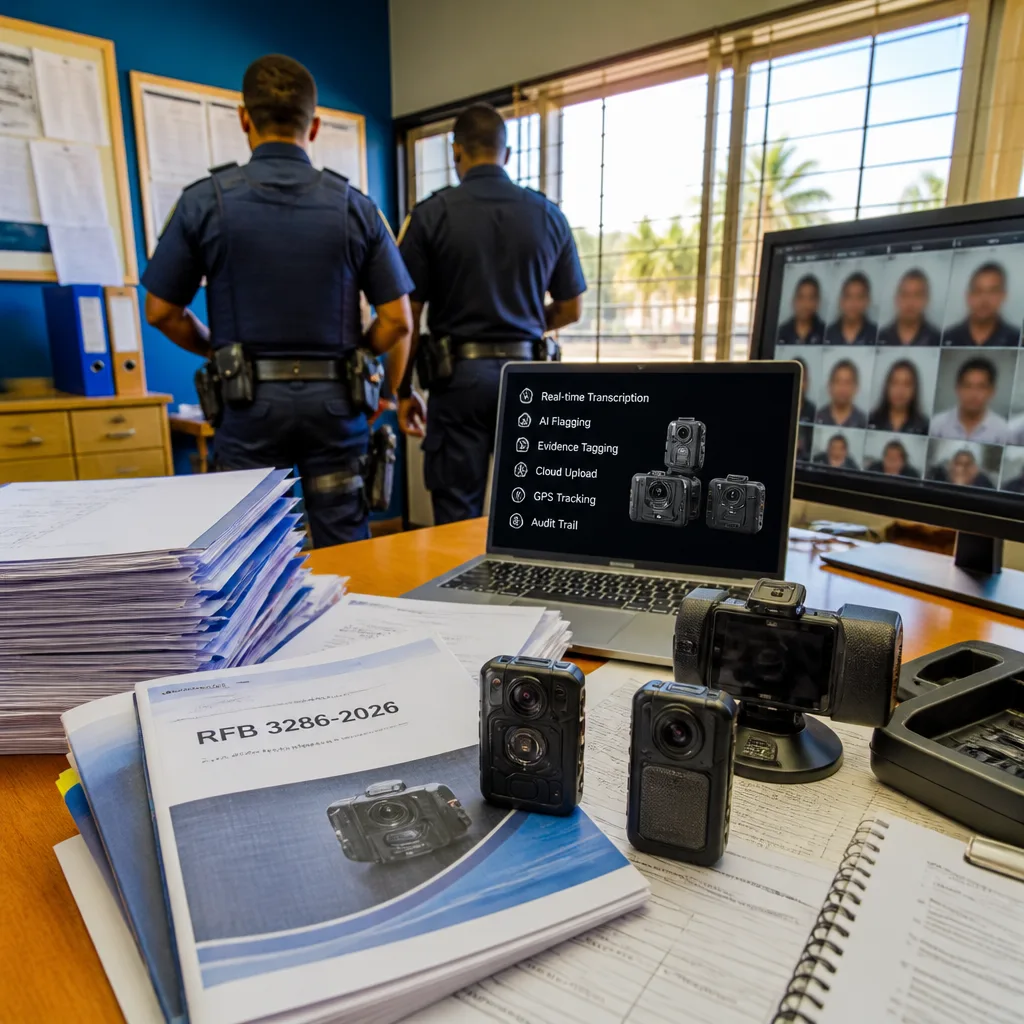
The State IT Agency (Sita) has published bid documents for a national contract that would oblige the South African Police Service (SAPS) to equip officers and vehicles with cameras capable of conducting facial recognition and other artificial-intelligence functions.
The specification, for RFB 3286-2026, is for a three-year contract covering the “supply, delivery, support and maintenance of body-worn and vehicle dashboard cameras” and related software. Bids are due at 11:00 on 29 September, according to the documents.
Mandatory, not optional
Crucially, the tender states that the solution must give SAPS the “ability to conduct facial recognition and integrate with various security platforms and have warning capabilities”. The requirement is listed among mandatory functional criteria; bids that do not demonstrate compliance with mandatory elements will not be evaluated further.
That stipulation extends beyond the basic accountability argument often used to justify body-worn cameras. The bid links facial recognition to broader analytics within the video-management software, which must also provide motion detection and licence plate recognition.
“the solution must give the SAPS the ‘ability to conduct facial recognition and integrate with various security platforms and have warning capabilities’.”
Capabilities described in the specification
The tender describes a device and system with a range of surveillance and control features:
- Officer identification: facial recognition is listed alongside a fingerprint reader and a key code as methods to release a camera from its dock, identifying the officer rather than bystanders.
- Dashboard AI: required embedded functionality includes automatic number-plate recognition (ANPR) and event detection triggered by blue lights, a door opening or a collision.
- Interior option: the specification includes an option for an interior camera facing vehicle occupants.
- Seamless recording features: continuous background recording, buffers capturing 120 seconds either side of when the record button is pressed, and the ability to turn off sound, alarm and light indicators.
- Remote control and tamper flags: devices must be remotely switchable and able to flag to a control room when pulled off their mount.
Questions left unanswered in the tender
The documentation does not specify how SAPS would use facial-recognition matches operationally, nor does it set out retention periods, oversight mechanisms or integration points with national databases. The only explicit operational use described in the user-management section is to identify an authorised officer when a camera is removed from its dock.
The specification also notes that cameras are intended to serve typical accountability functions such as gathering evidence for court, and to allow the SAPS to “refute false civil claims against” it. However, the broader analytics requirements suggest ambitions that go beyond a narrowly framed accountability tool.
Implications for oversight and privacy
Introducing facial recognition and continuous background recording into everyday policing raises questions for criminal-justice oversight and data protection. The tender’s mandatory technical features would create capabilities to identify individuals and track vehicles at scale, and to record encounters without obvious indicators such as lights or sounds.
Any deployment of such systems would intersect with existing obligations under the Protection of Personal Information Act and with court oversight where biometric identification is used in investigations. The documents published by Sita do not set out specific legal or governance safeguards.
| Item | Detail |
|---|---|
| Tender reference | RFB 3286-2026 |
| Contract length | Three years |
| Bid closing | 11:00, 29 September |
Procurement of policing technology has become a contested area internationally because of accuracy concerns with facial recognition, the risk of biased outcomes and the potential chilling effect on public life. In South Africa, questions about how biometric tools intersect with constitutional rights, policing priorities and oversight arrangements are likely to be central to any public debate once the SAPS moves from specification to procurement and deployment.
The tender documents published by Sita form the current basis for what the SAPS is seeking from suppliers. They do not, by themselves, authorise any operational deployment; that would require further decisions by SAPS and relevant oversight bodies.













