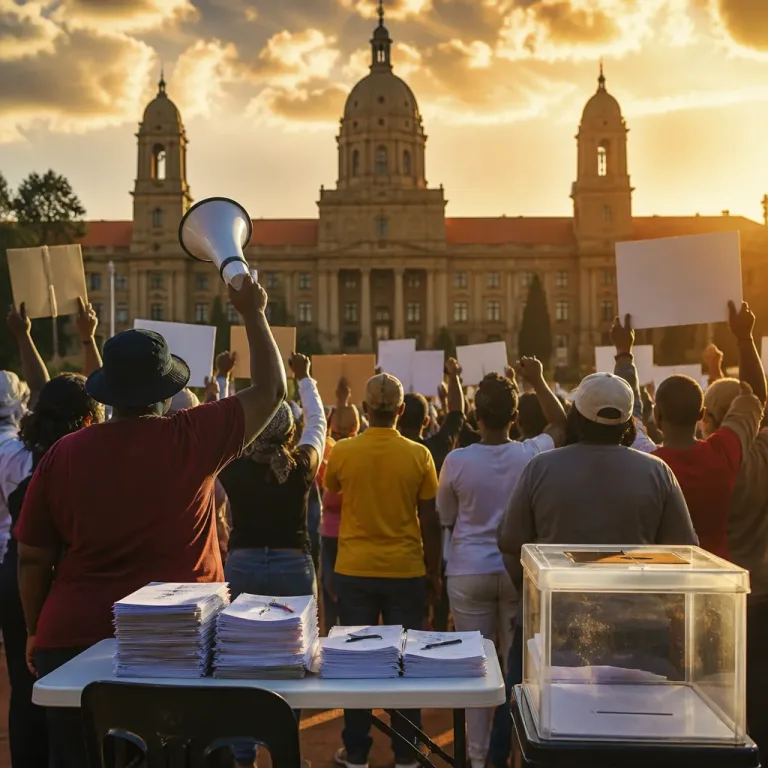
A recent commentary published on Politicsweb warns that South Africa faces a significant test of its democratic institutions as power shifts at the ballot box and political tensions sharpen ahead of the municipal elections in November.
Author’s diagnosis: weakened ANC, emboldened DA
William Saunderson‑Meyer writes that the ruling African National Congress (ANC) is “enfeebled” while the Democratic Alliance (DA) is growing in confidence. The piece frames the coming local government elections, and the longer horizon of the 2029 national election, as a particularly exacting trial for the country’s constitutional order.
According to the commentary, the national picture is worrying because state security structures have begun to play a role in public political battles. Saunderson‑Meyer says the country’s intelligence services have increasingly insinuated themselves into politics through the leaking of dossiers to media outlets, material intended to smear opposition politicians and civic organisations.
“The best that can be said of the ANC is that it is profoundly ambivalent about democracy,” Saunderson‑Meyer wrote.
Local flashpoints and the politics of place
At municipal level, the commentary points to a recent incident in Johannesburg that illustrates how charged the contest has become. It reports that DA mayoral candidate Helen Zille made an unannounced visit to the Johannesburg Roads Agency’s asphalt plant. The plant had been idle for a month after a gas‑supply contract was allowed to expire; workers reportedly hurled insults and formed a human chain to prevent the DA team from entering.
That encounter is used in the piece to show how local governance failures, and contestation over service delivery, are feeding into partisan mobilisation ahead of the November ballot.
Institutional norms under strain
Saunderson‑Meyer argues that some within the ANC and parts of the security apparatus — intelligence, policing and the military — harbour a view of the party’s historical right to rule. The commentary suggests this outlook leads to a tendency to treat the Constitution not as an absolute constraint but as a tool to be used when convenient for the broader project the author terms the National Democratic Revolution.
The piece cautions that as the ANC’s electoral dominance continues to erode — the author points to the party’s setback in the 2024 national election — these strains on constitutional norms and public institutions may become more pronounced.
- Key near‑term test: municipal elections, November (year as reported).
- Previous benchmark: 2024 national election, described as a major setback for the ANC.
- Future inflection point: 2029 national election, flagged as consequential.
| Event | Significance |
|---|---|
| 2024 national election | Marked a major electoral setback for the ANC, according to the commentary |
| November municipal elections | Described as the country’s sternest immediate test |
| 2029 national election | Projected as a more decisive potential turning point |
The author’s diagnosis is concise and stark: declining electoral dominance will reveal the depth of ambivalence about democratic constraints inside the ANC and among allied parts of the security apparatus, with possible consequences for how the state and opposition actors interact.
Who benefits and who pays, in the author’s account, depends on whether the political system can absorb electoral defeat without the politicisation of state institutions. If the intelligence and policing arms of the state are used for partisan ends, the costs would fall on democratic norms and ordinary citizens dependent on competent, impartial public services.
Whether the warnings in the commentary translate into a shift in behaviour by political parties or state institutions remains an open question. For now, the piece serves as an early alarm: the next set of municipal contests will do more than redistribute local power. They will be a measure of South Africa’s ability to manage competitive politics without eroding the constitutional foundations that underpin the post‑apartheid order.