
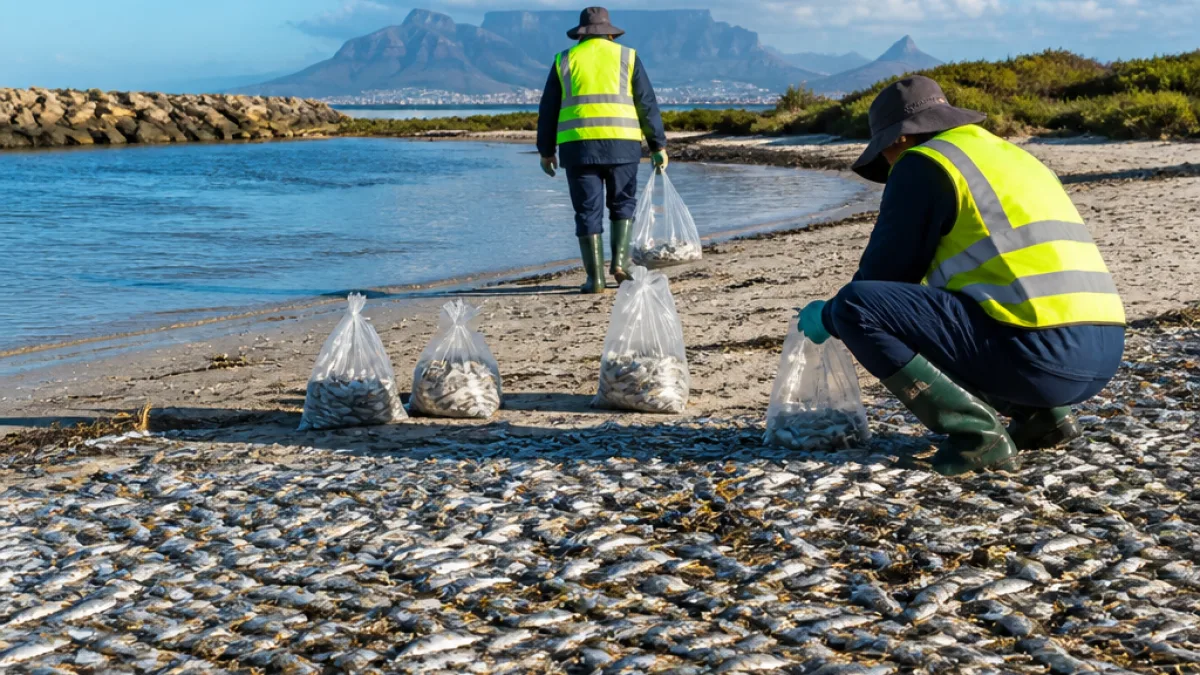
The City of Cape Town has moved to reassure residents that the recent strandings of dead and dying sardines along the Western Cape coastline are not linked to pollution in the Milnerton Lagoon or the Diep River estuary.
City distances lagoon pollution from ocean event
The sightings, which span from Saldanha Bay on the West Coast to Cape Agulhas on the Cape South Coast, have included reports of pilchards washing ashore at Silverstroomstrand, beaches around Milnerton and Camps Bay. Local concern focused quickly on the Milnerton estuary because of its long‑standing pollution problems.
But the City rejected any causal link, noting that pilchards are oceanic and do not inhabit the lagoon or its estuary. Eddie Andrews, the City’s Deputy Mayor and Mayoral Committee Member for Spatial Planning and Environment, said the phenomenon was part of a broader mortality event along the coast and not caused by the lagoon.
“We want to assure residents that this phenomenon has nothing to do with the Milnerton Lagoon. Sardines do not live in the Milnerton Lagoon, neither in the estuary, they are oceanic fish,”
What national scientists have found
The National Department of Forestry, Fisheries and the Environment (DFFE) has confirmed laboratory sequencing detected genetic material from pilchard herpesvirus (PHV) in sardines collected from affected areas. However, the department cautioned that PHV has been found at both high levels in dead fish and at lower levels in some apparently healthy specimens, meaning the mere presence of the virus may not be sufficient to trigger mass mortality.
DFFE is continuing investigations to determine whether other environmental stressors — rather than a single pathogen — might have contributed to the die‑off. The City said it was monitoring DFFE's enquiries and would remain “abreast of these findings”.
Where strandings have been reported
| Location | Reported observation |
|---|---|
| Saldanha Bay | Dead and dying sardines along coast |
| Silverstroomstrand | Pilchards washing ashore |
| Milnerton area | Pilchards reported on beaches |
| Camps Bay | Pilchards washing up |
| Cape Agulhas | Part of wider coastline mortality event |
Practical implications for residents and visitors
While authorities continue laboratory and field work, the immediate message from the City is that Milnerton Lagoon pollution is not the cause. That distinction matters for local management and long‑term remediation efforts, but it does not remove short‑term concerns for coastal users and fisheries.
- Do not touch large numbers of dead fish; local authorities or DFFE teams may need to collect samples.
- Avoid affected beaches until authorities advise they are safe — rotting fish can be a health and nuisance issue.
- Report sightings of significant fish mortalities to the City or DFFE so samples can be taken and patterns mapped.
Broader context
Mass mortalities of small pelagic fish can have multiple causes, including disease, oxygen depletion, harmful algal blooms, sudden temperature shifts and human impacts. The DFFE's finding of PHV genetic material provides an important clue, but scientists will need to correlate virological, oceanographic and environmental data before drawing firm conclusions.
The distinction drawn by the City — that pilchards are oceanic and not residents of the Milnerton Lagoon — also shifts attention back to offshore conditions and regional coastal processes. For communities dependent on coastal tourism and small‑scale fisheries, understanding the cause is critical to any recovery and mitigation planning.
The City said it had received multiple reports from across Cape Town’s West Coast and that these incidents were being treated as part of the larger event affecting the Western and Southern Cape coastline. The DFFE investigation remains under way.
Further updates are expected as laboratory and field results are analysed and released.










