
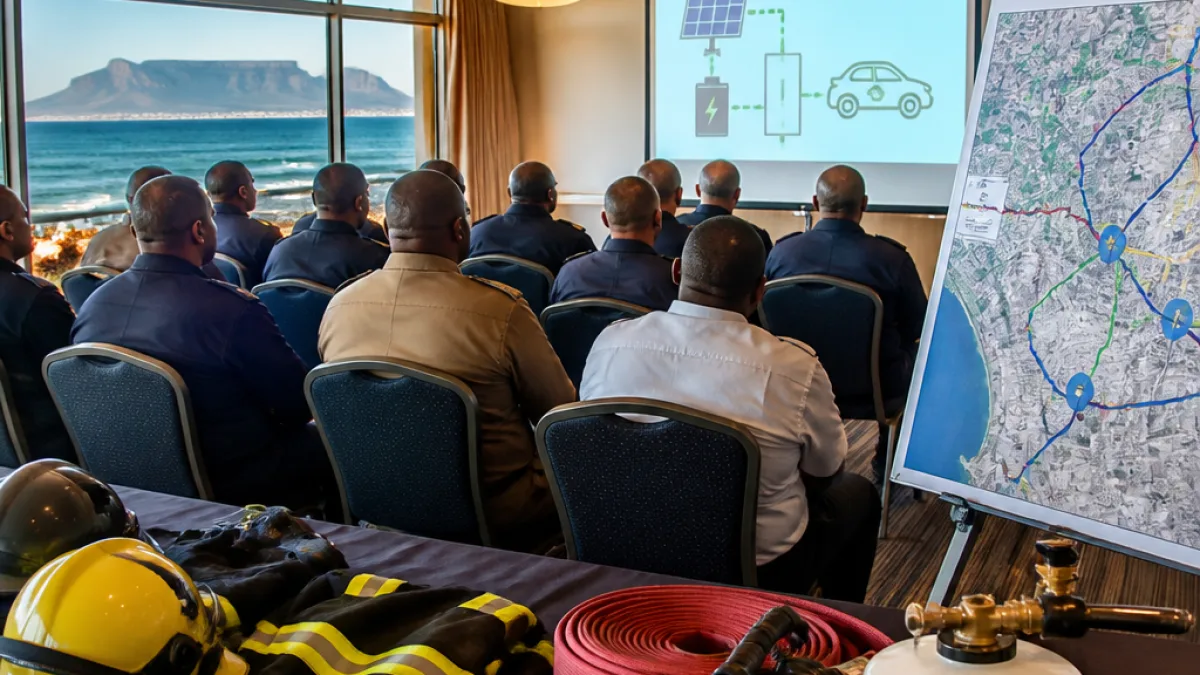
The Western Cape gathered firefighters, municipal officials, industry partners and international experts in Milnerton on Thursday for a two-day Structural Firefighting Summit aimed at modernising the province’s response to increasingly complex building fires.
Adapting to new risks in the built environment
Hosted by the Western Cape Disaster Management Centre in partnership with Santam and Fire Support Services SA, the summit at Lagoon Beach Hotel brought together practitioners and policy-makers for knowledge-sharing, professional development and practical guidance on structural firefighting.
Delivering the keynote address, Western Cape minister for local government, environmental affairs and development planning, Anton Bredell, framed structural fires as an under-recognised but costly component of the province’s overall fire burden. He said the changing composition of buildings and new technologies were reshaping what firefighters face at incident scenes.
"Just as the built environment is changing, our fire services must change with it,"
Bredell highlighted the cumulative toll of recent wildfire seasons across the province but cautioned that structural incidents — driven by photovoltaic systems, battery energy storage, lithium-ion batteries and electric vehicles — pose specialised hazards that require upgraded skills, equipment and operational approaches.
Technical focus and key topics
Day one concentrated on the evolving fire environment and the technical challenges this creates for response teams. Sessions included large-volume water supply, the science and application of firefighting foam, next-generation transitional attack techniques, and guidance on assessing firefighting capacity against the SANS 10090 standard.
Speakers named in the programme included international expert Andre Tomlinson from Bristol Fire, who addressed water-supply challenges, and Trevor Fiford of Industrial Fire Services SA, who spoke on foam science. Presentations also reviewed lessons from the Grenfell Tower fire and scenarios such as parking garage conflagrations.
- New threats discussed: photovoltaic (PV) installations, battery energy storage systems, lithium-ion batteries, electric vehicles
- Operational priorities: training, equipment modernisation, large-volume water supply
- Standards and assessment: SANS 10090 firefighting capacity assessments
Scale of the fire challenge
Minister Bredell recalled the extent of the previous wildfire season to underline the pressure on provincial and municipal services: more than 215 000 hectares burned across the Western Cape, including about 53 000 hectares in the Cederberg Wilderness Area — that region’s largest wildfire since 1997. The statistics were used to argue that fire risk is not only a rural or veld issue but part of a broader emergency-planning landscape.
| Area affected | Hectares |
|---|---|
| Western Cape (total wildfire season) | 215 000 |
| Cederberg Wilderness Area | 53 000 |
Speakers and municipal delegates used the summit to compare incident command approaches and to stress interoperability across metros, district municipalities and specialist units. Practical material — including video case studies of real fires — formed part of the technical exchanges.
Practical implications for municipalities and residents
For local authorities, the gathering reinforced the need to update standard operating procedures, to invest in new protective equipment and detection technologies, and to re-examine water-resource planning for high-demand scenarios. For residents and businesses, the message was equally direct: household and commercial risks are changing as more PV installations, batteries and electric vehicles enter the market, and those technologies require specific safety measures during incidents.
Organisers said the second day would continue with hands-on and scenario-based learning designed to translate technical discussion into operational change. The summit aimed to leave participating fire services better prepared for the mix of urban, industrial and residential fires that are becoming more frequent and more complex.
By convening municipal fire chiefs, specialists and insurers, the Western Cape has signalled a shift from treating structural firefighting as an isolated discipline to embedding it in a wider resilience and emergency-management agenda — a necessary step if the province is to reduce the human and economic costs of modern fires.














