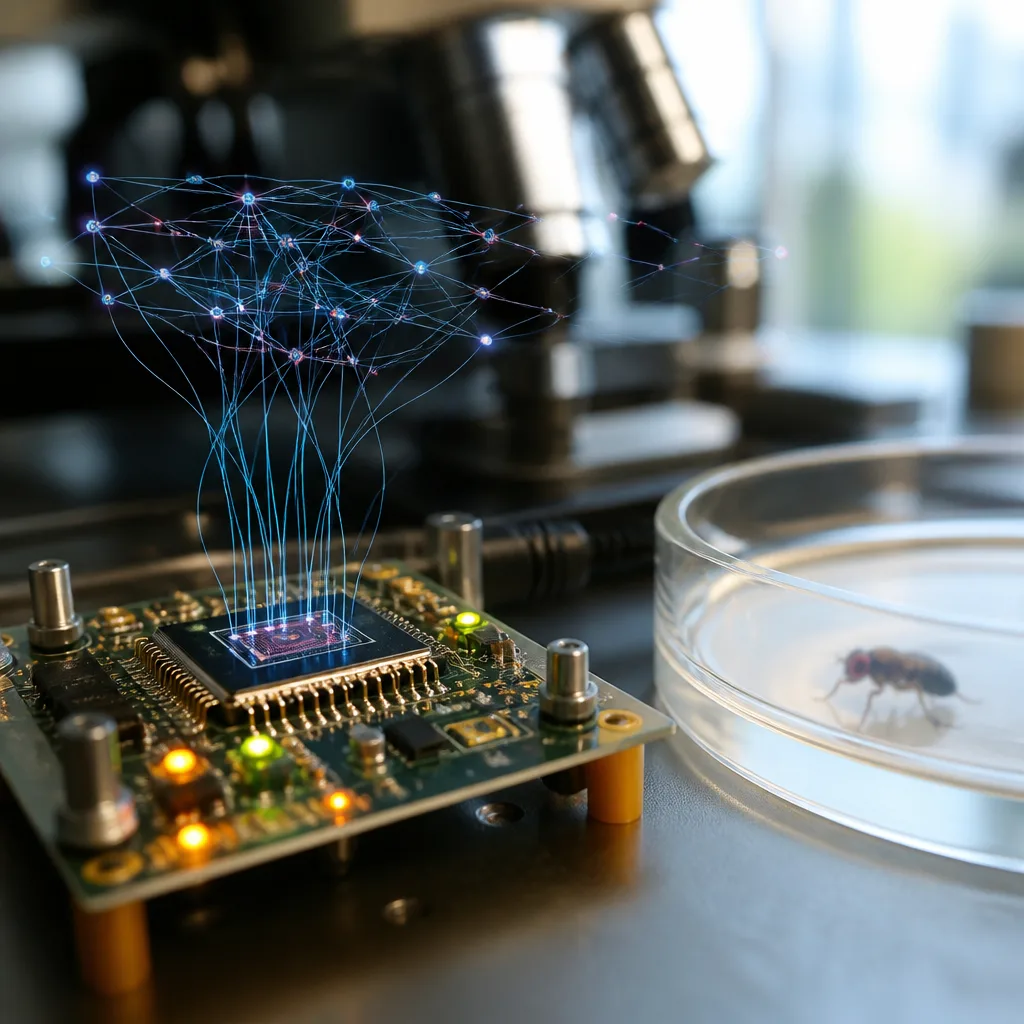
Researchers at the Okinawa Institute of Science and Technology (OIST) have reported a brain‑inspired algorithm that classifies odours accurately while demanding little memory and training data — properties that could make it useful for low‑power, real‑world sensing systems.
What the team built
Published in Neuromorphic Computing & Engineering, the new algorithm — developed by scientists in OIST’s Biological Nonlinear Dynamics Data Science Unit — takes design cues from the fruit fly olfactory circuit. The fruit fly brain is small but well mapped and uses a strategy called sparse coding to represent smells with minimal overlap between signals. That sparsity helps reduce energy and memory requirements for encoding sensory inputs.
The authors report that the algorithm, named Spi‑Fly, was trained and tested on experimental odour data sets and produced accurate classification results. The paper highlights the algorithm’s strengths in situations where training examples are scarce — a common constraint for deployed sensors that must learn from new inputs over time.
Hardware compatibility and context
Spi‑Fly was designed to be compatible with neuromorphic hardware already described in prior work from collaborators at TU Eindhoven and Kiel University. That earlier work presented a chip and peripheral hardware intended to support low‑power olfactory sensing; the present algorithm is intended to run on such platforms, closing the loop between biologically inspired software and energy‑efficient hardware.
Dr Yang Shen of OIST’s Biological Nonlinear Dynamics Data Science Unit is quoted in the paper emphasising the appeal of the insect model:
“It’s one of the best‑mapped brains; it’s simple enough that we can study the brain as a whole, but it still achieves complex processing.”
The research team argues that computational systems built in this manner could be especially useful in settings where energy is limited and data arrive sequentially — for example, remote environmental monitors, mobile chemical sensors, or edge devices in the Internet of Things. By contrast, many modern machine‑learning approaches depend on large labelled data sets and substantial memory footprints, which are impractical for those applications.
Why sparse coding matters
In neuroscience, sparse coding describes a representation in which only a small fraction of neurons respond to any given input. This reduces overlap between different inputs and makes representations easier to separate with simple classifiers. The Spi‑Fly algorithm implements this strategy algorithmically, rather than by extensive supervised training, and the authors found that it preserved classification performance even when training examples were limited.
- Biological inspiration: fruit fly olfactory circuit and sparse coding.
- Performance claim: accurate odour classification on experimental data sets, especially with limited training data.
- Hardware link: compatible with previously published neuromorphic chips from TU Eindhoven and Kiel University.
Implications and limits
The work is an incremental but important step towards practical neuromorphic sensing systems. It demonstrates a proof‑of‑concept algorithm that marries biological principles with hardware constraints. However, the study remains at the level of experimental data sets and lab validation; the paper does not report wide‑scale field deployments or long‑term operational trials.
Adopting such algorithms in real devices will require additional development: integration with sensors, robustness testing in variable environmental conditions, and benchmarking against alternative low‑power approaches. Nevertheless, the research highlights a growing trend in computing: taking lessons from compact biological systems to build machines that are efficient, adaptive and suited to edge computing.
| Aspect | Reported feature |
|---|---|
| Inspiration | Fruit fly olfactory system (sparse coding) |
| Publication | Neuromorphic Computing & Engineering |
| Hardware compatibility | Chip designs from TU Eindhoven and Kiel University |
| Strength | Accurate classification with limited training data |
For South African researchers and engineers working on environmental sensing, agriculture, or low‑cost diagnostics, the study offers a useful model: simpler, biologically informed representations can reduce the resource burden of machine perception and make continuous, on‑site sensing more viable.