
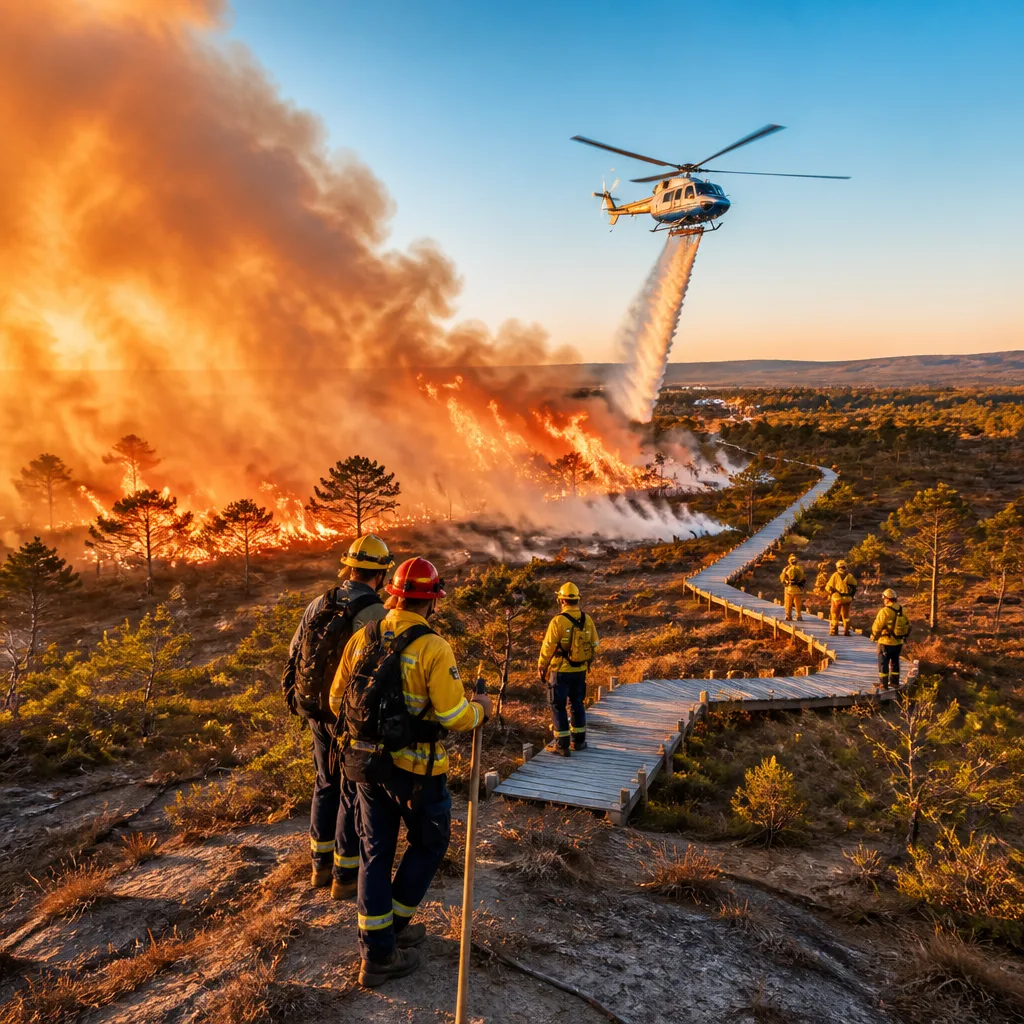
Belgian authorities and European partners raced to contain a major wildfire in the High Fens nature reserve on Sunday after a blaze that began on Friday exploded in size, consuming a landscape of heath, peat bog and pine forest close to the German border.
Rapid expansion and difficult terrain
Emergency services said the fire initially affected roughly 80 hectares but spread quickly, growing to 850 hectares by Saturday morning and to about 3,000 hectares by early Sunday, according to reporting by RFI. More than 250 firefighters and emergency personnel worked through the night amid challenging conditions.
Authorities described firefighting operations as “particularly complex”.
The High Fens is a mosaic of raised wooden walkways, peat bogs and sandy heathland that limits access by heavy vehicles and crews. Peatland presents special hazards: soft ground can cause heavy equipment to sink, and fires can smoulder below the surface, reigniting later or spreading underground where crews cannot safely reach.
Evacuations and cross‑border assistance
Changing winds repeatedly altered the direction of the flames, complicating containment. A thick plume of yellowish smoke blanketed the area, prompting the evacuation of residents from parts of two nearby villages. By Sunday morning authorities reported that no homes had been destroyed, although several active fire fronts remained.
Belgium requested aerial reinforcements from across Europe, and crews and modern fire engines from neighbouring Germany joined the response. The European Commission’s civil protection mechanism has been used in recent years to share aerial firefighting assets among member states; RFI reported that Belgium called in these resources as the situation escalated.
Historical scale and wider concerns
Officials characterised the incident as Belgium’s largest wildfire since 1911, when the same region experienced major fires during an earlier spell of heat and drought. The size and speed of the current blaze have revived discussion about preparedness, land management and the funding of preventive measures.
- Area affected: from about 80 ha to roughly 3,000 ha in three days (RFI).
- Personnel: over 250 firefighters and emergency staff were deployed through the night.
- International aid: German firefighting crews and European aerial assets were mobilised.
| Time | Estimated area burning |
|---|---|
| Friday (start) | ~80 hectares |
| Saturday morning | ~850 hectares |
| Early Sunday | ~3,000 hectares |
Implications for South Africa and policy lessons
While the High Fens is geographically distant from South Africa, the incident underscores two shared challenges: the vulnerability of sensitive ecosystems to fire and the limits of tactical suppression when prevention and landscape management lag behind changing climatic conditions. Peatlands and other carbon‑rich soils are especially problematic because they can burn for extended periods and are hard to extinguish.
EU crisis management officials have used the episode to press for greater investment in prevention and preparedness, a message reported by RFI that resonates with debates here over municipal and provincial readiness for veld and informal settlement fires. South African fire authorities have in recent years stressed the importance of firebreaks, early detection and community engagement; the Belgian case highlights the additional need for resourcing in difficult or protected landscapes where standard firefighting approaches are impractical.
Investigators have not yet identified the cause of the Belgian blaze; rescue teams have been unable to reach the suspected ignition zone because of the hazardous terrain. Authorities are continuing suppression efforts while coordinating international support and monitoring changing weather conditions that could either aid containment or exacerbate the fire.
The High Fens incident is likely to feed into wider conversations across Europe about adapting land management, boosting aerial firefighting capacity and financing preventive measures as summers grow warmer and drier in many regions.