
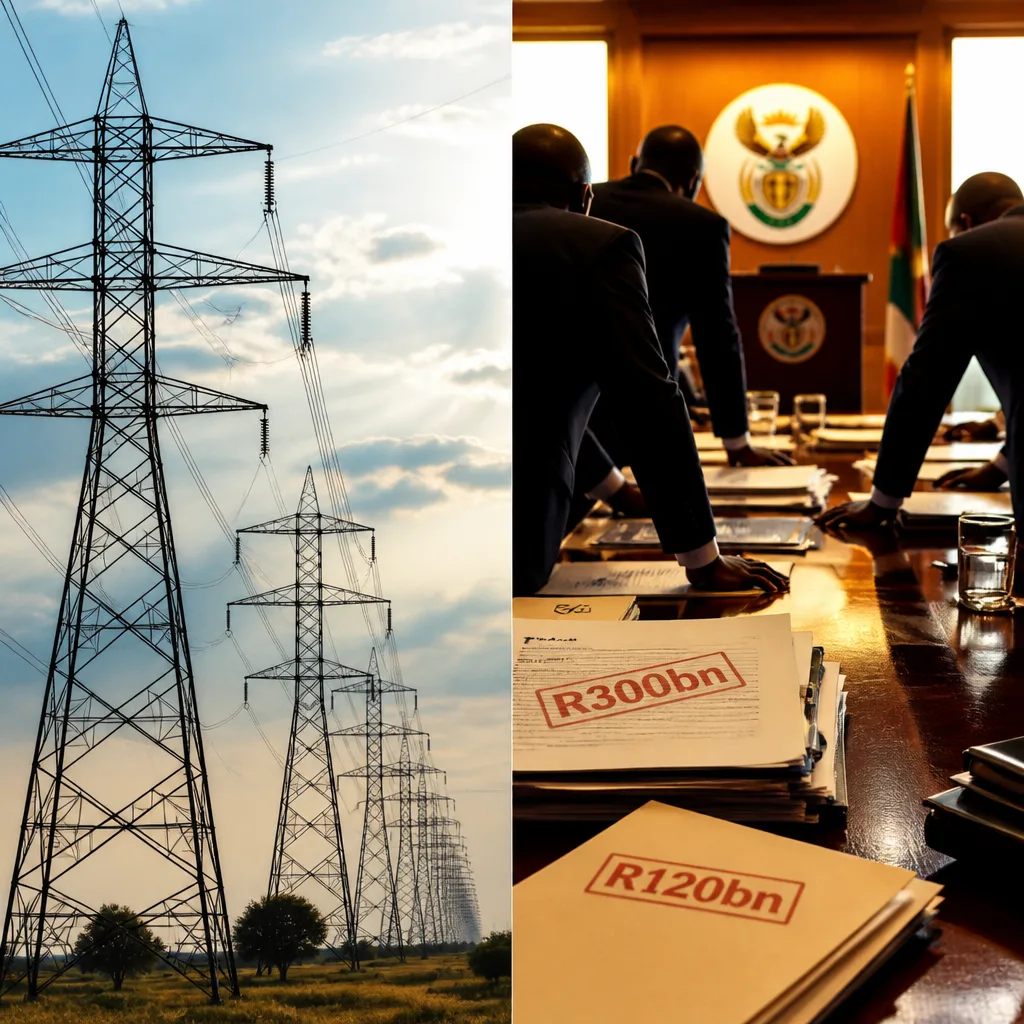
President Cyril Ramaphosa’s push to transfer control of South Africa’s transmission network has moved from policy corridors into public confrontation after his spokesman publicly criticised Eskom chair Mteto Nyati for questioning the proposal to hand the entire grid to a new national Transmission Systems Operator (TSO).
What has happened
The row centres on the fate of Eskom’s roughly 33,000km transmission network. Government plans envisage a TSO that would operate the grid independently and create a market that buys power from both Eskom and private renewable generators according to price and demand.
A National Transmission Systems Company has already been created as an Eskom subsidiary to hold the transmission assets until the TSO is established. But the public exchange this week — in which Vincent Magwenya, the President’s spokesman, admonished Nyati — has made clear that implementation will be politically charged.
"It is unfortunate that Mr Nyati creates an impression as if there’s a process under way without the inclusion of Eskom and at the detriment of Eskom,"
The dispute spotlights competing institutional incentives. Eskom’s leadership, including chief executive Dan Marokane, has publicly expressed reservations about surrendering a monopoly asset. The presidency, according to reporting, is determined to place transmission and price control into an entity that is free of Eskom influence.
Who benefits — and who pays
There are clear winners and losers in the proposed arrangement. Government argues a separated TSO would open space for private generators and create price competition, a change that business has broadly welcomed. For the presidency, transferring control is a way to set the rules of the market and insulate transmission pricing from operational failures at Eskom.
Eskom — saddled with an overall debt mountain — stands to lose a strategic asset that currently underpins its dominance in the power sector. The utility’s balance sheet remains heavily strained; the company carries about R300bn of debt and is owed roughly R120bn by municipalities, most of which are effectively non‑performing, according to reporting.
| Item | Figure |
|---|---|
| Total Eskom debt | R300bn |
| Debt owed by municipalities | R120bn |
- Government wants transmission and price control in an entity free of Eskom influence.
- Eskom leadership fears losing assets and market position amid a broken balance sheet.
- Business supports reform; political contestation is likely to shape implementation.
Politics, power and the long game
What follows is likely to be horse‑trading rather than a technocratic handover. Any monopoly that has been central to the economy for decades will resist giving up control, especially when its finances are precarious. The reported municipal arrears compound Eskom’s vulnerability: a utility asked to divest a core asset while wrestling with cash flow and credit risk faces hard choices.
The presidency’s stance also underlines a broader political calculus: placing transmission beyond Eskom’s control is a lever to reshape the electricity market and constrain future pricing decisions. That strategy carries political risk: implementation needs technical capacity, regulatory clarity, and the co‑operation of multiple state actors — and those actors are not politically neutral.
Energy minister Kgosientsho Ramokgopa has, the reporting notes, privately echoed some of Eskom’s concerns in the past. He was reportedly rebuked for doing so. That suggests the fault lines run through the governing coalition and state bureaucracy as much as they do between the presidency and Eskom boardroom.
For now, the creation of a National Transmission Systems Company as an Eskom subsidiary is an interim step. The question is whether that subsidiary will become an effective bridge to a truly independent TSO, or whether it will be a staging post in a protracted legal, financial and political battle. Either outcome will affect tariffs, investment signals for renewables, and Eskom’s own capacity to stabilise the grid.
The public rebuke has brought the argument into full view. Implementation will require political capital, technical planning and credible funding arrangements. Absent those, the row over transmission could add another layer of uncertainty to a power sector already beset by supply shortfalls and financial fragility.
Measured in balance-sheet terms and in control over future market design, the stakes are high: who benefits from reform, and who ultimately pays, will be the central political questions as the country moves from announcements to execution.












