
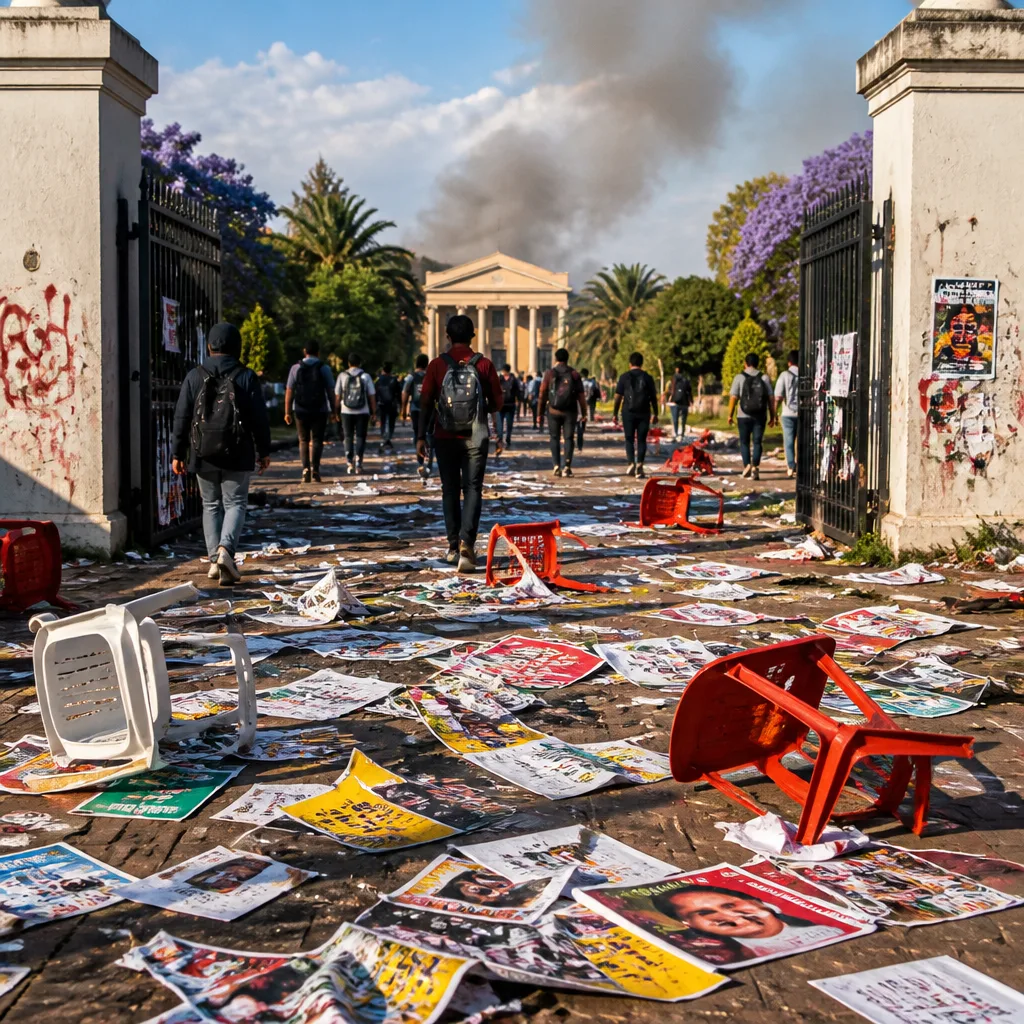
Student organisations have been central to Bangladesh’s political life for decades, but that legacy carries a double edge: the same networks that fuel democratic mobilisation have also been linked to recurrent episodes of campus violence. A new review by the NUS Institute of South Asian Studies (ISAS) maps that history and says concerns have resurfaced since the Bangladesh National Party (BNP) assumed office in February 2026.
Roots of mobilisation and a recurring pattern
The ISAS summary retraces a lineage of activism stretching back to the language movement of 1952, when students at Dhaka University formed the All-Party State Language Action Committee and led demonstrations on 21 February 1952. The report links later waves of student political action to successive national crises: opposition to the Sharif Commission education report in 1962; the Six-Point campaign after 1966; the January 1969 uprising; and student organisation involvement in the 1971 liberation struggle. Student-led mobilisation also played a role in the movement that ended Hussain Muhammad Ershad’s rule.
ISAS describes the July 2024 uprising as part of that tradition of campus-led protest. That movement drew students from across the political spectrum — including the Anti-Discrimination Student Movement, Chhatra Dal, Islami Chhatra Shibir, Chhatra Shakti, Bangladesh Chhatra Union, Chhatra Federation and many non-aligned students — in mass action against the government at the time.
From protest to party muscle
The ISAS paper warns that the same institutions that have mobilised for democracy can be repurposed as instruments of partisan discipline and coercion. It highlights the role of party-affiliated student wings in episodes of campus violence, and notes that when the Awami League government confronted the July 2024 protests, its student wing, Chhatra League, was subsequently designated a terrorist organisation in October 2024.
Since the BNP took national office in February 2026, ISAS reports, allegations against Chhatra Dal — the BNP’s student wing — have prompted questions about whether historical patterns of violence and campus intimidation are re-emerging. The study does not offer prosecutions or legal findings, but documents a renewed set of concerns around the behaviour of organised student groups tied to political parties.
| Event | Year |
|---|---|
| Language movement (Dhaka University) | 1952 |
| January uprising | 1969 |
| Liberation struggle involvement | 1971 |
| End of Ershad’s rule (student role) | 1990s |
| July uprising | 2024 |
| Chhatra League banned as terrorist organisation | October 2024 |
| BNP assumes office | February 2026 |
Who benefits, who pays
ISAS presents a sober calculus: student organisations can be engines of democratic change but also a source of coercive power when absorbed into party structures. The beneficiaries are often the parent parties, which gain a ready-made grassroots apparatus for contests on and off campus. The costs are borne by ordinary students, who may find campuses less safe and less open to non-partisan civic activity, and by the institutions of higher education, which can suffer reputational and operational damage when political violence flares.
- Political parties gain mobilising capacity and local reach through student wings.
- Students and universities face heightened risk of violence, disruption and polarisation.
- Democratic practice can be both strengthened by mobilisation and weakened when that mobilisation turns violent or partisan.
The ISAS review does not prescribe a single remedy, but its historical framing underlines that patterns of student mobilisation are persistent and adaptable. Policymakers and university authorities face the challenge of preserving space for legitimate political expression while containing organised violence and preventing campuses from becoming proxy battlegrounds for party conflict.
For outside observers, the Bangladeshi case is a reminder that student politics is rarely merely symbolic. It can be a barometer of national political temperature — signalling democratic vitality at its best and, at its worst, the institutionalisation of partisan coercion.












