
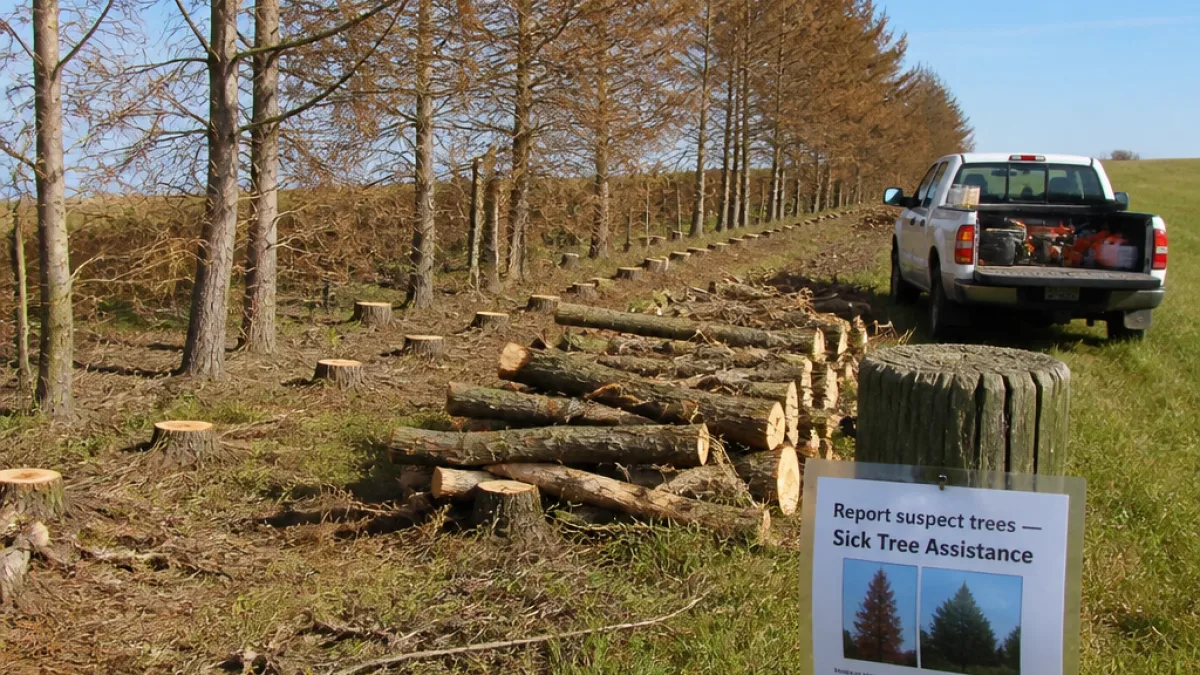
FORMAN, N.D. — Pine wilt disease, a fast-acting and fatal illness of certain pines, has been confirmed in North Dakota for the first time, state foresters said Monday, a development that threatens windbreaks and ornamental plantings across much of the state.
Where it was found and how it spreads
North Dakota Forest Service staff investigated die-offs of Scotch pine at Sheyenne River State Forest and near the town of Forman. Samples from those trees were tested and the diagnosis was validated on Aug. 11 by the plant pathology laboratory at South Dakota State University.
The disease is caused by microscopic nematodes that move from tree to tree on the bodies of native sawyer beetles. The pest complex targets nonnative conifers that have been widely used in farmstead windbreaks and community plantings.
Which species are most vulnerable
Forestry officials say the following nonnative pines are particularly at risk:
- Scotch pine (Pinus sylvestris) — typically dies within a single growing season after infection.
- Austrian pine — usually succumbs within about two seasons.
- Mugo pine — also considered susceptible.
| County | Location | Confirmed |
|---|---|---|
| Ransom | Sheyenne River State Forest | Aug. 11 (lab confirmation) |
| Sargent | Near Forman | Aug. 11 (lab confirmation) |
Management and outlook
North Dakota Forest Service officials warn there is no effective chemical cure to save trees once they are infected. Forest Health Manager Martin Shervey advised landowners that the most effective way to limit spread is removal and destruction of affected wood.
“Removal and destruction of the wood is the best treatment to slow the spread of the disease,” Shervey said.
With summer temperatures generally trending warmer, foresters expect the pathogen to move further north across the state, following a pattern already documented in South Dakota. That raises concerns for windbreaks that shelter crops, livestock and buildings across rural North Dakota.
Practical steps for landowners
Officials encourage property owners, county and city foresters, and landscapers to take the following actions if they suspect pine wilt in their trees:
- Submit a report via the Sick Tree Assistance form on the North Dakota Forest Service website.
- Contact a local extension agent for help with assessment and sample collection.
- Arrange for prompt removal and destruction of confirmed infected material.
- Plan new plantings using a broader mix of species, prioritizing native trees where appropriate.
Laboratory confirmation requires active nematode samples. Because nematodes are most reliably detected while they remain active, the Forest Service says samples can be collected only through early September.
Longer-term recommendations
Foresters are advising landowners to diversify future windbreaks and landscape plantings, replacing or mixing nonnative pines with species better suited to North Dakota conditions. The agency specifically noted Ponderosa pine as a native alternative to consider for some locations.
Beyond individual property decisions, the detection has management and conservation implications for municipalities, state agencies and conservation districts that maintain community forests and shelterbelts. The loss of large numbers of windbreak trees could affect erosion control, snow drifting patterns and wildlife habitat, in addition to altering the appearance of farmsteads and towns.
Reporting and assistance
Anyone who suspects their trees may be infected should act quickly. The North Dakota Forest Service and local extension offices are the first points of contact for evaluation and guidance. The window for collecting the active nematode samples needed for lab confirmation closes in early September, making immediate reporting important.
State foresters stressed prevention, rapid reporting and thoughtful species selection as the best strategies to reduce the disease’s spread and protect North Dakota’s windbreaks and community trees.
Ingrid Bjornstad is the state correspondent for WE NEWS.
















