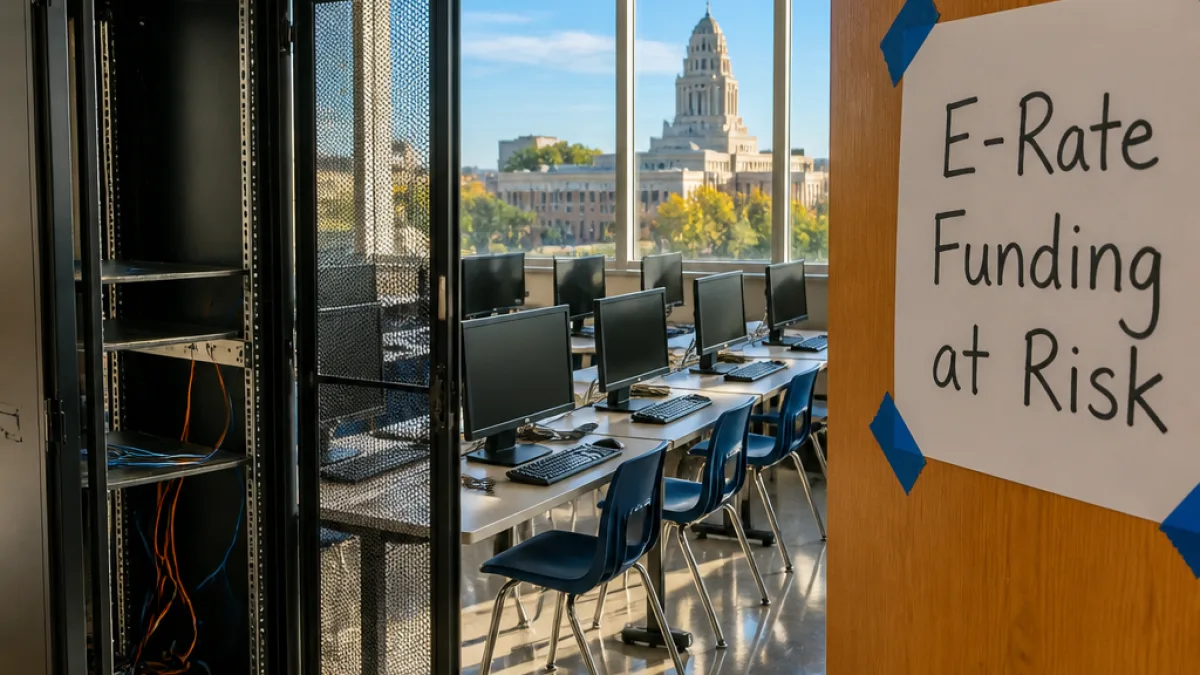
BISMARCK — A federal change under consideration could strip North Dakota schools and libraries of a major source of funding that helps pay for internet connectivity, data transmission and network hardware, education leaders warned this month.
What’s at stake
The Federal Communications Commission has circulated drafts in recent months that revisit the long-running E‑Rate program, which provides discounted telecommunications services to schools and libraries. North Dakota’s share of that support has ranged from about $2.6 million last year to $4.1 million in 2022, according to state figures — money district leaders say is built into operating budgets.
The program is widely used to lower the cost of school internet and networking in the state. On average, individual schools in North Dakota receive roughly $30,000, though larger systems receive substantially more. Bismarck Public Schools, for example, receives between $350,000 and $780,000 over a five‑year cycle, Superintendent Jeff Fastnacht said.
“So is that significant? Absolutely,” Fastnacht said. “For us to have to collect that, is there an impact to taxpayers? Absolutely.”
Across the United States, E‑Rate provided roughly $10.5 billion to public and private schools between 2021 and 2025 and remains one of the largest federal funding streams that K‑12 systems rely on to maintain internet connectivity and related infrastructure.
Local leaders warn of sharp impacts
Educators and administrators in North Dakota say the program is already woven into how districts budget for basic operations. Aimee Copas, executive director of the North Dakota Council of Education Leaders, cautioned that proposed changes would affect districts of all sizes but could hit larger systems especially hard.
“(This will) truly hit any school, but our large schools particularly hard,” Copas said.
Superintendents say E‑Rate functions similarly to a utility discount — lowering the ongoing cost of internet the way a reduced rate would for electricity or water — and that losing it would force districts to choose between cutting other services or seeking additional local revenue.
Numbers and recent state allocations
| Year | North Dakota E‑Rate funding |
|---|---|
| 2022 | $4.1 million |
| 2023 | $3.6 million |
| 2024 | $2.9 million |
| 2025 | $2.6 million |
State officials and school leaders say those totals are distributed unevenly, with smaller districts typically receiving modest sums and larger districts pulling in far more under multi‑year cycles.
Historical context and why it matters
The E‑Rate program was created after the 1996 Telecommunications Act to broaden internet access in schools and libraries. Federal education statistics show internet availability in classrooms rose dramatically in the years after the program’s inception — from single digits to well over 90 percent — a shift proponents say would have been slower and costlier without the federal subsidy.
While the FCC reviews draft changes internally and has released documents for public comment in recent months, the ultimate scope of any reform or repeal is still unfolding. State education leaders say they are watching the regulatory process closely and preparing to urge federal policymakers to consider the local consequences.
What districts say they would do
- Some districts would seek additional levy authority or other local revenue to replace lost federal discounts.
- Others may delay infrastructure upgrades or reduce nonessential technology expenditures.
- Large systems that rely on multi‑year E‑Rate reimbursements could face immediate budgetary gaps.
Superintendents emphasized that enhanced connectivity is now integral to classroom instruction, administrative functions and digital resources. Reductions to E‑Rate funding, they said, would not only affect long‑term projects but also day‑to‑day operations.
Public comment periods on the FCC drafts have opened channels for stakeholders to weigh in. Education groups in the state are expected to submit feedback, detailing how cuts or program changes would translate into increased costs for local taxpayers and altered educational services.
As the federal review proceeds, North Dakota districts and libraries continue preparing contingency plans while urging policymakers to preserve the program’s core role in enabling affordable, reliable connectivity for schools across the state.