BISMARCK — North Dakota’s Ethics Commission will again ask the Legislature for additional staffing after reporting a substantial uptick in complaints and growing demands on its limited personnel, the panel said Monday.
Workload jump strains small team
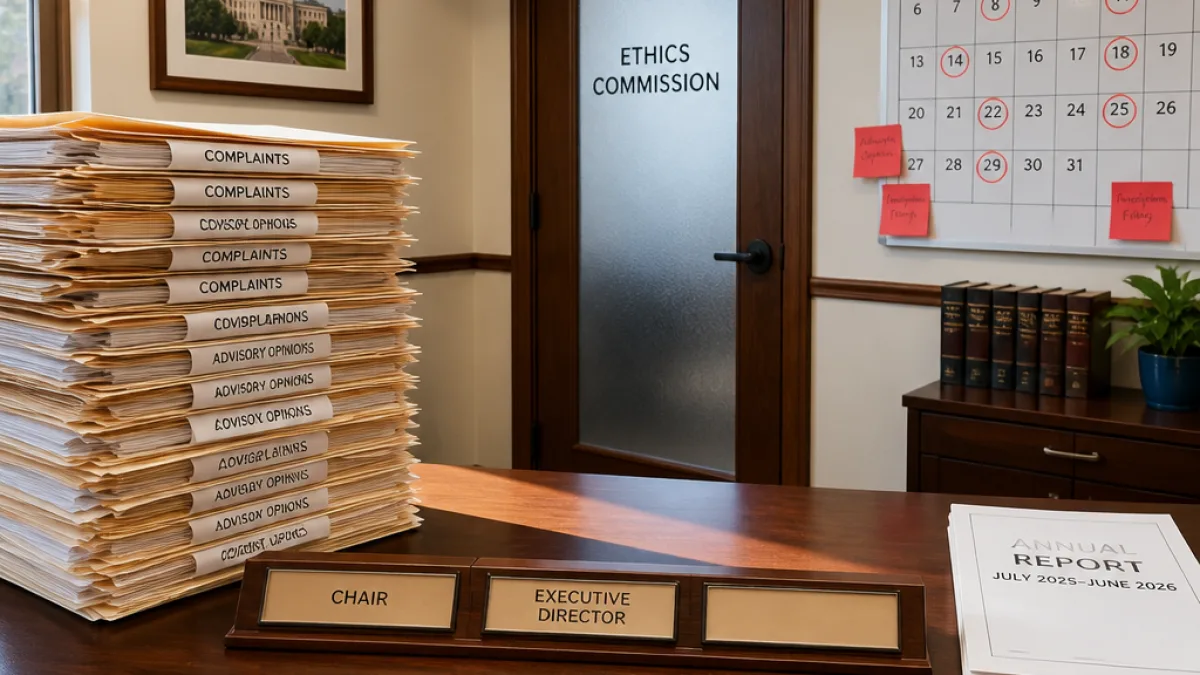
The commission reviewed and approved its second annual report covering the period from July 1, 2025, to June 30, 2026, showing the office handled dozens of matters with just a handful of employees. During that stretch the panel received 34 complaints, closed or dismissed 43 complaints and issued five advisory opinions.
Commission Chair Pam Sharp said the volume of work is the main reason the panel will seek more resources from the Republican-led Legislature.
"That's the primary message here, is that there has been such an increase in all of the work that the commission has to do,"
Much of the work — reviewing complaints and writing advisory opinions — is time intensive, Sharp said. The commission currently operates with a staff of three: an executive director, a general counsel and a support role. The report recommends expanding that team so the commission can both investigate cases effectively and increase its outreach and education efforts to the public and officials.
Complaints rising, counts changing
The commission has seen a rising trend in filings. In all of 2025, the panel took in 84 complaints, which was more than double the 41 complaints filed in 2024. So far in 2026, the commission has already received 50 complaints.
Officials note a rule change in 2024 altered how complaints are tallied: whereas one submission previously could address multiple people or allegations, the new method limits one complaint to one person. That revision affects year-to-year comparisons but does not fully explain the recent surge, the commission said.
Types of complaints and investigative activity
Of the 34 complaints filed during the most recent reporting year, 16 involved elected or appointed state officials and 12 named local officials. Four complaints were about state actors the commission lacks authority over and two were filed against private citizens — categories the panel cannot investigate.
During that reporting window the commission opened 14 investigations and, to date, has not issued any formal findings of ethical violations stemming from those probes. Five additional investigations remain open. Overall, more than 200 complaints have been lodged with the commission since it began meeting in 2019; at the time of the report the panel had 29 complaints pending, some dating back to 2023 and 2024.
| Metric | 2024 | 2025 | So far 2026 |
|---|---|---|---|
| Complaints received | 41 | 84 | 50 |
| Investigations opened (report period) | — | 14 | — |
Public confusion and jurisdictional limits
The commission said some filings reflect confusion about what falls within its authority. Complaints about private citizens or about certain state officials lie outside the panel’s remit, resulting in dismissals or referrals. The commission has confidentiality constraints on what it can disclose about open complaints and probes, limiting what officials can say publicly about active cases.
One finding stemming from a prior complaint involved Republican state Rep. Jason Dockter and related to his ownership of a building in Bismarck. That remains one of the few instances where the commission has issued a public finding.
Recommendations to lawmakers
In its report, the commission included several recommendations for the Legislature, chief among them an increase in staff to address the caseload and allow the office to place a greater emphasis on educating the public and officials about ethical obligations and the commission’s role.
- Expand staff beyond the current three-person team to handle investigation and advisory workloads.
- Enhance public education so potential complainants better understand the commission’s jurisdiction.
- Provide clearer guidance on complaint submission and processing to reduce administrative burden.
Commission leaders told the North Dakota Monitor they will press for those changes when the Legislature convenes. The additional staff would aim to shorten investigation timelines, free up time for advisory work and improve outreach so fewer filings are misdirected.
Lawmakers have the final say on funding and staffing changes. If approved, the expansion would represent a notable growth in the state’s oversight capacity after several years of steadily rising complaints and public attention on ethical questions involving state and local officials.
— Ingrid Bjornstad, State Correspondent