
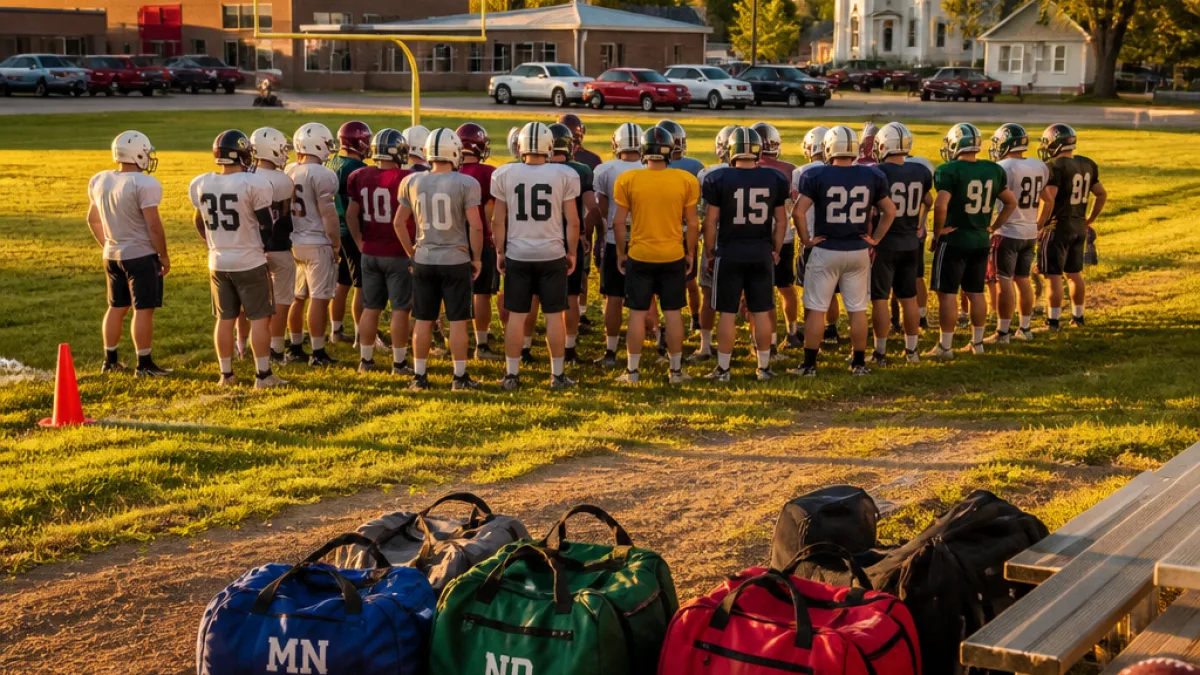
ROSHOLT, S.D. — The Tri-State Tigers will open their nine-man football season this week with a roster that crosses state lines and school district boundaries, illustrating how rural communities in the Upper Midwest collaborate to keep opportunities for student-athletes alive.
Three schools, one team
The cooperative program, formed in 2007, fields athletes from Campbell-Tintah, Minn.; Rosholt, S.D.; and Fairmount, N.D. This fall the Tigers reported 22 players at their first practice, a group assembled by coach Steven Schiltz.
The roster breakdown shows how the program draws across state lines to sustain a viable team:
| State | Players |
|---|---|
| Minnesota | 8 |
| North Dakota | 5 |
| South Dakota | 9 |
Daily routines that cross borders
Players travel regularly for practice and games. The Tigers hold their initial two weeks of fall camp in Rosholt, where athletes from three states converge to prepare for the season opener Friday. For some students, that means longer days and added travel between home and school.
Senior captain Owen Wood, who attends school in Minnesota and lives in Campbell, said juggling the logistics is worth it to play.
“The only downside is you get home a little later.”
Wood is one of the Minnesota students who made the trip to participate with the Tigers. The cooperative arrangement began as a football-only alliance and later expanded to include additional sports for the three member schools, giving rural students chances to compete that might otherwise be unavailable.
Team identity and camaraderie
Co-captain Jonah Loll, a senior who is homeschooled on a family farm outside Campbell, Minn., said the players have formed bonds that transcend their separate hometowns.
“We’re a team, that’s how I see it. We’re just a group of kids that want to play football.”
Schiltz greeted the 22 players at the first practice and will shape the Tigers through the early part of the season. Players said they already sense cohesion despite the logistical challenges of bringing students together from three states.
Why co-ops matter in rural areas
In sparsely populated regions across the Dakotas and Minnesota, school cooperatives provide a pathway to sustain extracurricular offerings. By pooling students from neighboring districts, small schools can field teams, offer more robust schedules and preserve traditions that might otherwise fade as enrollment declines.
The Tri-State Tigers model also highlights practical realities: travel, scheduling and shared practice sites require coordination among families and school officials. Still, for participants, the priority remains on playing and competing.
- Cooperative start: 2007, initially for football.
- Member schools: Campbell-Tintah (MN), Rosholt (SD), Fairmount (ND).
- Current roster: 22 players — 8 Minnesota, 5 North Dakota, 9 South Dakota.
Season outlook
As the Tigers prepare for their opener Friday, coaches and players will focus on conditioning, cohesion and executing fundamentals in nine-man football, a variant that remains popular in small-school programs across rural America. For seniors such as Wood and Loll, the season represents a final opportunity to compete with teammates they have come to know through this cross-state partnership.
For communities in Campbell, Rosholt and Fairmount, the Tigers represent more than a football team: they are a demonstration of how neighboring towns work together to sustain student activities and preserve a sense of regional connection.
Coverage of the Tri-State Tigers’ season will continue as the team moves through its schedule and competes in nine-man play this fall.

















