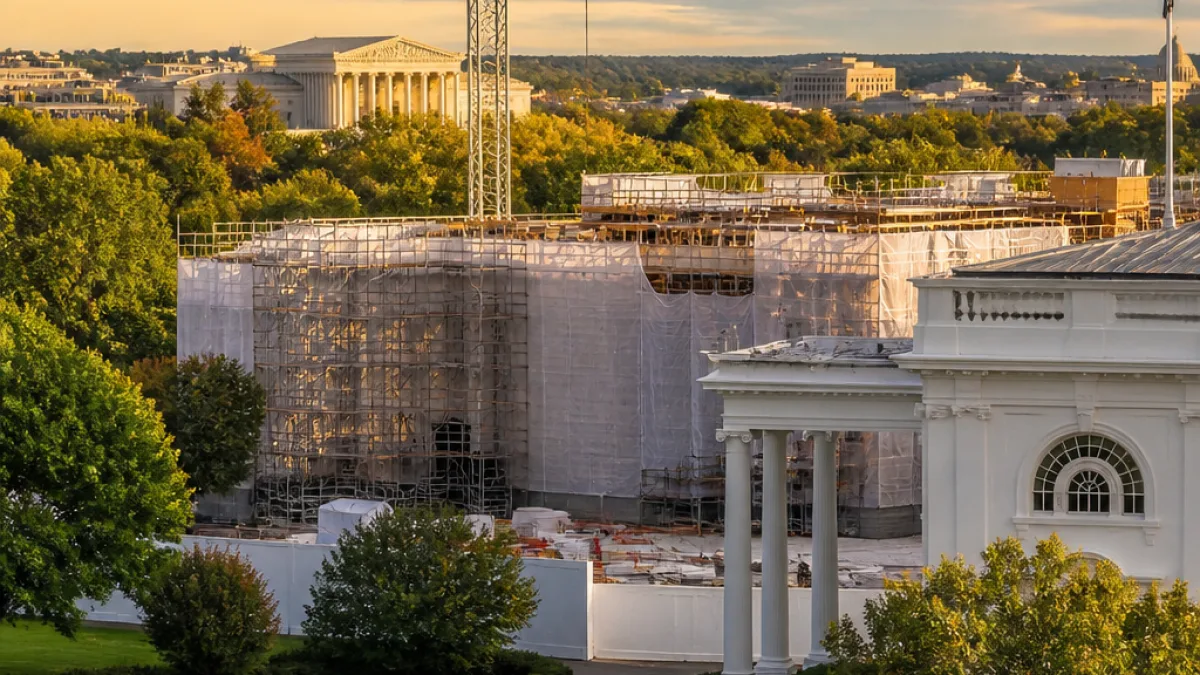
The Supreme Court on Monday granted the Trump administration’s request to allow construction on a new White House ballroom to continue, issuing a 5-4 order that pauses a federal judge’s ruling that would have stopped above-ground work.
Court focuses on standing, not legality
The unsigned, eight-page order did not resolve whether the project itself is lawful. Instead, the majority emphasized that the plaintiff likely lacks the legal right, known as standing, to bring the challenge in federal court. The decision comes after Chief Justice John Roberts issued a temporary administrative stay 10 days earlier to give the justices more time to consider the government’s emergency request.
The order leaves the disposition of the underlying legal questions to later proceedings, while permitting construction to continue in the meantime. The announcement raises the realistic prospect that the ballroom — which the administration said on Aug. 13 was already 65% complete — could be finished or nearly finished by the time the dispute is ultimately resolved.
Split among justices
The vote was 5-4. Chief Justice Roberts and the three justices appointed by Democratic presidents dissented from the majority. In a pointed critique, those four justices said the construction “is likely unlawful,” and called the majority’s action “no victory for the separation of powers.”
“is likely unlawful,” and the majority’s decision was “no victory for the separation of powers.”
The plaintiff and lower-court history
The suit was brought by the National Trust for Historic Preservation, a private nonprofit that says it has “led the movement to save America’s historic places” for more than 75 years. The organization filed suit in federal court in Washington, D.C., in December, asking Senior U.S. District Judge Richard Leon to halt above-ground construction until several federal review steps were completed.
On March 31, Judge Leon issued an order that temporarily blocked above-ground construction on the ballroom but permitted underground work — such as shelters or security-related excavations — and any above-ground measures necessary for safety and security. That order, however, had not gone into effect when the Supreme Court issued Monday’s emergency action.
What the National Trust sought
The National Trust asked the district court to pause building until local and federal review processes could be completed and, if necessary, until the National Capital Planning Commission and the Commission of Fine Arts could review and approve the plans and Congress could authorize the construction. The group’s filings argued that those procedures were bypassed and that the site — part of the historic White House complex — merits additional scrutiny.
Practical implications for the project and public oversight
Because the Supreme Court’s order is limited to the question of the plaintiff’s right to sue, it does not prevent later courts from evaluating whether the proper reviews or approvals were required. Still, by allowing construction to proceed during that assessment, the order significantly reduces the chance that authorities could return the project site to its pre-construction condition even if a court later rules against the administration.
- Construction status: Administration said the ballroom was 65% complete as of Aug. 13.
- Legal posture: Supreme Court paused a lower-court injunction on standing grounds.
- Next steps: Underlying merits and procedural challenges remain for lower courts to resolve if the case proceeds.
Timeline
| Date | Action |
|---|---|
| December | National Trust files suit in federal court in D.C. |
| March 31 | Judge Richard Leon issues order temporarily blocking above-ground construction (not yet in effect) |
| Aug. 13 | Administration says ballroom is 65% complete |
| 10 days before Aug. 31 | Chief Justice Roberts issues administrative stay |
| Aug. 31 | Supreme Court grants emergency stay, 5-4 |
Local and civic concerns
The dispute touches on longstanding local and national debates about historic preservation, executive authority and the proper oversight of alterations to federally owned historic sites. Preservation advocates and watchdog groups have warned that proceeding with construction before completing consultations and approvals could undercut statutory processes intended to protect public heritage and ensure public input.
As a reporter covering the District, I will continue to monitor filings, any expedited appeals and statements from the National Trust, the White House, and federal review panels. The long-term legal outcome remains uncertain: Monday’s order buys the administration time, but it does not resolve whether the project complied with applicable review requirements or whether the plaintiff ultimately will be permitted to press its case in court.