
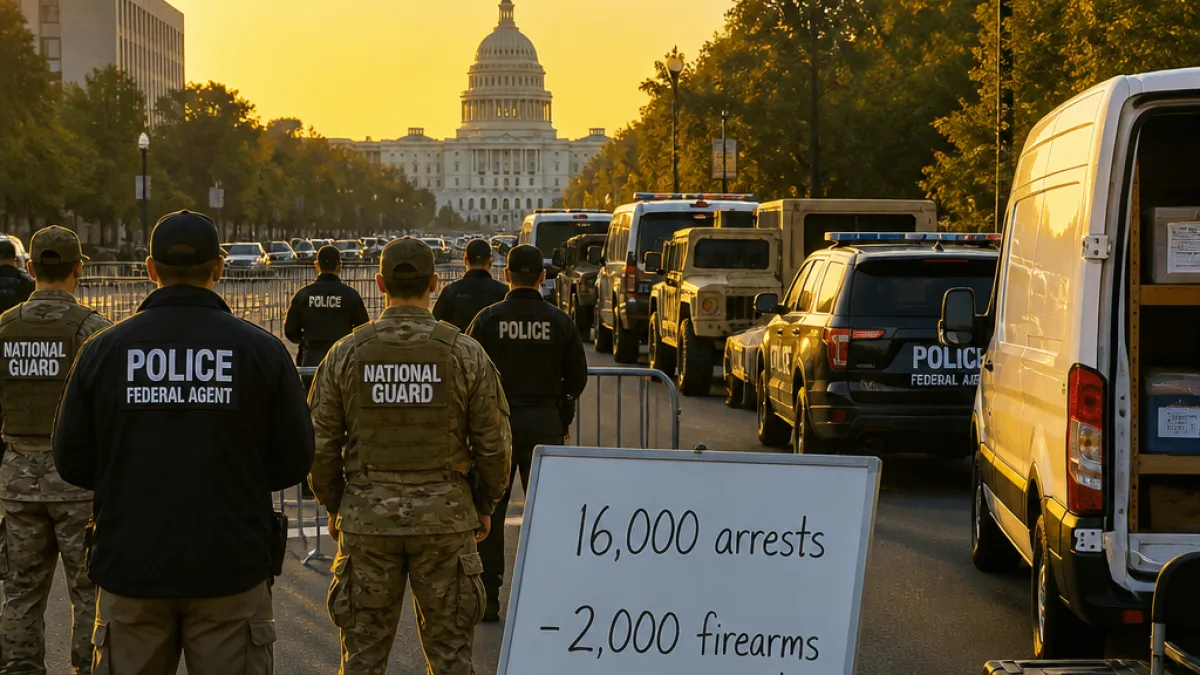
One year after federal authorities launched a sweeping enforcement operation in Washington, D.C., officials say the effort has produced thousands of arrests and a steady federal law enforcement footprint across the city.
Scope and results of the task force
The Make D.C. Safe and Beautiful Task Force, created after the federal announcement Aug. 11, 2025, combined personnel from federal, state and local law enforcement agencies with the National Guard to target violent crime in the District. According to figures released by the U.S. Marshals Service, the effort has resulted in more than 16,000 arrests in its first year.
Officials provided a breakdown of some of the case types the task force pursued: more than 3,200 narcotics-related arrests, about 35 homicide suspects detained and in excess of 100 known gang members apprehended. Authorities also said they recovered nearly 2,000 illegal firearms and located 25 missing children, who were reunited with their families.
| Metric | Reported total |
|---|---|
| Total arrests | 16,000+ |
| Homicide suspects | 35 |
| Known gang members | 100+ |
| Narcotics arrests | 3,200+ |
| Illegal firearms seized | ~2,000 |
| Missing children found | 25 |
“We will not relent until every community in Washington, D.C., is safe,” Attorney General Todd Blanche said in a statement.
Notable cases and community impacts
Federal officials highlighted several high-profile arrests tied to local crimes since the task force started work. Those include arrests related to the 2025 shooting death of a congressional intern and suspects taken into custody in connection with attempted carjacking and assault cases later that year. Authorities also pointed to arrests of individuals accused of murder in regional investigations that involved coordination with Maryland law enforcement.
City residents and local leaders have offered mixed reactions. Some neighborhood groups welcome the added law enforcement resources and say heavy enforcement has led to a perceived reduction in visible street-level violent incidents. Others have expressed concern about the long-term presence of federal forces and the National Guard, and the potential for civil liberties consequences when local policing becomes entwined with federal operations.
National Guard presence and operational questions
Officials have confirmed that roughly 4,600 National Guard troops remain in the District as the mission approaches its one-year mark. The deployment has drawn scrutiny from elected officials and policy advocates who question the appropriate role for the Guard in non-wartime public safety missions and ask how long the sustained presence will last.
City policymakers are also seeking clarity about coordination between the task force and the Metropolitan Police Department, oversight mechanisms for federal agents operating locally and data on outcomes such as crime trends and community safety measures beyond arrest counts.
What the numbers do and do not show
Law enforcement officials emphasize that arrests and seizures are one set of measurable outcomes from the task force, while critics note that arrests alone do not address underlying drivers of crime, including poverty, housing instability and access to social services. Independent analysts and advocacy groups call for public reporting on recidivism, case outcomes and any civil rights complaints tied to the operation.
- Officials report more than 16,000 arrests since Aug. 11, 2025.
- Task force efforts included operations that led to firearms recoveries and locating missing children.
- Roughly 4,600 National Guard members remain stationed in the District as the mission nears its one-year point.
As the task force marks its anniversary, Washingtonians face a continuing debate over strategy: whether the federal-led crackdown should be judged primarily on enforcement statistics or on long-term reductions in violence and improvements in community well-being. City and federal officials say the operation will continue until leaders determine that objectives have been met; community groups and some elected representatives say more transparency and independent oversight are needed to evaluate those claims.
Local residents can expect continued law enforcement activity in targeted areas, and municipal leaders say they will press for detailed reporting from federal partners on operations, outcomes and plans for transitioning responsibilities back to predominantly local control.
















