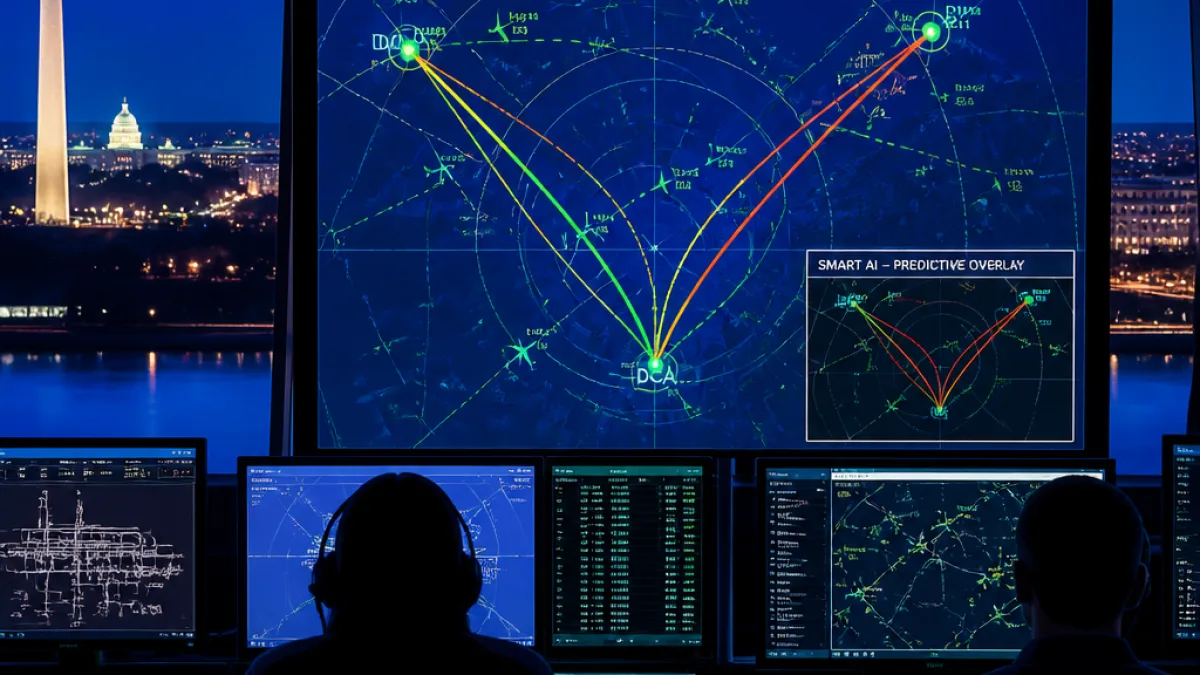
The Department of Transportation has launched a major artificial intelligence pilot aimed at reducing flight delays across the Washington, D.C. airspace, beginning tests this week at three area airports.
SMART — the Strategic Management of Airspace, Routing and Trajectories system — was unveiled Sept. 21 and will be evaluated at Ronald Reagan Washington National Airport, Washington Dulles International Airport and BWI Thurgood Marshall Airport. The system was developed by Boston-based Air Space Intelligence under a 12-year, $875 million contract.
Transportation Secretary Sean Duffy emphasized that the technology is intended to support, not replace, human air-traffic controllers. The tool aggregates hundreds of streams of information to present analysts and controllers with a unified, predictive view of traffic and surface operations.
"Human controllers will continue to manage U.S. airspace, with AI providing real-time data to enhance decision-making,"
The SMART platform pulls in more than 200 data streams, according to federal officials, and is designed to flag potential traffic conflicts before they emerge. It offers status updates on aircraft at gates and taxiways and displays color-coded visual cues that indicate expected wait times for departures.
How the system will be used in the region
Federal Aviation Administration officials say the D.C. region's airspace — known for its complexity and frequent weather disruptions — was chosen for the initial rollout because a successful deployment here could demonstrate the system's value ahead of wider adoption.
- Real-time decision support: SMART will provide controllers and traffic analysts with consolidated, predictive information about flights and surface operations.
- Predictive analytics: By processing multiple sources, including weather data, the system can forecast traffic flows and recommend adjustments to routes and speeds to reduce delays.
- Human oversight: The FAA has said controllers responsible for separation and collision prevention will remain in charge.
FAA Administrator Bryan Bedford reiterated the supplement-not-supplant approach, noting that the system is meant for air-traffic managers and traffic analysts rather than as an automated replacement for controllers who maintain aircraft separation.
What the pilot could mean for travelers and operations
Officials say the SMART trial aims to improve on-time performance by smoothing traffic flows and identifying bottlenecks earlier. Incorporating accurate weather inputs and trajectory predictions could allow airlines and controllers to adjust speeds and routes sooner, potentially cutting minutes from wait times and reducing fuel burn.
The FAA has said it plans to expand SMART across the national system by 2028, contingent on successful testing. The program is part of a broader modernization effort that includes telecommunications upgrades and surface-awareness tools already underway at several airports.
| Airport | Role in pilot |
|---|---|
| Ronald Reagan Washington National | Operational testing of surface and arrival/departure predictions |
| Washington Dulles International | Integration with complex arrival and departure flows |
| BWI Thurgood Marshall | Regional traffic coordination and weather-impacted operations |
Local travelers could begin to see incremental improvements if the system helps controllers make earlier, better-informed decisions. Airlines also stand to benefit from more predictable flows that reduce gate hold times and taxi delays.
Advocates for modernization argue that integrating AI-driven analytics into air-traffic management is a natural evolution of a system that has relied on incremental technological upgrades for decades. However, any change to how airspace is managed draws scrutiny from labor groups, safety experts and privacy advocates — especially when it involves new decision-support technologies.
For now, federal officials are focused on collecting data from the D.C. trial sites and assessing how SMART's outputs affect controller workflow and system performance. If testing meets expectations, the FAA intends to move forward with a staged, nationwide implementation by the 2028 target date.
The coming months of testing will show whether the ambitious, costly program can deliver measurable reductions in delays across one of the nation's busiest and most complicated airspaces.