
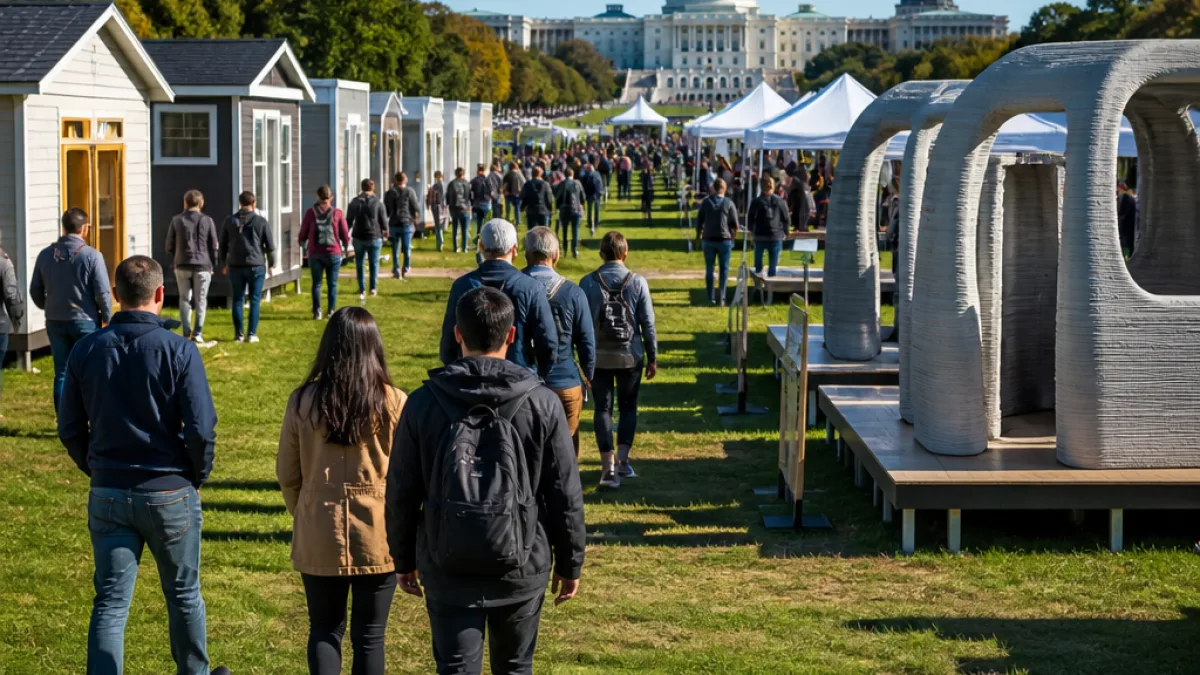
WASHINGTON — Homebuilders, startups and federal officials converged on the National Mall this week for the Innovative Housing Showcase, putting a spotlight on technologies and construction methods aimed at lowering the cost of housing at a time when affordability is a top concern for residents in the District and across the country.
New building methods take center stage
The event featured a range of alternatives to traditional site-built homes, including manufactured housing, modular construction and 3D-printed homes. Organizers said the U.S. Department of Housing and Urban Development attended to highlight novel approaches that could increase supply and speed construction.
The Showcase follows a major legislative development: Congress recently passed the 21st Century Road to Housing Act, described by participants as the most substantial housing reform package in three decades. Builders and industry advocates said the new law is an opening to pair policy changes with technological advances.
Industry perspective and persistent headwinds
Speakers at a panel on supply issues framed the challenges as multifaceted. Bill Owens, chairman of the National Association of Home Builders, warned that cumulative regulatory and market pressures have made new construction costly.
“If we look at the composite of what keeps housing so expensive right now, it’s sort of death by a thousand cuts,” Owens said during the panel.
Owens’ group estimates that regulatory costs add $131,000 to the price of a new home. Officials and builders at the Mall noted that these regulatory expenses layer on top of other obstacles such as supply chain disruptions, rising materials costs, labor shortages, local resistance to new housing and the growing impacts of natural disasters.
- Regulation: NAHB estimate of $131,000 added per new home.
- Construction innovations: Manufactured units, modular systems and 3D printing were demonstrated.
- Federal engagement: HUD participated as Congress enacted major housing legislation.
Startups showing practical, rapid-deployment solutions
Along the Mall, small companies demonstrated units intended for short-term and emergency use as well as permanent housing. Austin-based startup Uplift exhibited its compact, mobile microunits — an example of products pitched for disaster relief, workforce housing at job sites and other temporary needs.
Uplift, which raised $7 million in seed funding led by Andreessen Horowitz, launched its microunits about four months ago. Co-founder Charlie Nitschelm, a former SpaceX engineer, said the units are designed for quick deployment and basic self-sufficiency, with plug-in utilities and self-leveling mechanisms. The company reported selling its first unit to a paying customer this month.
What this means for Washington residents
For people in Washington, initiatives shown at the Showcase underscore two immediate realities: policymakers are under pressure to increase housing supply, and builders are pushing a mix of technological and regulatory approaches to bring down prices. The presence of HUD and the new federal law signal that the conversation is shifting from concept to policy implementation.
Local officials and community groups will face choices about how and where to deploy innovations like modular housing or manufactured units. Those decisions touch on zoning, neighborhood character, infrastructure capacity and long-term affordability — factors that the District has grappled with for years.
Advocates for faster, cheaper building methods argue they can ease shortages and create more options for renters and potential homeowners. Critics and some neighborhood voices often counter that new construction must be paired with investments in transit, schools and services to preserve livability.
| Topic | Detail |
|---|---|
| Legislation | 21st Century Road to Housing Act — largest housing reform in 30 years |
| Industry estimate | Regulatory costs add $131,000 to a new home (NAHB) |
| Startup example | Uplift: $7M seed round; sold first microunit this month |
The Showcase made clear that no single technology or policy will solve Washington’s housing challenges. As Owens put it, the problem is complex and layered, requiring multiple efforts from federal, state and local leaders, as well as the private sector. For residents of the District, the immediate questions are how quickly these new approaches can be put into practice and whether they will lower costs without sacrificing neighborhood priorities and long-term sustainability.

















