
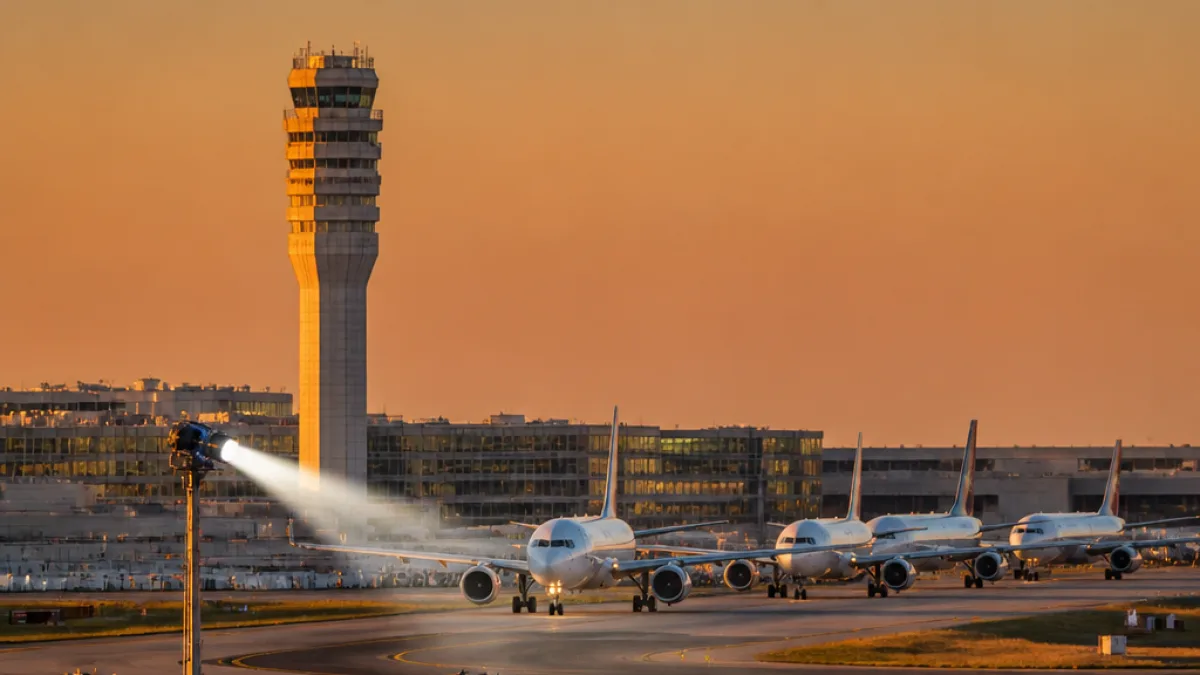
Flights at Ronald Reagan Washington National Airport were briefly suspended Wednesday night after two pilots reported seeing what they believed was a drone crossing an active runway, according to the Federal Aviation Administration.
What happened
Air traffic control halted operations for roughly 20 minutes after a pilot landing from Tulsa radioed the tower to report, in the controller’s words, “a drone or something” moving along the runway. A second pilot, a charter operator waiting to depart for New Jersey, told the tower he also saw a light that he thought might be a drone. Airport operations personnel conducted a ground search but did not locate any unmanned aircraft.
“We saw, like, a drone or something that went flying by, probably halfway down the runway,”
The FAA said local and federal authorities were notified. The agency’s statement confirmed the temporary stoppage and identified the cause as an unauthorized UAS (unmanned aircraft system) activity reported in the vicinity of DCA, with type and color unknown.
Regulatory and safety context
Unmanned aircraft are restricted over much of the airspace around Washington, D.C., and are also prohibited within designated zones around airports because of the high risk of collision with manned aircraft. The FAA and the FBI investigate illegal drone operations; federal penalties can include up to one year in jail and fines as large as $100,000.
Reagan National sits a short distance from the White House, the U.S. Capitol and the Pentagon, and it operates on a relatively compact footprint. The airport has a long history of heavy traffic and complex operations — factors that increase the potential consequences of any unauthorized aircraft in the area.
Local implications and background
I spoke with aviation sources who emphasized that any unidentified object near an active runway is treated as an urgent safety risk. Even a brief interruption can cascade into delays and additional operational scrutiny — and in the worst-case scenario, a midair collision could endanger passengers and crew.
The March of 2025 collision at Reagan National, which involved a U.S. Army Black Hawk helicopter and a commercial regional jet and resulted in 67 deaths, underscored longstanding safety concerns at the airport. Subsequent investigations documented thousands of near-miss events and prompted calls for improved procedures and infrastructure to reduce congestion and risk.
What authorities can and cannot do
After a report like Wednesday’s, airport operations teams typically conduct a perimeter sweep while air traffic controllers keep pilots apprised. The FAA will coordinate with law enforcement if an unauthorized drone is suspected. Detection and enforcement can be challenging: drones are small, often hard to spot once they land or move out of sight, and locating an operator in densely built urban areas can require substantial investigative resources.
- Duration of interruption: about 20 minutes
- Location: active runway at Reagan National (DCA)
- Outcome of search: no drone found by airport crews
Passenger impact
For travelers, the immediate impacts of a 20-minute pause are typically limited to minor delays and temporary hold patterns on departure or arrival. However, delays can ripple through airline schedules, affecting connections later in the evening. Passengers with questions about a specific flight should check with their airline for the most current status.
Next steps
The FAA confirmed that the incident was reported to local and federal law enforcement. The FBI handles investigations of drone operations that violate restricted airspace near national security sites. Whether charges are pursued depends on whether authorities can identify a responsible operator and determine intent or negligence.
As investigations proceed, airport officials and the FAA are likely to review surveillance and radar data to determine whether any unidentified aerial object was tracked and to evaluate procedures for responding to similar reports in the future. I will continue to monitor official updates and report new developments as they become available.

















