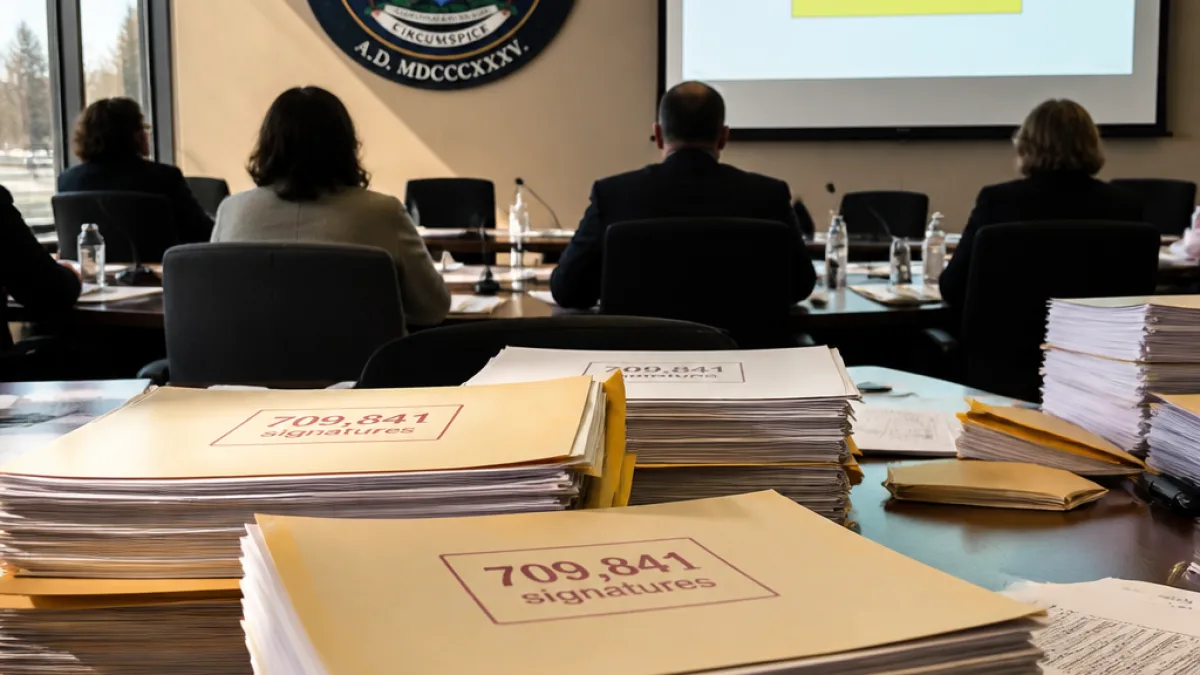
Two members of the Michigan Board of State Canvassers voted Aug. 24 to block certification of a citizen-initiated ballot question after an administrative review left the measure three signatures short of the threshold needed to qualify. The decision affects petitions signed by 709,841 Michigan residents and has prompted accusations that politics rather than law guided the board’s action.
What happened at the board meeting
At issue were a small number of disputed signatures that, according to board discussion, had been verified by a notary and supported by affidavits under penalty of perjury. Despite those attestations, two Democratic members voted against counting the contested names, leaving the sample short by three signatures and preventing automatic certification of the initiative for the ballot.
Arguments during the meeting were recounted by observers and officials present, including statements from Chairman Richard Houskamp, Michigan Elections Director Jonathan Brater and Democratic Vice Chair Mary Ellen Gurewitz. Exchanges captured in coverage indicate disagreement over whether the verified signatures should be given credit without further delay.
"These are ‘real people who are real voters who have signed these petitions,'"
The passage above, quoted by the board chairman during the meeting, was cited by critics who say denying those signatures disregards voters’ intent.
Reaction and claims of partisanship
Critics of the board’s action, including former state officials familiar with the petition-certification process, argue the decision was motivated by partisan considerations rather than the statutory criteria that govern canvassing. An opinion published after the meeting contended the move effectively disenfranchised nearly three-quarters of a million Michiganders who signed the petition supporting the proposed ballot measure.
Supporters of the board members’ stance say the review must adhere to legal standards and that canvassers are charged with ensuring signature validity under state law. The board’s stated role is ministerial: to confirm whether a petition meets statutory requirements and to protect the integrity of the ballot-access process.
Practical implications for the initiative process
The immediate consequence of the board’s vote is that the initiative will not be automatically placed on the ballot based on the petition sample. The decision could trigger additional legal challenges or efforts by proponents to gather more signatures.
For Michigan residents and organizers, the episode highlights these procedural realities:
- Ballot initiatives are subject to a verification process, including samples of petition signatures.
- Notarized affidavits can accompany contested signatures but may still be reviewed by canvassers.
- Board decisions can be split along partisan lines, with potential follow-up in the courts.
Broader context and stakes
Ballot initiatives in Michigan have been a central avenue for policy change and public engagement. The canvassers’ vote comes amid heightened national attention on voting rules and ballot-access procedures. When canvassing decisions leave measures narrowly short of qualification, supporters often pursue litigation or additional collection to meet thresholds.
Opponents of the board’s action say the result undermines public confidence in a process designed to empower citizens, while defenders assert the requirement for strict adherence to the law is necessary to prevent fraud and protect election integrity. Both perspectives reflect competing priorities in the administration of direct democracy.
What's next
Proponents of the initiative may seek legal remedies or mobilize renewed signature drives to secure placement on a future ballot. The Board of State Canvassers could also face scrutiny from lawmakers and the public regarding its internal procedures and whether reforms are warranted to increase transparency and consistency in signature verification.
| Item | Detail |
|---|---|
| Petition signers affected | 709,841 |
| Signatures short after review | 3 |
| Board action date | Aug. 24 |
As the fallout continues, Michiganders watching the process will be focused on whether the dispute escalates to the courts and how the state’s petition and canvassing procedures might be clarified to avoid similar controversies in the future.
Aaliyah Freeman, State Correspondent at WE NEWS, reported from available public accounts of the board meeting and public commentary; the piece relies on statements and exchanges recorded during the canvassers’ session and subsequent commentary about the vote.