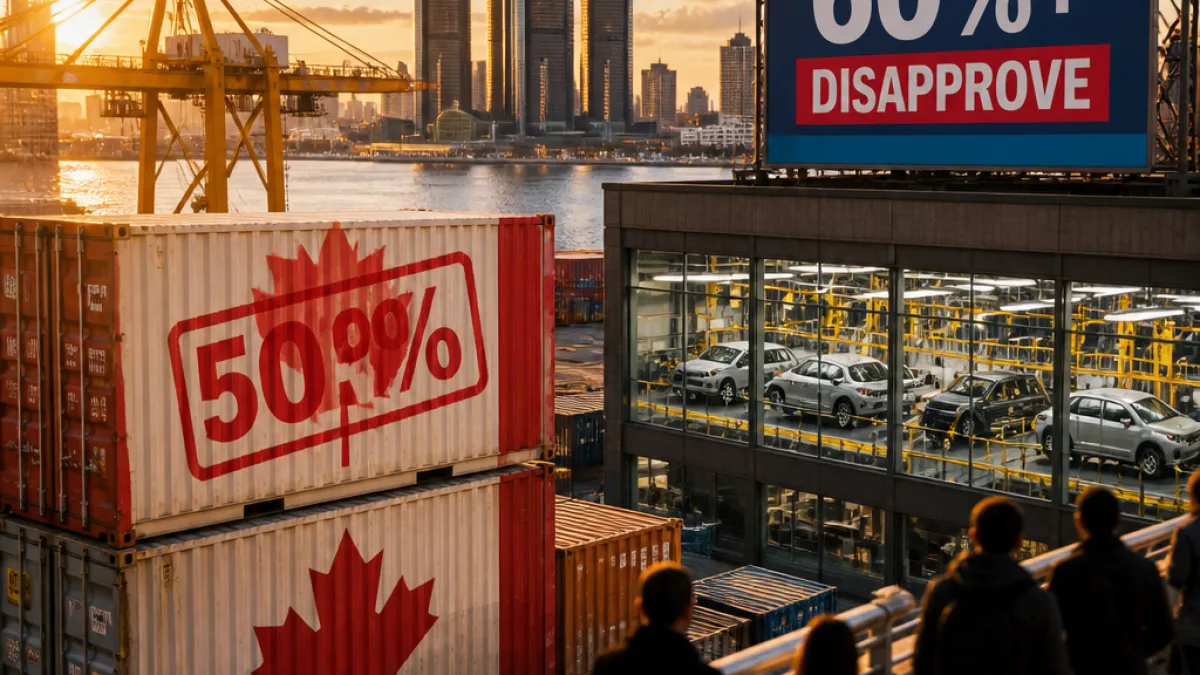
More than 60% of likely voters in Michigan disapprove of President Donald Trump’s decision to impose 50% tariffs on a range of Canadian products, according to a new statewide poll conducted Sept. 10–14 by The Washington Post and the Schar School.
Broad opposition, partisan split
The survey of roughly 800 Michigan residents showed deep disagreement along party lines: Democrats overwhelmingly opposed the tariffs, while a majority of Republicans supported them. Independents — a group that will be decisive in several tightly contested midterm races in the state — tilted sharply against the measures.
Key poll findings are summarized in the table below.
| Group | Disapprove | Support |
|---|---|---|
| All likely voters | 60%+ | Remaining portion |
| Democrats | 89% | 11% |
| Republicans | 44% | 56% |
| Independents | 68% | 32% |
Local industry alarm
Michigan’s economy is particularly exposed to disruptions in U.S.-Canada trade. The state recorded more than $66 billion in cross-border commerce with Canada last year, much of it tied to the automotive sector. Industry leaders warn that steep tariffs on inputs and finished goods could raise costs for manufacturers and create uncertainty across supply chains that stretch across the border.
“It’s just an escalation that is moving us economically in the wrong direction,” said Glenn Stevens, executive director of MichAuto, an advocacy group for Michigan’s auto industry.
Auto suppliers source numerous small components from Canadian firms — items such as fasteners, rods and other parts that are deeply embedded in assembly operations. Tariffs on those components, or on Canadian retaliation against U.S. exports, could increase production costs and complicate logistics for Michigan factories.
What the tariffs cover and responses
The administration announced the 50% levies this summer, applying them to a list of Canadian imports including dairy, alcohol, and other consumer goods. Canada responded on Sept. 8 with retaliatory duties on a number of U.S. products, and the White House has since threatened additional restrictions, including potential bans on certain Canadian imports effective Sept. 29.
- Trump administration action: 50% tariffs on select Canadian products.
- Canadian retaliation: New duties on U.S. items such as aluminum, dairy and machinery.
- Potential escalation: Threatened U.S. bans on some Canadian goods starting Sept. 29.
Those trade moves represent a small slice — roughly 6% — of the annual $715 billion in total cross-border trade between the two nations, but their concentrated effect on certain supply chains has local leaders on edge.
Political stakes in Michigan
Michigan is expected to be a focal point in the upcoming midterms, with several closely watched contests. The poll suggests the tariffs could be a political liability for the president in a state where independents and some working-class voters have swung elections in recent cycles.
Republican supporters of the tariffs argue the measures protect domestic producers and shore up leverage in trade talks, while opponents contend they risk harming U.S. manufacturers and raising prices for consumers. The partisan split in Michigan reflects those broader national debates but is sharpened by the state’s heavy economic ties to Canada.
What to watch next
Michigan businesses, trade groups and elected officials will be monitoring the immediate effects of the tariffs and any additional retaliatory measures from Ottawa. Lawmakers and industry representatives are likely to press for exemptions, negotiations or other relief if supply disruptions or cost increases begin to show up in factory output and consumer prices.
For voters and residents, the coming weeks may make clear whether the tariffs produce measurable harm to jobs and local industries — a factor that could influence ballot decisions in races across the state.