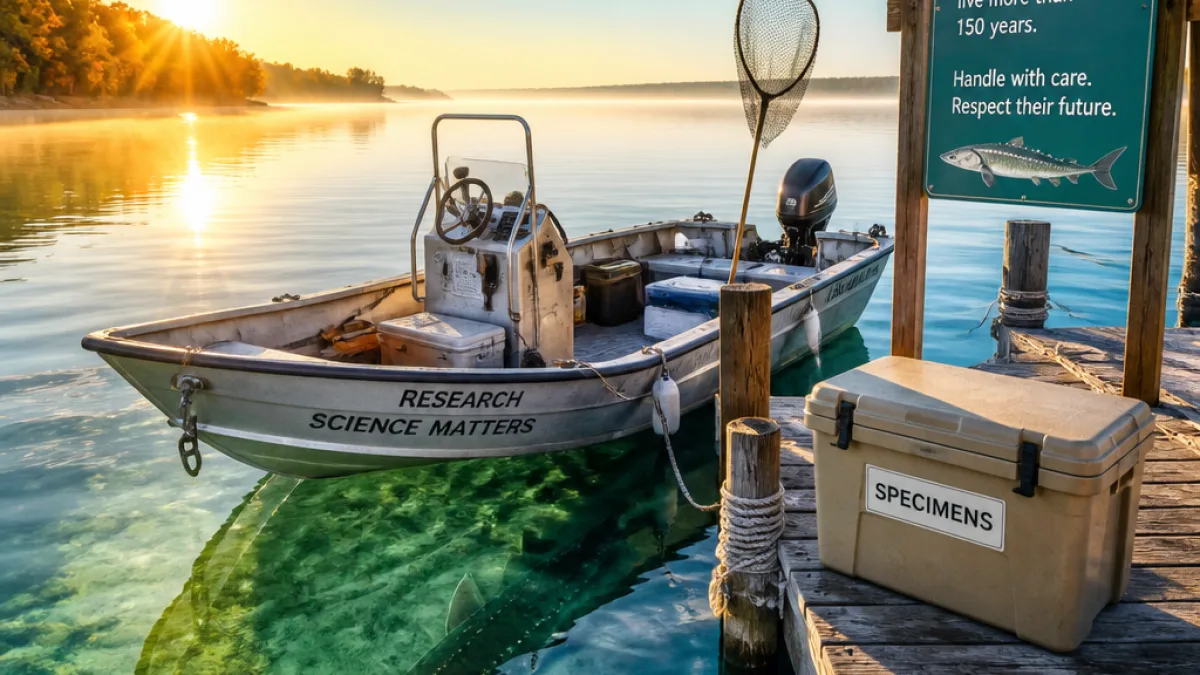
The Great Lakes’ lake sturgeon may be far older than scientists previously thought, with new age estimates stretching into the centuries and reshaping how managers might approach conservation and harvest.
New longevity estimates
A team including researchers from Michigan State University, Michigan Technological University and state departments of natural resources in Michigan and Wisconsin analyzed 44 years of data and determined that female lake sturgeon could live up to 427 years, while males might reach about 279 years. Those figures, published in the Journal of Fish Biology, far exceed the longstanding assumption that lake sturgeon top out at roughly 150 years.
Lake sturgeon are often called “living fossils” because their ancestors trace back to the Lower Jurassic period roughly 200 million years ago. If the new estimates hold across populations, lake sturgeon would rank among the longest-lived vertebrates on Earth, approaching the lifespan of species such as the Greenland shark.
How researchers reached the numbers
Rather than relying on traditional aging techniques that can underestimate age in very old fish, the researchers used growth-based modeling. They examined more than 1,200 individual fish from five genetically distinct populations across separate Great Lakes habitats and calculated average annual growth for each fish by location and sex. The populations studied were:
- Black Lake, Michigan
- Sturgeon River, Michigan
- Menominee River (Michigan-Wisconsin border)
- St. Clair River (Michigan-Ontario border)
- Lake Winnebago, Wisconsin
Using growth models, the team estimated ages for fish of typical adult size — females measuring about 180 centimeters (nearly 6 feet) and males about 160 centimeters (a little more than 5 feet). Traditional methods, such as counting annuli (growth rings) on fin spines or relying on survival records from captivity, become less reliable as sturgeon growth slows with age. The modeling approach can capture long, slow growth patterns that might otherwise be missed.
Implications for conservation and management
Longer lifespans alter how agencies assess population dynamics and the resilience of sturgeon stocks. If females can live for centuries, reproductive output, age structure and recovery timelines differ markedly from species with shorter lifespans.
That matters for:
- Harvest regulations and quota setting
- Population recovery plans following depletion
- Habitat protection priorities for long-lived, slow-maturing species
Researchers and resource managers say more accurate age estimates can refine models used to predict population trends and guide decisions on fishing seasons, size limits and restoration investments.
Where this research fits in with past knowledge
Previous high-end lifespan estimates for lake sturgeon hovered around 150 years. Those values were shaped by limits in aging techniques and fewer long-term datasets. The new study draws on decades of monitoring across multiple river and lake systems, providing a broader empirical base for modeling growth and age.
Because lake sturgeon are an ancient lineage, confirming exceptional longevity would not be wholly unexpected biologically, but documenting it provides practical information for managers and the public about how slowly sturgeon populations may respond to pressures such as overfishing or habitat loss.
Study scope and limits
The study used historical and contemporary data spanning five distinct Great Lakes-area populations. While the findings are robust for the sampled sites, additional research across other populations and with alternative aging techniques would help validate the extreme age estimates. The study itself notes limitations of standard aging methods and the potential for underestimates in older fish.
| Population | Location |
|---|---|
| Black Lake | Michigan |
| Sturgeon River | Michigan |
| Menominee River | Michigan–Wisconsin border |
| St. Clair River | Michigan–Ontario border |
| Lake Winnebago | Wisconsin |
For Michigan residents, anglers and conservationists, the study underscores the importance of long-term monitoring and cautious management for species that mature slowly and may persist for centuries. Resource agencies in Michigan and neighboring states routinely update rules based on the best available science; this study provides new data to inform those deliberations.
Further peer review, expanded sampling and complementary aging methods will determine whether these century-spanning estimates become widely accepted. For now, the research adds a striking chapter to what we know about a fish long associated with the region’s natural and cultural history.