
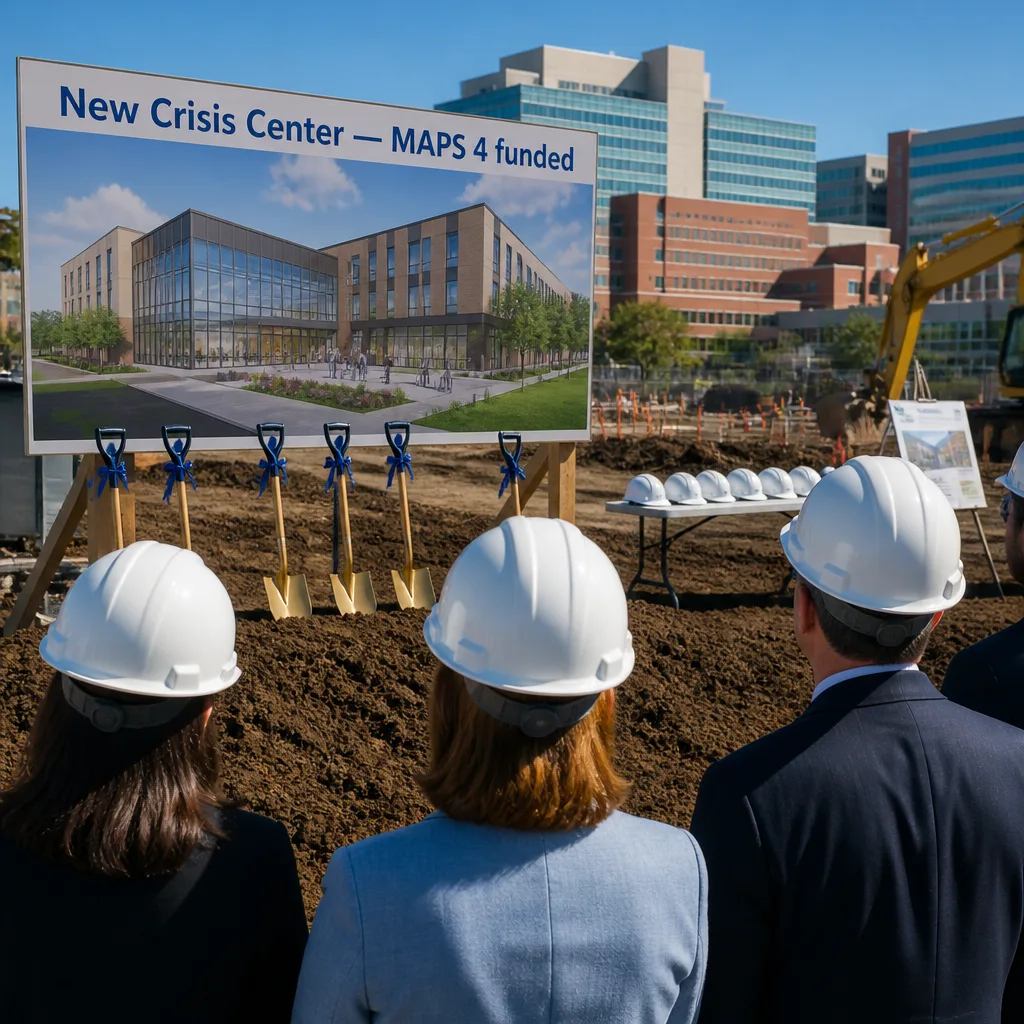
Oklahoma City officials on Monday broke ground on the Robert Ravitz Crisis Center, a new centralized facility intended to expand care for people experiencing mental health and drug crises and to serve as an anchor for the city’s Mobile Integrated Health response.
Centralized crisis services tied to MAPS 4 funding
The center is a cornerstone project from the MAPS 4 package approved by voters in 2019. The project carries a reported price tag of $12 million from MAPS 4 and an additional $2.6 million donated by the Arnall Family Foundation, with the new facility sited at 1200 NE 13th Street on the east side of the OU Health Sciences Center campus.
Planners say the building will replace the existing Crisis Center, described as aging and in need of replacement, and will be operated by the Oklahoma Department of Mental Health and Substance Abuse Services (ODMHSAS). The facility is also expected to be used by the Oklahoma City Fire Department’s Mobile Integrated Health (MIH) unit as a service anchor.
“Well, it’s the busy season for MAPS 4,” Mayor David Holt told the crowd Monday. “It’s a lot of fun, obviously, to live in a city that’s willing to invest in itself, and that gives you these opportunities to have something to look forward to.”
Local priorities and broader services
City leaders said the crisis center responds directly to resident feedback collected during planning for MAPS 4; mental health services repeatedly emerged as a top priority. Officials noted that the new center will provide a modern, centralized hub for crisis care and coordination — an effort to streamline services and support first responders handling behavioral-health emergencies.
Monday’s groundbreaking came amid a flurry of other MAPS activity this summer, including the start of construction on the Clara Luper Civil Rights Center, work on a $121 million multi-purpose stadium and a recent ribbon-cutting for a new Diversion Hub headquarters. City officials described the concentrated pace of projects as a sign of the program’s ongoing implementation.
- Project name: Robert Ravitz Crisis Center
- MAPS 4 funding: $12 million
- Additional donation: $2.6 million (Arnall Family Foundation)
- Location: 1200 NE 13th Street (east side of OU Health Sciences Center campus)
- Primary operator: Oklahoma Department of Mental Health and Substance Abuse Services (ODMHSAS)
| Item | Amount / Detail |
|---|---|
| MAPS 4 contribution | $12 million |
| Arnall Family Foundation gift | $2.6 million |
| Address | 1200 NE 13th Street |
Mayor David Holt acknowledged the steady stream of capital projects funded by MAPS 4 and framed the crisis center as a response to long-standing constituent concerns about mental health services. He said the development fills a gap identified during the public input process leading up to the MAPS 4 vote.
Leaders also emphasized the center’s role in the larger continuum of care for behavioral-health emergencies. By colocating services and coordinating with city responders such as the MIH unit, officials hope to improve outcomes for residents experiencing crises and to reduce pressure on emergency departments and jail systems.
Monday’s event drew a smaller crowd than some earlier MAPS ceremonies but officials said enthusiasm remained high among advocates and city leaders. Work is expected to replace the older Crisis Center building, which had been described as falling into disrepair, though officials did not provide a construction timeline at the groundbreaking.
The Robert Ravitz Crisis Center joins a growing set of municipal investments aimed at expanding mental health infrastructure and creating alternatives to traditional emergency responses for people in crisis.
















