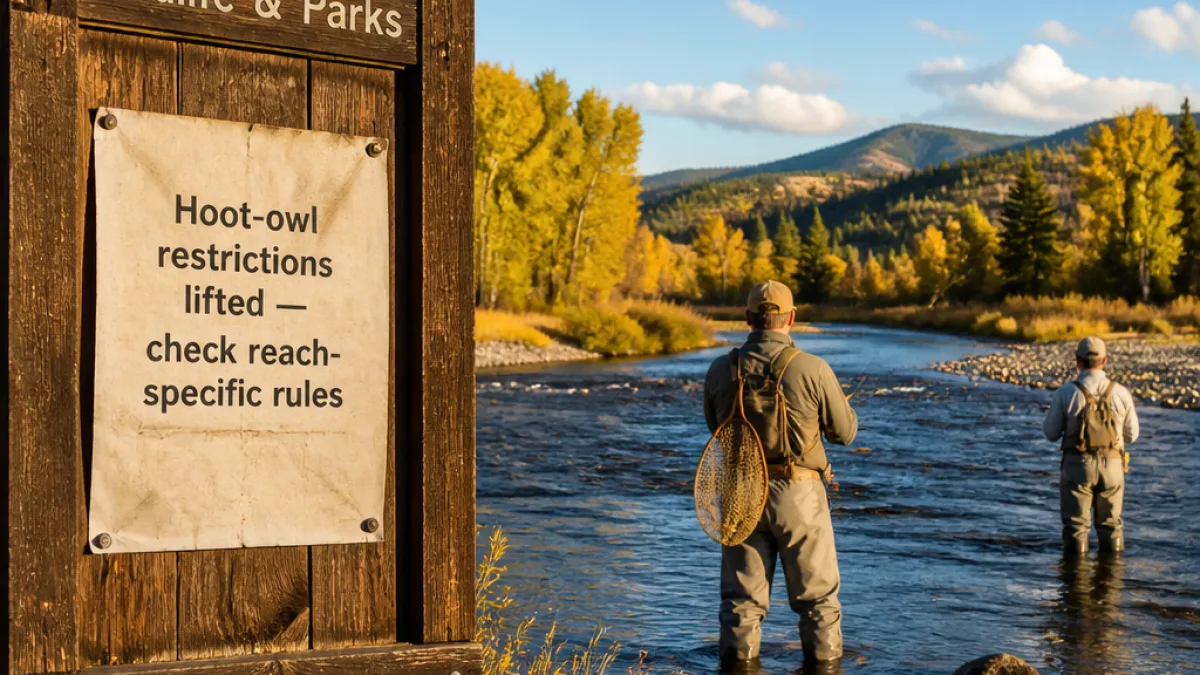
State wildlife managers announced Tuesday that falling water temperatures have allowed the immediate withdrawal of several afternoon fishing curbs, known as hoot-owl restrictions, across parts of western and southwest Montana. The move reopens many streams to angling during the hot-hours window that had been closed to protect stressed trout and other cold-water species.
The following was sent out by Montana Fish, Wildlife and Parks:
What was lifted and where
Montana Fish, Wildlife & Parks (FWP) specified several reaches where the hoot-owl limits are no longer in effect. Anglers should note that some drought-related closures and other seasonal restrictions remain in force on certain stretches.
| Region | Stream reach where hoot-owl lifted |
|---|---|
| Region 2 | Upper Clark Fork River from Warm Springs/Silver Bow creek confluence to the Blackfoot River; Lower Bitterroot River from Veteran’s Bridge in Hamilton to its confluence with the Clark Fork; Silver Bow Creek from Montana Street/Blacktail Creek confluence to Warm Springs Creek at Gas City Road Bridge |
| Region 3 | Big Hole River from the North Fork confluence downstream to Tony Schoonen Fishing Access Site (Notch) |
| Other | East Gallatin River, Shields River from the bridge upstream of Wilsall between Jordan Bench and Pinkerton roads to Brackett Creek Road (hoot-owl remains downstream to the Yellowstone) |
Why hoot-owl restrictions matter
Hoot-owl restrictions are short-term, temperature-driven limits that prevent fishing during the afternoon and evening — typically from 2 p.m. to midnight — when warm water can raise stress and mortality risk for trout and other cold-water fish. The goal is to reduce additional pressure from catch-and-release or harvested fish when temperatures are elevated.
- Timing: Hoot-owl limits normally close fishing during the warmest portion of the day.
- Scope: Restrictions are imposed on individual river reaches based on local monitoring of water temperature and fish condition.
- Other closures: Full-day or drought-related closures may remain even where hoot-owl limits are lifted.
What anglers should do now
Recreational fishermen should check the FWP website or local district offices for the latest, reach-specific rules before heading out. Even with hoot-owl curbs withdrawn on the stretches listed, other limits — such as seasonal or drought closures — still apply in some locations. For example, the Big Hole River has drought-related closures upstream of the North Fork and downstream of Tony Schoonen that remain in place.
Observers and anglers are asked to report stressed fish or any unusual conditions to FWP staff. Continued vigilance helps managers decide whether restrictions should be reimposed if temperatures climb again.
Local context and the season ahead
After weeks of high temperatures and low flows in parts of Montana, cooler conditions in recent days have eased thermal stress in several streams. That respite allowed officials to reopen afternoon and evening angling on the listed reaches. However, water temperatures remain variable across the state, and other rivers — particularly smaller, low-elevation tributaries — may still be vulnerable to warming.
Anglers seeking to minimize fish stress can follow best practices: avoid handling fish when water is warm, use barbless hooks for faster release, limit the time fish are out of the water, and fish during cooler morning hours when possible. These precautions complement regulatory actions and help protect trout populations for anglers and ecosystems alike.
FWP will continue to monitor water temperatures and fish condition and may reinstate hoot-owl restrictions or other closures if conditions deteriorate. For the most current information, consult Montana Fish, Wildlife & Parks’ online notices or contact regional offices.
This advisory affects communities and recreation businesses that depend on summer angling, from outfitters to local guides, and is an example of how short-term environmental changes can prompt rapid regulatory adjustments aimed at conservation and sustainable recreation.
— State correspondent