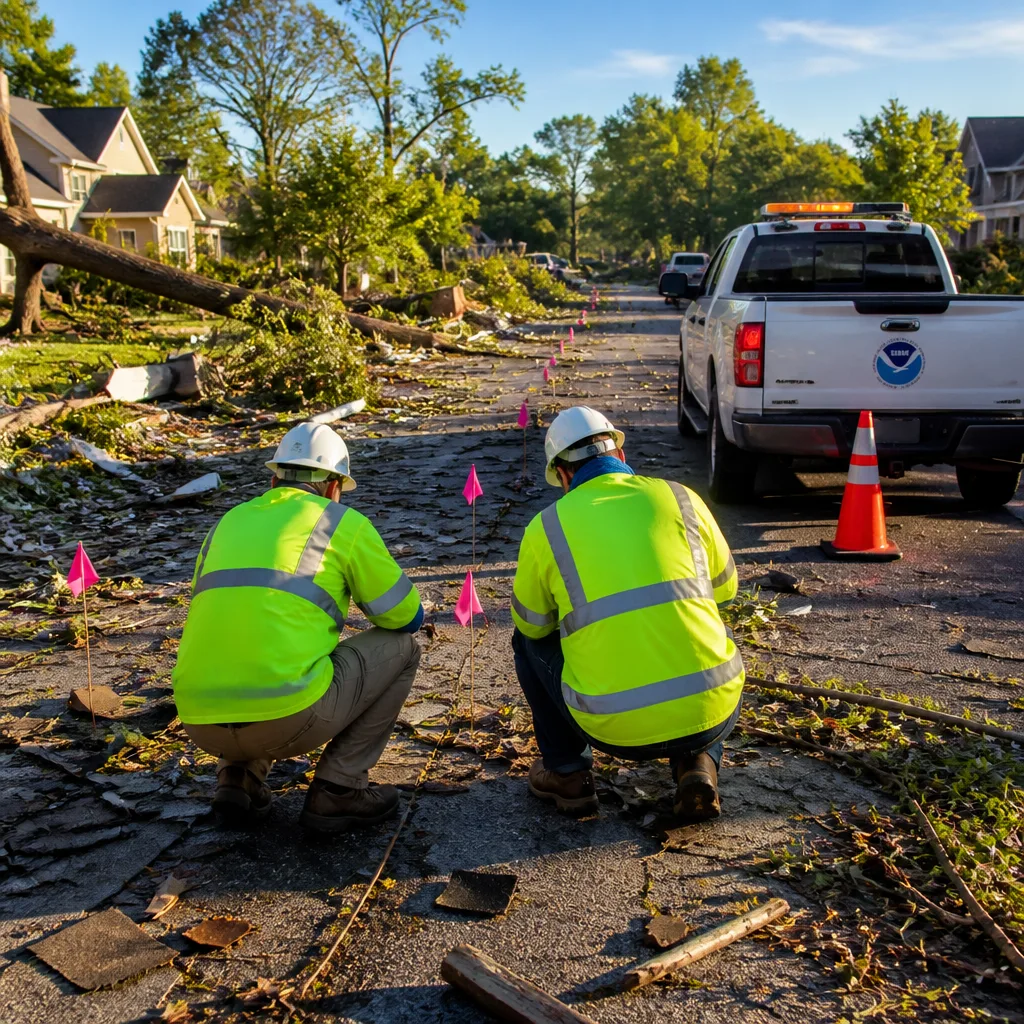
The National Weather Service dispatched survey teams after tornado warnings were issued in parts of Southwest Ohio on Sept. 20 to determine whether rotating tornadoes had actually struck communities including Middletown, Franklin, Monroe, Lebanon and Carlisle.
Local officials and residents often hear sirens and see destructive winds, fallen trees and damaged buildings in the immediate aftermath of storms. But the weather service emphasizes that "it’s not a tornado until the NWS can confirm it" — a confirmation that relies on in-person inspections of how the wind interacted with structures and vegetation.
Surveying the scene: pattern over intensity
When a storm is reported, teams from the nearest NWS office travel to affected areas to examine damage. Investigators focus on the pattern of damage rather than the amount of destruction. That pattern reveals whether winds were a violently rotating column — the hallmark of a tornado — or a strong downdraft from a thunderstorm known as a microburst.
Tornado damage typically appears chaotic. Surveyors look for evidence such as trees uprooted and tossed in multiple directions, large trees that cross over one another, and localized areas of concentrated devastation that indicate rotation.
By contrast, damage from a microburst tends to show a more uniform signature: debris and trees flattened in the same direction or fanned out from a central point, reflecting a downward rush of air that spreads outward on contact with the ground.
"It's not a tornado until the NWS can confirm it,"
Why the distinction matters
Distinguishing between a tornado and a microburst is important for public records, warning verification and scientific study. Both phenomena can produce severe impacts — including wind speeds that reach or exceed those of some low-end tornadoes — but they differ in their formation, behavior and how future warnings are evaluated.
Microbursts are defined by the NWS as localized columns of sinking air within a thunderstorm. Wind speeds in microbursts can reach up to 100 mph or higher, which the service notes is comparable to an EF1 tornado in terms of potential damage. Such winds are capable of causing major structural damage and leveling large numbers of trees.
- Survey teams prioritize the direction and arrangement of fallen trees and debris.
- Rotational signatures — debris thrown in multiple directions — point to tornadoes.
- Uniform, outward-flattened patterns point to microbursts or strong straight-line winds.
How tornadoes are classified
If investigators conclude a tornado occurred, they assign a rating using the Enhanced Fujita Scale, which relates observed damage to estimated wind speeds. The categories are:
| EF rating | Wind speed (mph) | Descriptor |
|---|---|---|
| EF0 | 65–85 | Weak |
| EF1 | 86–110 | Weak |
| EF2 | 111–135 | Strong |
| EF3 | 136–165 | Strong |
| EF4 | 166–200 | Violent |
| EF5 | Greater than 200 | Violent |
Investigators estimate wind speeds from the damage indicators and degree of damage to buildings, vegetation and other structures. That estimate anchors a final EF rating, which becomes part of the official weather record for the event and informs future risk assessments and building practices.
Public guidance after storms
While confirmation is a technical process carried out by specialists, the immediate public safety message remains simple: when severe thunderstorm or tornado warnings are issued, seek shelter promptly. The NWS and local broadcasters urge residents to move indoors and away from windows whenever thunder roars or tornado sirens sound.
Survey results from the Wilmington NWS office and others will be released as teams complete their assessments and compile findings on whether tornadoes occurred and, if so, how they are rated.