
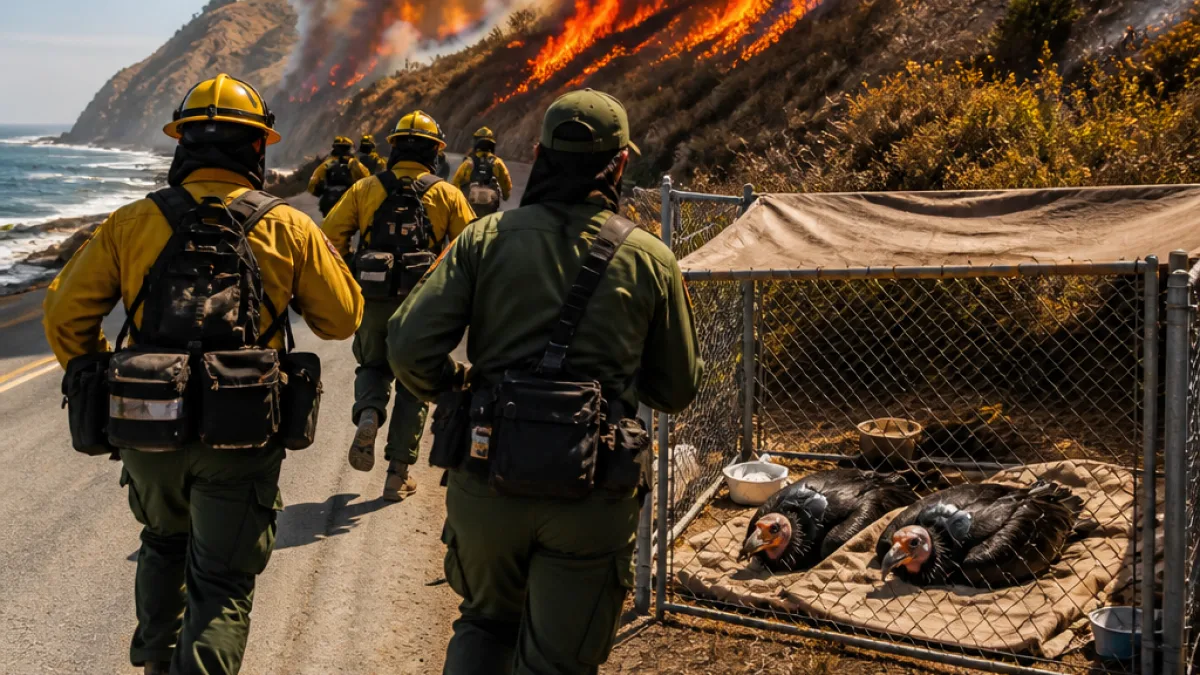
BIG SUR — As flames climbed the hillsides and columns of smoke turned the coastline sky gray, a Cal Fire battalion chief and staff from Ventana Wildlife Society pushed past a line of burning brush to reach two recovering California condors penned beside a road. The birds, part of a population numbering roughly 600 worldwide, were in the final stages of recovery from lead poisoning when the Timber Fire threatened their sanctuary.
High-stakes rescue under worsening wildfire conditions
Ventana staff arrived at the scene with the immediate priority of providing water and ensuring the birds' welfare as the fire advanced. Joe Burnett, a manager at Ventana Wildlife Society who has worked with the condors for years, described the scene as a familiar landscape transformed by the blaze.
"That was a really bad, scary thought to think that they were gonna basically burn alive,"
Burnett said he encountered flames more than 20 feet high alongside the road and burning debris on the cliffs above, creating a constant risk of falling embers and burning material. Despite those dangers, Battalion Chief Curtis Rhodes of Cal Fire evaluated conditions and proceeded with the rescue effort.
Why the condors were confined and why each bird matters
The two condors were housed in a pen as part of a recovery regimen after suffering from lead poisoning, a leading threat to the species. Ventana Wildlife Society had planned to release these birds back into the wild once they recovered sufficiently. With the fire encroaching, staff accelerated plans to provide immediate care and move them out of harm’s way.
The California condor population remains critically small, with roughly 600 birds left globally, making the survival of every individual important to maintaining genetic diversity and the broader recovery program.
Conditions faced by rescuers
Burnett recounted driving toward the sanctuary and finding a scene he compared to a different planet — scorched and transformed. Flames licked along the side of the truck, and fireballs flared on a cliff above roads rescuers were using. He credited Cal Fire with making calculated decisions to minimize risks to personnel during the operation.
- Flames exceeding 20 feet in height along the roadway
- Burning debris and flaring fireballs on an adjacent cliff
- Urgent need to provide water and remove the birds from a confined pen
Those conditions left little certainty that Ventana staff could reach the sanctuary. The pair of condors had nearly died months earlier from lead poisoning but had improved enough that release had been planned — until the wildfire changed the timetable.
What happened next and the role of local agencies
Cal Fire and Ventana personnel worked in tandem to reach the animals and, where possible, provide lifesaving care and relocation out of the immediate fire path. Officials have not released detailed medical updates on the condors' condition beyond noting their recent recovery from lead poisoning and the urgent need for water and shelter as the blaze moved through.
The rescue highlights the broader challenges firefighters and wildlife managers face during the state’s wildfire season: rapid shifts in fire behavior, threats to habitat and the need to coordinate human and animal safety simultaneously.
Broader implications for wildlife and wildfire response
Wildlife rehabilitators frequently must make quick decisions about whether to move recovering animals during wildfires, weighing risks of transport against the potential for animals to perish if left in place. For species with precarious populations, such as the California condor, those decisions carry extra weight.
| Item | Detail |
|---|---|
| Species population (approx.) | 600 worldwide |
| Threat to birds | Lead poisoning; immediate wildfire danger |
For residents and visitors, the episode serves as a reminder of how wildfires can imperil both human communities and critical wildlife recovery efforts. It also underscores the partnership between state fire agencies and conservation groups when confronting fast-moving disasters.
Officials have not provided a fuller public accounting of the condors' health status or long-term plans for the sanctuary following the Timber Fire. Ventana Wildlife Society and Cal Fire continue to respond to the fire and its aftermath as teams assess damage and work to protect remaining wildlife and habitat in the region.
As the landscape recovers from the flames, conservationists stress that habitat protection, lead exposure prevention and firefighting coordination remain essential to preserving small populations like the California condor.
Reporting for this article relied on firsthand descriptions provided by Ventana Wildlife Society staff and Cal Fire personnel involved in the rescue operation.















