
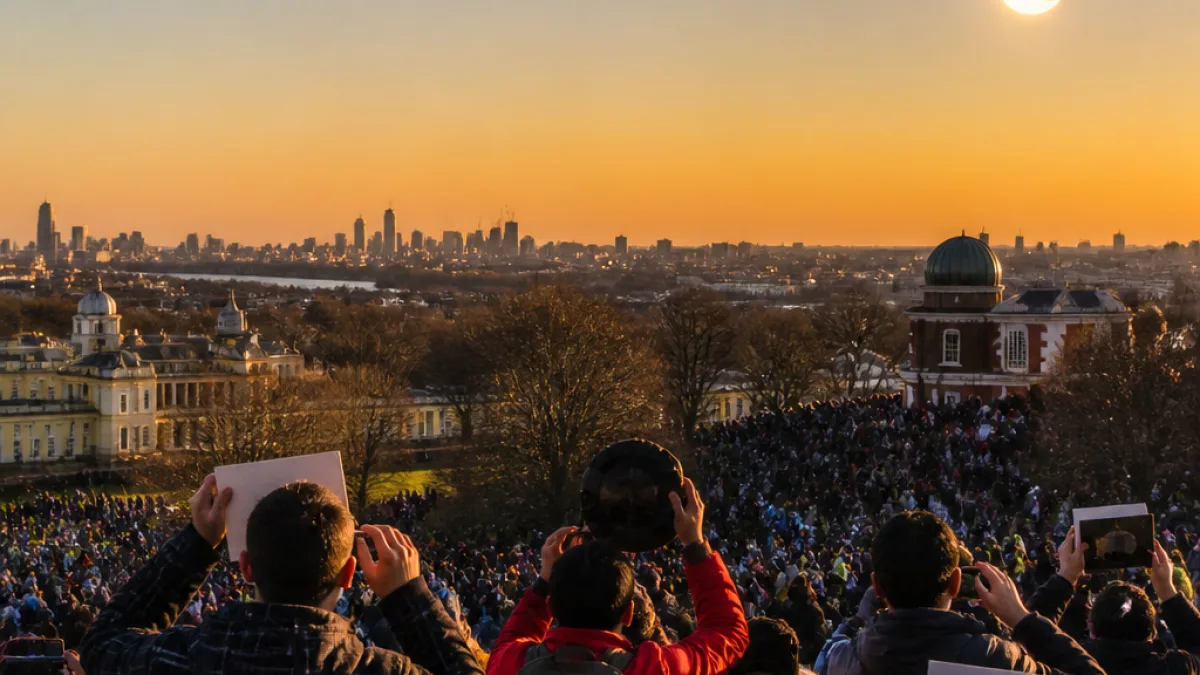
Thousands of Londoners paused their evening routines on Wednesday to watch the Moon glide across the Sun, creating a dramatic partial eclipse visible from across the capital. The phenomenon drew crowds to well‑known viewing spots such as Greenwich, Brockwell Park, King’s Stairs Gardens and Kew Green, where people assembled with cardboard viewers, kitchen implements and improvised pinhole boxes.
When the eclipse was visible in London
The partial eclipse began at 18:17 BST, reached its greatest coverage shortly after 19:00 BST and ended at 20:06 BST. At maximum, approximately 91% of the Sun’s surface was obscured as seen from London — the deepest partial eclipse visible from the capital since August 1999, according to the Royal Observatory Greenwich.
| Event | Time (BST) |
|---|---|
| Start of partial eclipse | 18:17 |
| Maximum coverage | Just after 19:00 |
| End of eclipse | 20:06 |
| Approximate peak coverage | 91% |
Where Londoners watched
Public spaces around the city became ad hoc viewing platforms. The hill at Greenwich filled with people looking west toward the skyline, while Brockwell Park hosted groups spread across its slopes. The river wall at King’s Stairs Gardens in Bermondsey provided a riverside vantage point, and Kew Green attracted families who converted cereal boxes into pinhole viewers.
- Greenwich — large crowds on the hill with a clear westward view.
- Brockwell Park — people spread across open slopes.
- King’s Stairs Gardens, Bermondsey — river-side viewing.
- Kew Green — improvised pinhole viewers from cereal boxes.
- Regent’s Park — inventive methods such as using a kitchen colander to project crescent shapes.
Practical viewing and public behaviour
Observers used a variety of methods to view the partial eclipse safely. Many relied on certified eclipse‑viewing glasses; others used simple projection techniques such as pinhole viewers made from cardboard or household objects. At Regent’s Park a spectator used a kitchen colander to cast dozens of small crescent projections onto a sheet of paper — a low‑tech demonstration of how the Sun’s remaining visible edge produced multiple crescent images.
Local parks teams and volunteers were present at several sites to manage crowds and encourage safe viewing. There were no reports of serious incidents in the capital connected to the event during the period covered by official timings.
Why this eclipse mattered in London
The Royal Observatory Greenwich described the event as the deepest partial eclipse visible from London since 1999. Partial eclipses do not obscure the Sun completely, but when coverage is as high as 91% the remaining crescent is highly striking, particularly as it sat low in the western sky during the early evening — a time when many people could join in after work.
For residents, the eclipse offered a communal spectacle and a reminder of the value of accessible science communication. Informal gatherings brought together families, amateur astronomers and casual passers‑by — many of whom improvised safe ways to view the Sun. The mix of formal equipment and household ingenuity underscored how public interest in astronomical events remains strong in the capital.
Looking ahead
While total solar eclipses are rare in the UK, partial events and other celestial happenings present regular opportunities for public engagement with astronomy. Local councils and astronomy groups typically issue guidance ahead of such events, advising on safe viewing practices and recommending certified filters or projection methods to avoid eye injury.
For Londoners who missed the event, many broadcasters and observatories publish recordings and explanations after the fact. Those interested in future celestial events should monitor announcements from the Royal Observatory Greenwich and local astronomy societies for planned public viewings and safety advice.
Across the capital on Wednesday evening, the eclipse became a shared moment: a scientific event experienced outdoors in neighbourhood parks and riverfronts, observed with both specialist gear and domestic creativity.









