
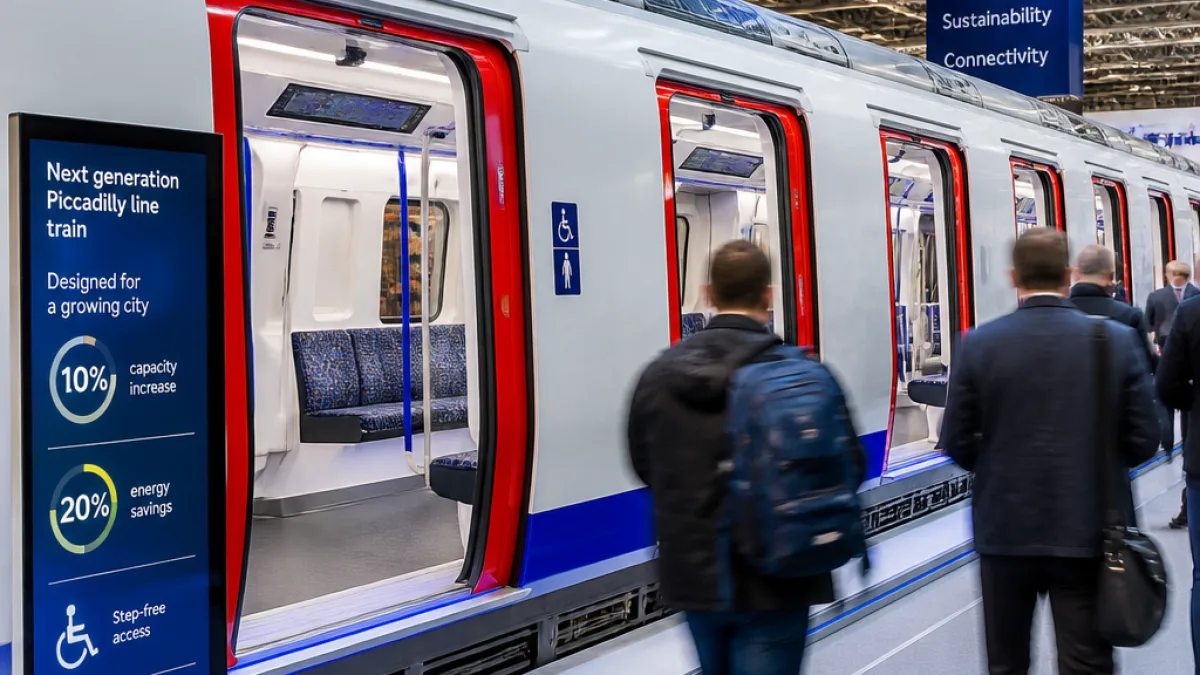
Transport for London has presented the new Piccadilly line trains at the InnoTrans exhibition in Berlin, saying the fleet will significantly improve journeys on one of the capital's busiest Tube routes.
What is changing on the Piccadilly line
The new trains have been developed in partnership with Siemens Mobility Ltd and include a suite of upgrades designed to modernise the line. Key features highlighted by Transport for London (TfL) include:
- Air‑conditioning across the fleet;
- Onboard CCTV for improved security;
- Walk‑through carriages to spread passengers more evenly;
- 10% increased capacity compared with the current trains;
- 20% reduction in energy consumption versus the existing fleet;
- Enhanced accessibility features.
TfL said the order will deliver 94 new trains to replace the current 86 sets operating on the Piccadilly line. Each new train will be approximately 113 metres long and consist of nine carriages.
Timetable and expected benefits
The new fleet is scheduled to enter passenger service between December 2026 and June 2027. TfL says the upgrade will make journeys faster and more reliable, while improving accessibility and safety.
| Specification | Detail |
|---|---|
| Number of new trains | 94 |
| Number of older trains replaced | 86 |
| Train length | 113 metres (nine carriages) |
| Capacity change | +10% |
| Energy consumption | -20% |
The Piccadilly line accounts for around 10% of all Tube journeys, serving central and west London and connecting the capital to Heathrow. For commuters and visitors alike, TfL argued the new trains will noticeably change the experience of travel on the route.
Voices from the industry
"Journeys will be more accessible, safer and faster, and the experience for our customers will be transformed,"
was the assessment from Andy Lord, London's Transport Commissioner. He added the new trains would form an early impression for many visitors to the city.
"I'm incredibly proud to see the new Piccadilly line train exhibited at InnoTrans,"
said Aglaja Schneider, joint chief executive of Siemens Mobility, describing the display as a milestone in the project's development.
Local impact and questions for delivery
At street level, reactions are likely to be mixed. Commuters weary of overcrowding will welcome the extra capacity and walk‑through interiors, while passengers who have long campaigned for air‑conditioning on deep Tube lines will see this as a long‑awaited improvement. However, rolling a wholly new fleet into service across one of the network's busiest lines will present operational challenges.
Key practical questions remain for Londoners: how TfL will phase the introduction without major disruption, what depot upgrades will be needed to maintain the longer nine‑carriage trains, and whether timetables will be adjusted to exploit the promised gains in reliability.
What to expect next
TfL and Siemens will need to navigate testing, staff training and infrastructure works before passengers see the trains in regular service. The display at InnoTrans signals that vehicle manufacture and design have reached an advanced stage, but the next months will determine how quickly Londoners can benefit from the improvements.
For regular users of the Piccadilly line, the promise is clear: a modernised fleet with more space, better environmental performance and features designed to make travel easier. The delivery between December 2026 and June 2027 will be watched closely by passengers and by elected leaders who oversee the capital's transport network.
Reporting from London, this newsroom will continue to follow developments and publish details on service changes and rollout plans as TfL makes them available.
















