
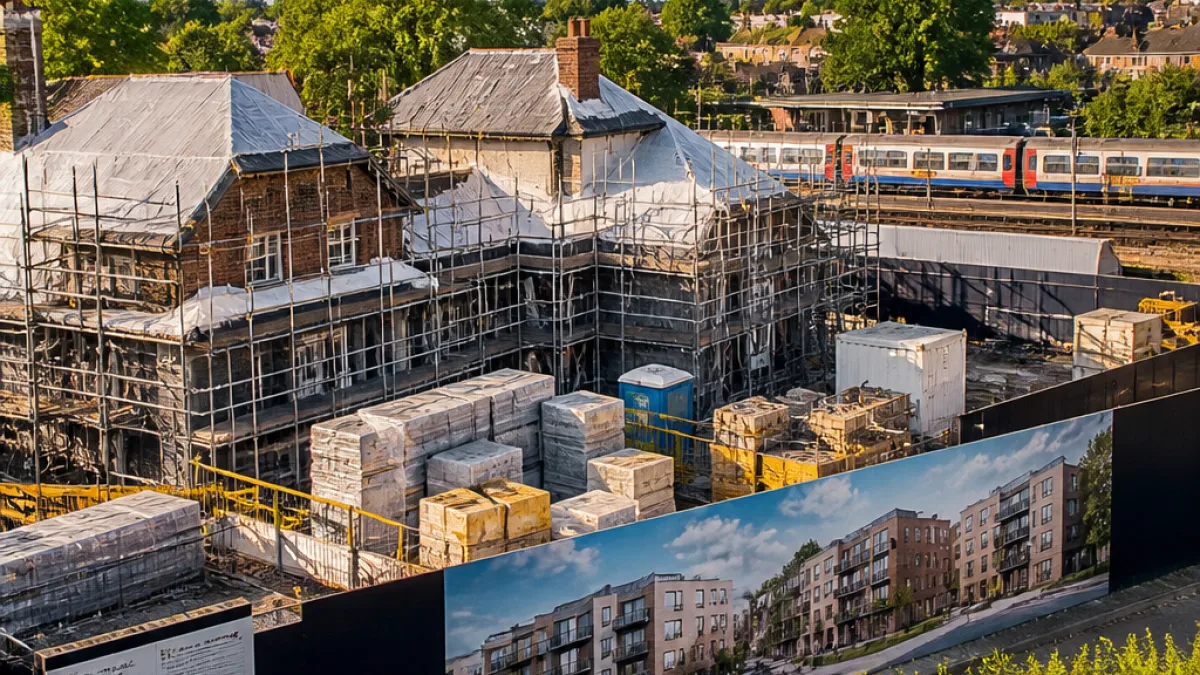
The council in Hillingdon has approved a scheme to build 96 homes around a late 16th/early 17th-century farmstead in west London, despite the developer saying it is not financially viable to provide any on-site affordable housing.
The site contains three Grade II listed structures — Sherley’s Farmhouse, the Leaning Barn and the Oak Room — and planning documents show the largest new block will be four storeys and sit to the rear of Ruislip station. The developer’s proposal includes a mix of houses and flats: 15 houses, 26 one-bedroom homes, 30 two-bedroom homes, 14 three-bedroom homes and one four-bedroom house, a total of 96 units.
Heritage retained but altered
The scheme would convert Sherley’s Farmhouse into a four-bedroom family house, while the Leaning Barn and Oak Room are to be stripped of later 20th century extensions and converted into two residential units. Historic England backed the plans, welcoming the removal of intrusive extensions and arguing that the benefits of securing restoration and reuse outweigh the harm caused by increased density around the historic farmstead.
Planning officers judged that building around the farmstead causes “less than substantial harm” by changing its former spacious, rural setting, but concluded that the public benefit of securing long-term restoration authorised the proposal.
Affordable housing dispute
Hillingdon Council’s Local Plan sets a minimum on-site affordable housing requirement of 35%. For this development that would equate to roughly 24 or 25 homes. The developer has told the council it cannot provide affordable units while maintaining financial viability, and council assessments reportedly found the scheme would run at a financial deficit.
To prevent the developer from completing and selling new market-rate blocks before work on the listed buildings is finished, the council has secured a legal agreement requiring full restoration of the listed sections prior to completion of blocks A to C.
What the scheme contains
- Total homes: 96
- Houses: 15 (including one four-bedroom house)
- Flats: mix of one-, two- and three-bedroom units, with the largest block providing 31 flats
- Heritage assets: Sherley’s Farmhouse, the Leaning Barn, the Oak Room
- Objections received: 215 during the planning process
| Unit type | Number |
|---|---|
| One-bedroom | 26 |
| Two-bedroom | 30 |
| Three-bedroom | 14 |
| Four-bedroom | 1 (house) |
| Houses (total) | 15 |
Local reaction and safeguards
During the planning process the council received 215 objections. Concerns commonly raised in cases of this type include the impact on heritage, increased density, local infrastructure and the loss of affordable homes. The council say they have included a review mechanism: if the scheme’s financial performance improves while development proceeds, a legally binding agreement will require a reassessment of affordable housing provision.
Officials have sought to strike a balance between protecting listed assets and delivering housing, but critics will point to the tension between conserving heritage and meeting the borough’s affordable housing targets. Residents I spoke to near the site expressed frustration that new development can proceed without guaranteed affordable homes on site.
One neighbour said the farmstead was a visible reminder of the area’s history and that any redevelopment should prioritise public benefit. Another resident questioned whether an uplift clause in the legal agreement will be robust enough to secure affordable units if market conditions change.
What happens next
With planning approval secured, the developer can proceed subject to the legal undertaking requiring completion of restoration works to the listed buildings before certain new blocks are finalised. The council’s independent financial assessments will remain central to any future argument over whether the scheme can provide affordable housing without compromising viability.
The case underlines a recurring dilemma for London boroughs: how to reconcile national and local heritage protections with pressing housing needs and affordable housing targets. For people living near the farmstead, the practical questions are immediate — how construction will be managed, what protections will be applied to the historic fabric, and whether the promise of reassessing affordable housing will ever translate into homes people on modest incomes can afford.
















