
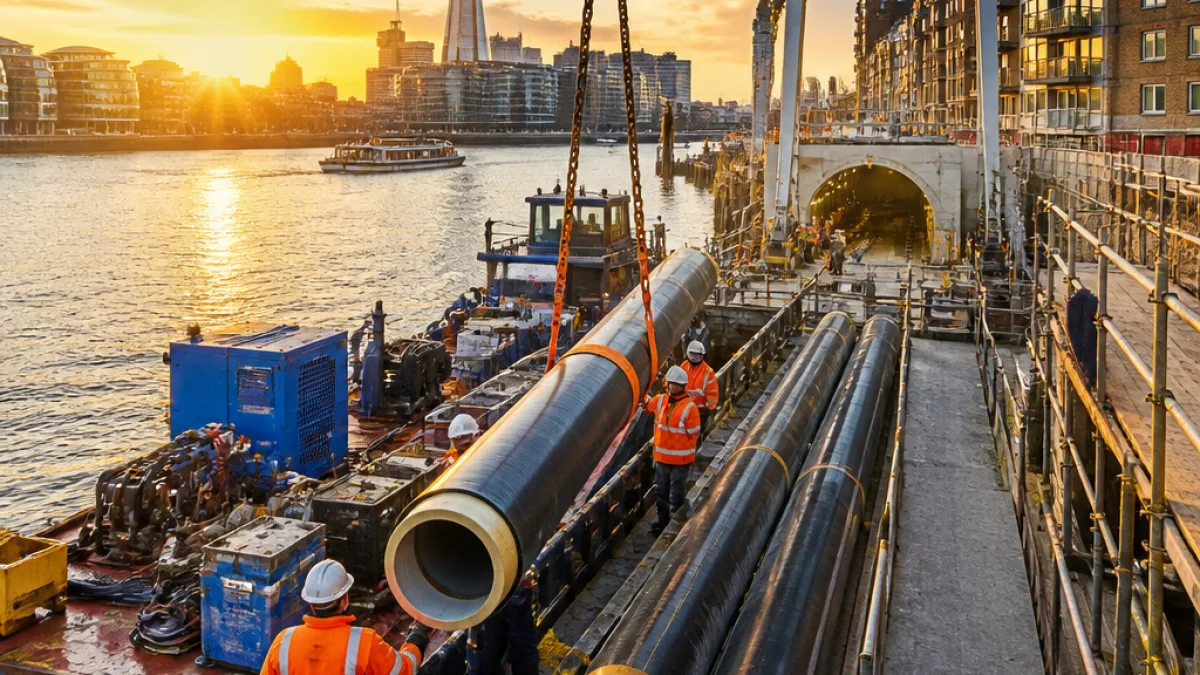
The government has awarded a £41 million grant towards the development of a major heat network running beneath and alongside the River Thames that officials say could eventually warm around 650,000 homes across the capital.
What the project is and where it would run
The scheme, called the London Strategic Heat Main, proposes to capture surplus heat from industrial sources such as data centres and factories, and move it around the city via an interconnected system of hot-water pipes. The initial phase of the scheme would link seven boroughs, stretching from Bexley in the south-east through Greenwich, Lewisham, Southwark, the City of London, Lambeth and Westminster.
Project planners envisage later extensions into parts of east and west London, including Barking and Dagenham, Tower Hamlets, and Kensington and Chelsea. Ultimately a specially constructed tunnel running beside and beneath the Thames would carry hot water to supply homes and businesses along its route.
Interim delivery and wider ambitions
While the tunnel is being constructed, the plan is to move hot water using barges along the river. Officials estimate that barges could transport around 15.5 miles (25km) of heated water every day, delivering warmth to connected networks until the permanent tunnel is complete.
Ministers say the scheme could unlock roughly £5 billion of additional investment into London’s heat networks and support jobs in tunnelling, engineering and river logistics.
- Initial government contribution: £41 million for the London Strategic Heat Main
- Additional London heat network funding: part of a wider £90 million package
- Potential reach: up to 650,000 homes when fully built
- Short-term logistics: electric barges to move hot water along the Thames
Other funded schemes and local effects
The funding announcement also included separate awards for smaller networks around the capital. One development in Bexley and Greenwich secured £11.5 million and is projected to serve up to 100,000 homes when complete. Another grant — worth around £11.4 million — was allocated to a scheme near Marble Arch that will use water-source heat.
| Scheme | Funding | Estimated homes served |
|---|---|---|
| London Strategic Heat Main | £41m | Up to 650,000 |
| Bexley & Greenwich network | £11.5m | Up to 100,000 |
| Marble Arch water-source system | £11.4m | Not specified |
Climate and cost implications
Heating buildings accounts for about a fifth of the UK’s greenhouse gas emissions, according to government figures, and London’s housing stock includes many buildings heated by gas boilers. Supporters of heat networks say they can reduce both emissions and household bills by centralising heat generation and making use of waste heat that would otherwise be lost.
Officials also argue that a London-wide strategic heat route could lower the cost of connecting new development sites and social housing projects to low-carbon heating – a common barrier to wider rollout of heat networks.
Jobs, urban design and river use
Backers of the scheme highlight potential employment benefits in construction and long-term operations, particularly skills in tunnelling and river transport. The plan suggests pontoons used to store hot water could be developed into public amenities described in planning material as speculative "Thames Floating Gardens" — new river-edge green spaces modelled on historic embankments.
However, the project remains at the development stage and will need planning consent and detailed environmental assessments before major works can begin. Questions for residents and councillors will include the impact of river-borne barges on river traffic, implications for riverside ecosystems, costs and disruption during construction, and how benefits will be shared between private investors and local communities.
For Londoners wanting to follow progress, the scheme’s promoters are expected to publish planning documents and environmental statements in time for public consultation. Borough councils along the route will also consider the proposals in their planning processes.
The funding is the latest push by ministers to scale up heat networks in the capital and across the UK, aiming to combine climate goals with infrastructure investment and urban regeneration.
















