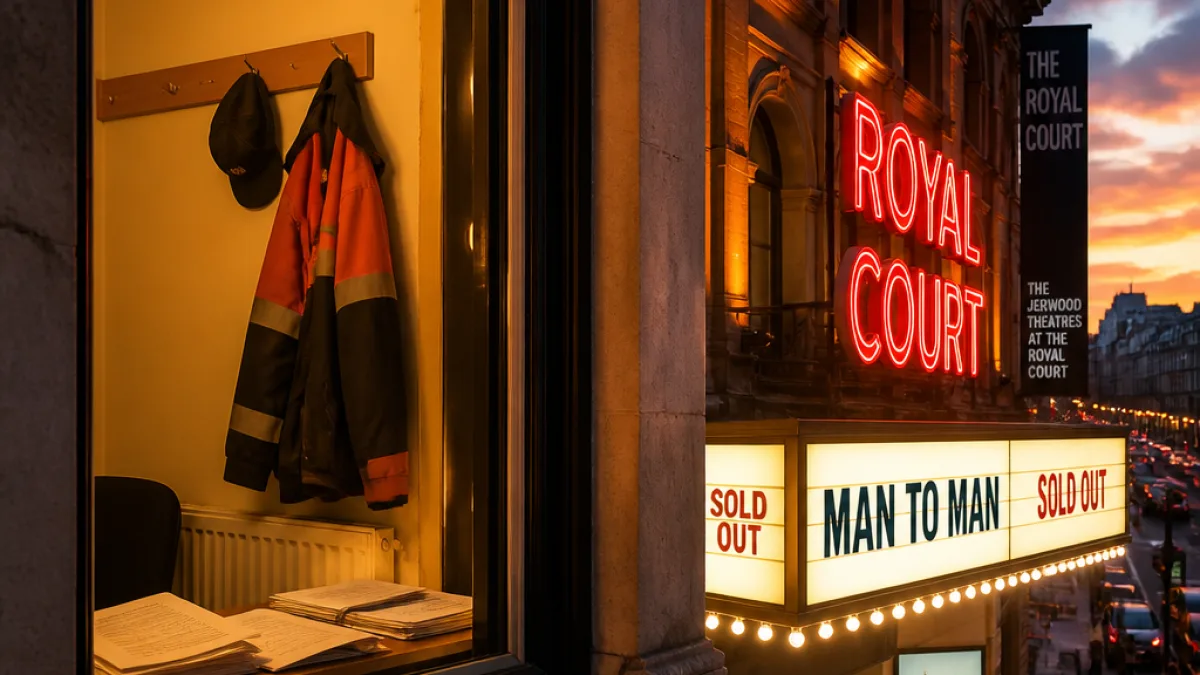
Tilda Swinton has resumed a role she first inhabited nearly four decades ago in a new production of Man to Man at the Royal Court, a staging that has reportedly sold out and been lightly revised to speak to the present political moment. The play, written by Manfred Karge and translated by Anthony Vivis, is directed by Stephen Unwin and remains a single‑hander examining identity, gender and working‑class hardship.
What the play does
The piece follows the life of Ella Gericke in 1930s Germany, who, after her husband Max dies of cancer, adopts his identity in order to keep his job operating a crane. What begins as a pragmatic disguise to avoid destitution becomes a long‑term concealment of self. The work is told across episodic scenes that range from coarse humour and doggerel to verse and naturalistic slang, mapping one life through the convulsions of 20th‑century German history.
The production has been adjusted to include a new scene that responds to what the creative team describe as a recent resurgence of the far right in German politics. That addition reinforces the play’s interrogation of how political movements intersect with everyday survival and the policing of identity.
Style and impact
Anchored in elements of Brechtian dramaturgy, the staging favours intellectual provocation over sentimental catharsis. The narrative voice shifts between coarse, working‑class banter and more lyrical moments, creating a tonal mixture that keeps the audience at a critical distance rather than drawing them into straightforward emotional release.
Moments of stark humanity punctuate the tougher material. In one scene, Max gives Ella’s identity card to a Jewish bartender to aid her escape — a brief, notable act of compassion within the wider milieu of rising intolerance. At other points, the protagonist attempts to navigate new dangers by aligning with changing power structures: becoming an SA guard, evading scrutiny from suspicious pub‑goers, and surviving the ideological pressures that sweep through society.
“I am my own widow”.
That line, delivered amid the staging’s more theatrical flourishes, crystallises the play’s constant negotiation between past and present selves.
Credits and practical information
Theatre‑goers will note the production credits as follows:
- Writer: Manfred Karge
- Translator: Anthony Vivis
- Director: Stephen Unwin
- Lead performer: Tilda Swinton
- Venue: Royal Court Theatre, London (reported sold out)
| Element | Detail |
|---|---|
| Form | Single‑hander, episodic scenes |
| Language | Mix of verse, prose and slang |
| Themes | Identity, gender fluidity, class survival, authoritarianism |
Local context and relevance
At a moment when questions of identity and the resurgence of hard‑right movements have returned to public conversation across Europe, the Royal Court’s revised staging seeks to foreground how historical forces bear down on individual lives. The theatre’s decision to insert a new scene addressing contemporary political shifts underlines a wider trend in London stages to reframe mid‑century works for 21st‑century audiences.
For London audiences, the play offers both a distillation of European history and a prompt to consider the parallels with present‑day developments. The Royal Court has a reputation for staging politically engaged drama; this production fits that pattern by asking audiences to track both the practical choices that sustain life and the ideological pressures that can render those choices perilous.
What to expect if you go
The play’s tone will not be what some expect of a conventional character study. Audiences should be prepared for a work that interrogates as much as it depicts, where moments of blunt humour sit alongside unsettling episodes of social cruelty. The mix of styles — from doggerel to solemn lyric — means the piece rewards attentive viewing rather than passive consumption.
Given the reported sell‑out status, those wanting to see the production should check the Royal Court’s box office for possible returns, standby allocations or future dates. The staging is positioned as a conversation starter rather than a comfort piece, arriving in London with a pedigree and a renewed urgency.
From outside the theatre, the iconic red of the Royal Court’s façade feels apt: a space that has long hosted theatre that asks difficult questions of both history and the present.