
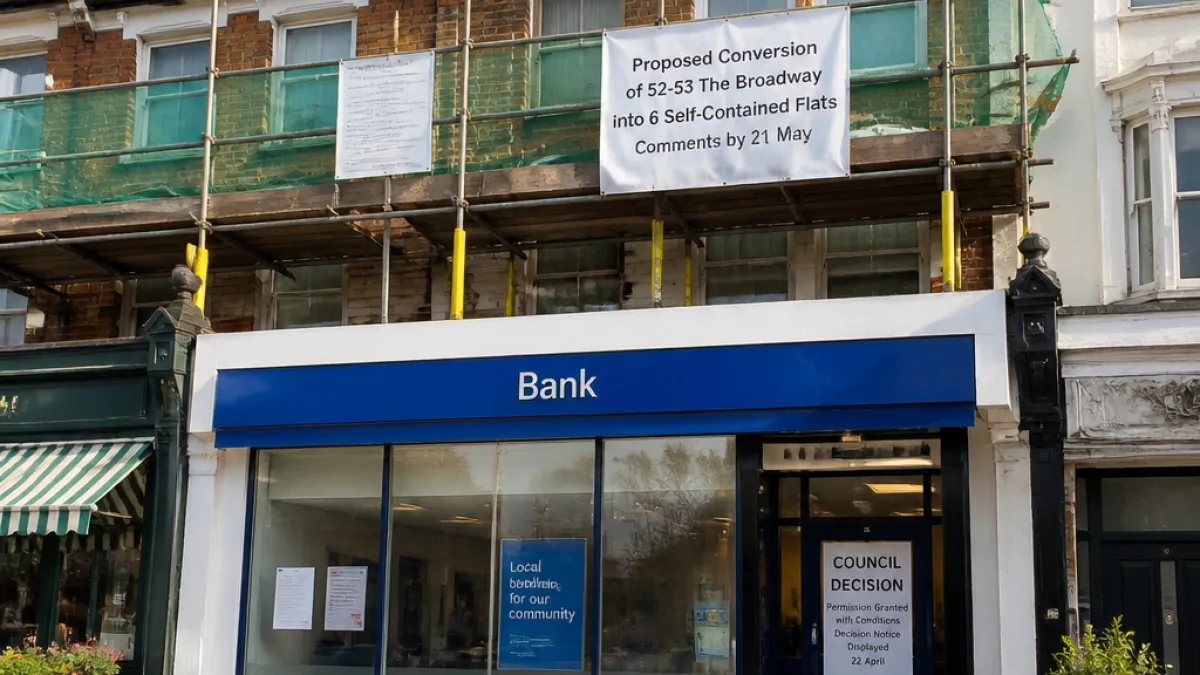
Developers have secured planning approval to convert a first-floor office above a Barclays branch at 52–53 The Broadway, Ealing Broadway, into six flats after a legal dispute stretching back a decade.
Background to the dispute
The application — originally refused by Ealing Council in November 2016 — was rejected at the time because the council considered the first-floor space to be a community and medical use rather than offices. That classification made the unit ineligible for conversion to housing under the rules then applied.
The developer’s planning team countered by assembling evidence that Barclays had occupied the first-floor offices alongside its ground-floor retail branch on a continuous basis. Documents submitted to the council demonstrated uninterrupted lawful commercial office (Class E) use since at least 2007, a period long enough to meet more recent permitted development criteria.
How the rules changed the outcome
Changes to permitted development rights introduced in 2021 allow conversions from commercial to residential where the building has been in lawful commercial use for at least two years. Because the site could be shown to have met that test for nearly two decades, the council accepted the new evidence and the earlier 2016 objection was judged no longer applicable.
What is proposed
Prior approval was granted on 5 August, allowing the first-floor space to be remodelled into:
- four studio flats
- one one-bedroom flat
- one two-bedroom flat
The permission specifies a car-free development, with provision instead for ten secure bicycle parking spaces. The Barclays branch on the ground floor will continue to operate unchanged.
Local impact and reaction
Residents and commuters in Ealing Broadway are likely to see a modest increase in nearby housing stock, with the conversion focused on smaller units. A car-free approach reflects local transport policies and the town centre location close to Ealing Broadway station.
On the high street this week, shopkeepers said they had noticed ongoing churn in upper-floor uses over the last decade. One trader commented that bringing vacant or underused office space into residential use could help footfall outside core retail hours, while others warned about pressure on local services.
Precedent for other conversions
Planning teams elsewhere will watch this case closely because it underlines how the historical use of a building can determine eligibility for conversion under permitted development rights. Where ownership or uses on neighbouring properties gave councils cause to treat units as community or medical space, applicants may now seek to separate their site legally from adjoining permissions to meet the commercial-use test.
| Address | 52–53 The Broadway, Ealing Broadway |
|---|---|
| Approved units | 4 studios, 1 one-bed, 1 two-bed |
| Approval date | 5 August |
| Car parking | None (car-free) |
| Bicycle spaces | 10 secure spaces |
What this means for prospective buyers and neighbours
For local people seeking small, central flats, the scheme will add a handful of units in a well-connected area. Potential buyers or renters should note that the development is explicitly car-free; those who drive will therefore not have on-site parking and will need to rely on public transport or nearby controlled parking zones.
Neighbours concerned about noise, building works and construction traffic should look to Ealing Council’s planning portal for the approved prior approval documents and any conditions attached to the consent. The ground-floor banking operation will remain in place, limiting disruption to the high street retail frontage.
This decision illustrates how long-running planning positions can be overturned when new evidence and national policy changes are brought to bear. For Ealing’s town centre, it is a relatively small but locally significant example of how office-to-residential conversions continue to reshape parts of west London.















