
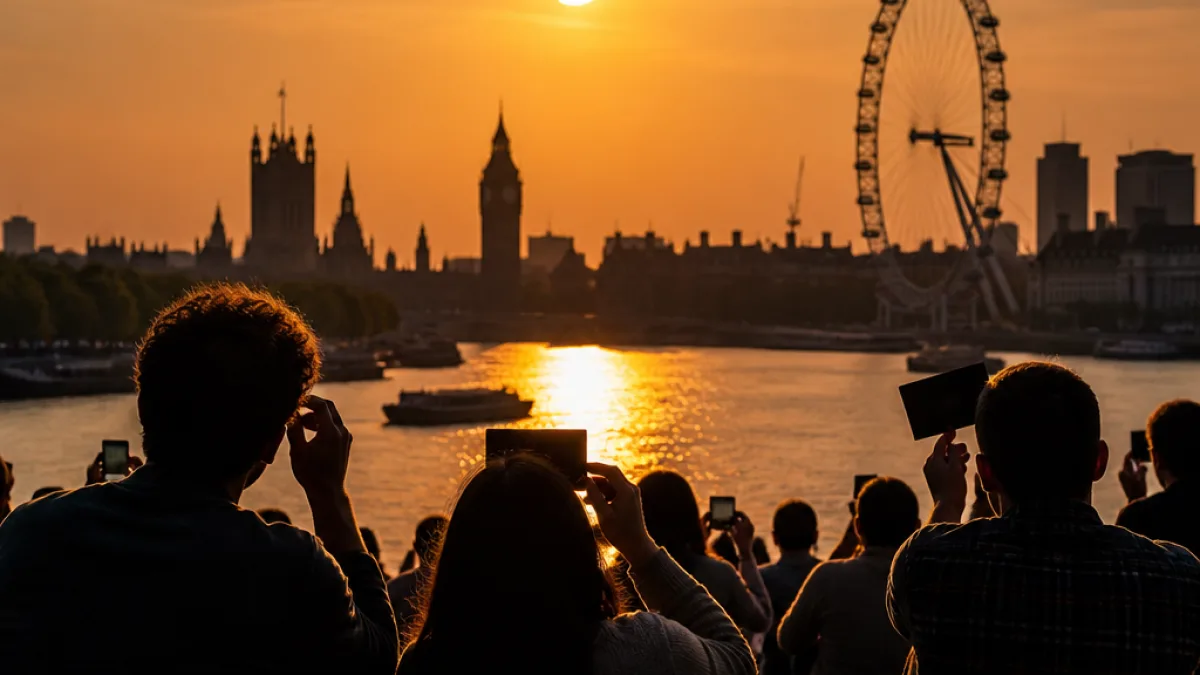
London is set to witness one of the deepest partial solar eclipses in decades this evening, with up to 96% of the Sun expected to be obscured at peak in parts of the country. For many in the capital who miss tonight’s spectacle or want to plan ahead, clear dates for the next eclipses visible from the UK have now been outlined.
What Londoners need to know now
The partial eclipse begins in the early evening and reaches its greatest coverage shortly afterwards. Eye-care specialists have emphasised that nobody should look directly at the Sun without certified solar-viewing equipment, because unprotected viewing can cause severe and potentially irreversible harm to eyesight.
Local residents planning to attend watch parties in parks or on hilltops should ensure they have approved filters or eclipse glasses and avoid improvised protection such as untested sunglasses or smoked glass.
When the next eclipses will be visible from the UK
Officials have indicated a series of partial events will follow the 2026 eclipse. The schedule affecting the UK is as follows:
- 2 August 2027 – a partial eclipse visible during the morning, with roughly 30% to 45% of the Sun obscured. In London the partial eclipse is expected to start at about 9:00am, peak near 10:00am and finish around 11:00am.
- 26 January 2028 – a small partial eclipse will be visible from the UK (no detailed timing provided).
- 3 September 2081 – a far more dramatic partial eclipse is forecast, with approximately 99% of the Sun predicted to be covered.
| Date | Type | Expected coverage | London timing (where provided) |
|---|---|---|---|
| 12 August 2026 | Partial | Up to 96% (in parts of the UK) | Begins 18:17; peak c. 19:02–19:16 |
| 2 August 2027 | Partial | 30–45% | Starts ~09:00; max ~10:00; ends ~11:00 |
| 26 January 2028 | Partial | Small partial | Not specified |
| 3 September 2081 | Partial | ~99% | Not specified |
Why the wait for a total eclipse?
Total solar eclipses are rare for any given location because the Moon’s shadow traces a narrow path across Earth. While partial events are relatively frequent, a total eclipse visible from the UK is much less common, so tonight’s deep partial event is a significant opportunity for many who will not be in the narrow track of a future totality.
Practical advice for would-be viewers
- Only use certified solar filters or eclipse glasses that meet international safety standards.
- Do not use ordinary sunglasses, smoked glass, CDs, or camera filters that are not rated for direct solar viewing.
- Supervise children closely and ensure any viewing devices are used correctly.
- If using binoculars or telescopes, fit an appropriate solar filter over the front of the instrument — never look through optics that are not protected.
Residents I spoke to across south-east London said they planned to travel to high points and open spaces to watch the sky darken. One neighbour, preparing with eclipse glasses and a picnic, said it would be an opportunity to show children a rare natural event safely.
Local authorities and observatories have been sharing guidance throughout the day to help people enjoy the spectacle without risking their vision. Parks that offer clear western horizons and elevated vantage points will be popular; those who want to avoid crowds should consider quieter green spaces where views of the sunset are unobstructed.
For those unable to view directly, many astronomical organisations will provide live streams and commentary so the event can be followed online with expert explanation.
Tonight’s partial eclipse is a reminder of both the grandeur of celestial mechanics and the need for caution. Plan ahead, use proper protection and, if you miss it, mark your calendar for the partial eclipses in 2027 and 2028 — and the particularly deep event forecast for 2081.









