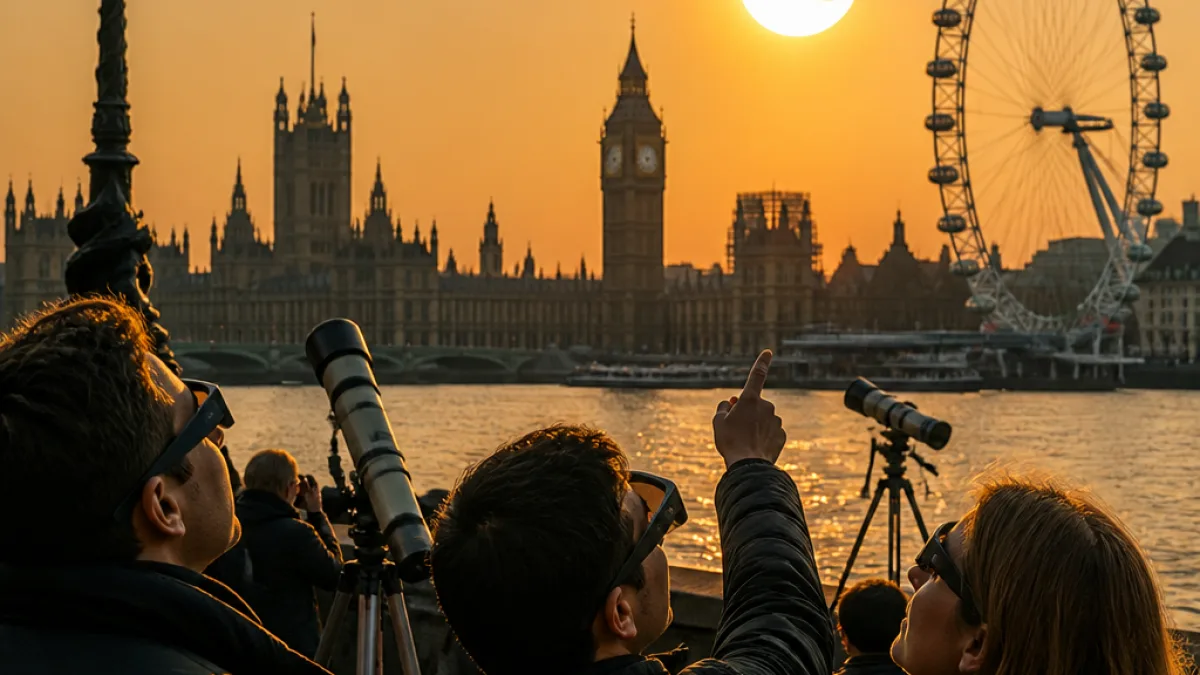
Londoners are being urged to prepare for a striking celestial show this evening as the Moon moves between the Earth and the Sun, producing the most complete solar eclipse visible from the capital for more than a quarter of a century.
What to expect in the capital
Observers in London should expect a partial eclipse in which the Moon will cover almost the entirety of the Sun’s disc as seen from the city — officials estimate roughly 90% of the Sun will be obscured. The event will be substantial enough to noticeably dim daylight for a short period, though only those in a narrow path across northern latitudes will experience totality.
In Britain the last total solar eclipse that was visible from the UK occurred in 1999, and forecasters note there will not be a better eclipse for viewers in the UK until 2090. That rarity has prompted interest from astronomy societies, schools and members of the public.
Timings across the UK — when to look up
Those planning to watch from London should note the key moments this evening:
- Start (London): 6.17pm — the Moon begins to pass across the Sun for London viewers.
- Midpoint/Greatest Coverage (London): 7.13pm — the Sun will be at peak obscuration.
- End (London): 8.06pm — the partial eclipse concludes.
Other regional start times given by forecasters include 6.13pm for Manchester and Liverpool and around 6.08pm for locations in Scotland. In some remote parts of the North Atlantic and Greenland the eclipse will be total.
| Location | Start | Peak | End |
|---|---|---|---|
| London | 18:17 | 19:13 | 20:06 |
| Manchester / Liverpool | 18:13 | — | — |
| Scotland (general) | 18:08 | — | — |
Where to watch in London
Clear, elevated views of the western to north-western horizon will offer the best sightlines as the Sun lowers in the sky. Popular open spaces with wide horizons include public parks and riverfronts, but viewers are advised to avoid busy carriageways and enclosed streets where sightlines are restricted.
Many astronomy groups and observatories will be staging public viewings and explanatory events; check local society websites or council listings for confirmed gatherings and any organised telescope viewing sessions.
Safety — essential guidance
Looking directly at the Sun without appropriate protection can cause permanent eye damage. The following precautions should be observed:
- Use only certified solar viewing glasses (ISO 12312-2 compliant) or solar filters fitted to optical equipment.
- Do not use improvised filters such as sunglasses, smoked glass or exposed film — they do not provide sufficient protection.
- When viewing through binoculars or a camera, always use a properly rated solar filter attached to the front of the device; viewing through optics without a filter will concentrate sunlight and severely damage eyes.
- Supervise children closely during any viewing activity.
Several free and paid smartphone apps and websites can help identify clear viewing windows and track the eclipse across local skies. One commonly recommended tool is an eclipse horizon checker app that shows the Sun’s altitude and azimuth for specific locations.
Practical notes and travel
Evening traffic and public transport patterns may be busier than normal as people travel to preferred vantage points; plan journeys with extra time and check Transport for London and local council updates for any event-related changes. Because the eclipse will be at low elevation in the sky as it peaks, weather conditions — cloud and haze — will be the main factor affecting visibility.
For those who cannot get a clear view outdoors, a number of broadcasters and astronomy societies are expected to provide live streams and commentary online.
Why it matters
Beyond the spectacle, eclipses offer opportunities for public engagement with astronomy and for scientific observations of the Sun’s outer atmosphere from regions of the globe experiencing totality. For Londoners, the rarity of this degree of coverage — almost total but not quite — makes tonight’s event a notable moment to look up, safely.