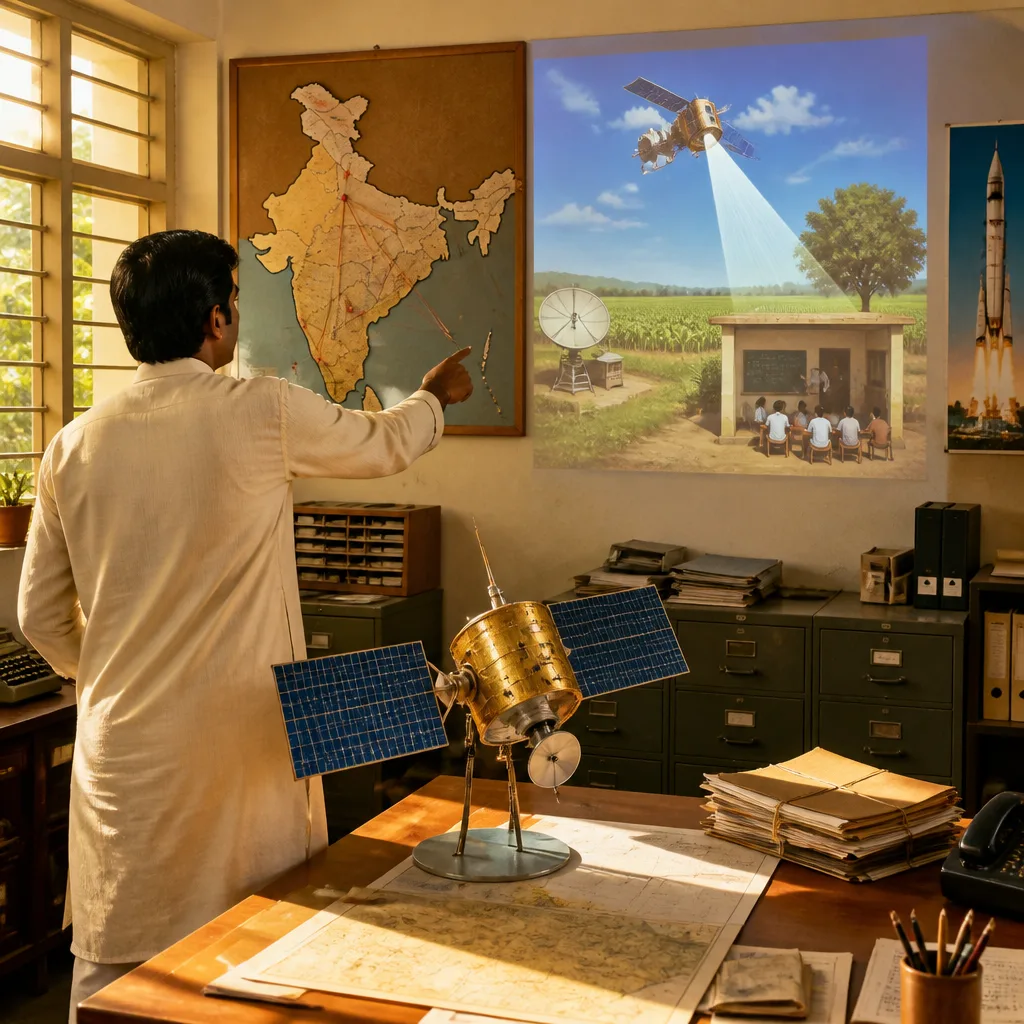
Vikram Sarabhai, born on 12 August 1919 in Ahmedabad, is widely recognised as the architect of India's space programme because he reframed space technology as a tool for social and economic development rather than a prestige project. His thinking shaped the institutions and early missions that would become the Indian Space Research Organisation.
From national needs to a national programme
In the early years after independence, India faced urgent problems of poverty, food security, housing and basic services. Sarabhai confronted a core challenge: what use would a space programme be to a country still struggling with these fundamentals? His answer diverged sharply from the Cold War model of space activity pursued by the United States and the Soviet Union. Rather than seeking symbolic feats such as lunar landings for their own sake, Sarabhai argued that India should concentrate on applying advanced technology to concrete problems affecting people and society.
That philosophy became the operational DNA of the national effort. The organisation that began as the Indian National Committee for Space Research (INCOSPAR), set up under his influence in 1962, evolved into the Indian Space Research Organisation (ISRO) in 1969. Projects that started with sounding rockets at Thumba were quickly recast with a broader, application-driven agenda: satellite communications for education, meteorology for weather forecasting, and remote sensing for natural-resource management.
"India did not need to compete with economically advanced nations simply to reach the Moon or send humans into space," he said, instead arguing India must become "second to none" in applying technology to people's problems.
From conversation to classroom: SITE and satellite education
Sarabhai's outreach beyond India helped translate his vision into concrete experiments. His discussions with NASA and international partners contributed to the design of the Satellite Instructional Television Experiment (SITE), a pioneering initiative that used satellite technology to deliver educational programming to rural communities. SITE is often cited as an early demonstration of how satellites could be harnessed for development priorities such as education and extension services rather than for prestige alone.
- Philosophy: Space as an instrument for development — education, weather, resource management.
- Institutions: INCOSPAR (1962) → ISRO (1969).
- Early focus: Sounding rockets at Thumba, quickly extended to satellite applications.
Why Sarabhai’s approach still matters
Sarabhai’s model of prioritising application over spectacle set a precedent for successive decades of India’s space policy. It established a pragmatic approach — develop indigenous capability where it delivers social value — that has influenced satellite design, mission planning and international collaborations. The emphasis on utility over symbolism helped shape projects that deliver everyday benefits: tele-education, weather services for agriculture, and remote sensing for land and water management.
That orientation towards societal needs also framed the way India engaged with international partners. Rather than importing grandiose objectives, the early programme sought collaborations that could help deploy space tools for pressing national priorities.
| Year | Event |
|---|---|
| 1919 | Vikram Sarabhai born in Ahmedabad |
| 1962 | INCOSPAR established under Sarabhai’s influence |
| 1969 | INCOSPAR evolves into ISRO |
As India’s space capabilities have grown, the tension Sarabhai highlighted — between prestige-driven milestones and utility-driven applications — remains a theme in public discourse on space policy. His insistence that space work must be measured by its contribution to society provides a benchmark as India contemplates more ambitious undertakings.
While later decades have seen India take on higher-profile missions, including interplanetary probes and human spaceflight ambitions, Sarabhai’s legacy endures in the continuing emphasis on satellite services that address the country’s development challenges.
The anniversary of his birth is a moment to revisit that founding ethos: a reminder that for Sarabhai, the ultimate aim of space science was to improve life on Earth.