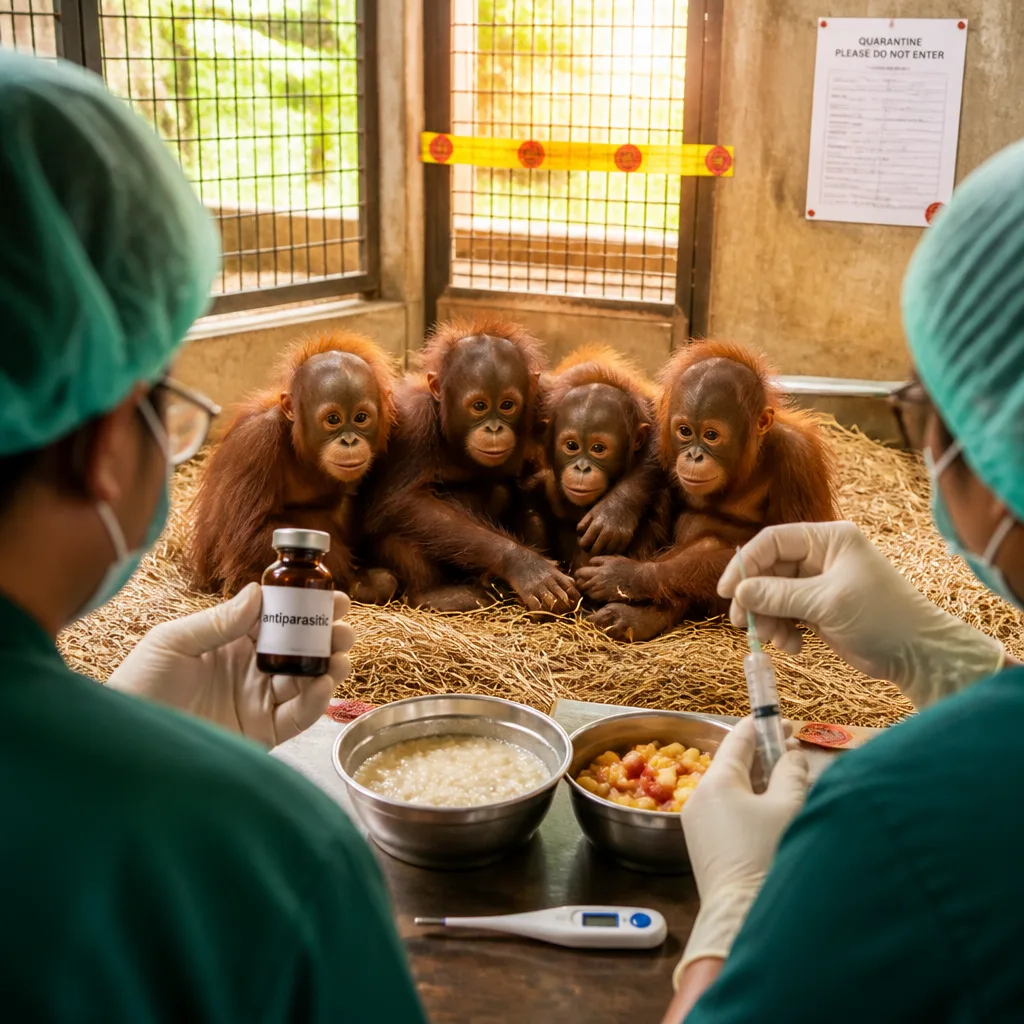
Bhubaneswar: A technical veterinary team that visited the Nandankanan Zoological Park on Saturday found the five orangutan cubs rescued from Balasore district on September 8 to be in a stable condition, while advising targeted medical and management measures, the zoo said in a health bulletin.
Medical assessment and treatment advice
The visiting team comprised veterinary personnel from the Delhi Zoo and the Wildlife Institute of India (WII), Dehradun, identified in the zoo release as Abhijit Bhawal and Krishna Muliya. After clinical screening in the quarantine facility, the experts recommended administration of antiparasitic drugs — ivermectin or doramectin — to clear the animals’ worm burden completely, the statement said.
Zoo officials said the cubs’ body temperatures measured between 98.6°F and 101°F during the examination and that feed acceptance was normal. In‑house haematology had earlier identified anaemia in three of the five animals; one cub showed severe anaemia and two others mild anaemia, the bulletin added.
| Parameter | Finding |
|---|---|
| Body temperature | 98.6–101°F |
| Anaemia | Severe in 1, mild in 2, absent in 2 |
| Antiparasitic recommendation | Ivermectin/doramectin |
Nutrition and husbandry guidance
The visiting veterinarians advised the zoo to increase feed quantities gradually and to begin introducing solid food into the cubs’ diets in a controlled manner, the bulletin said. They also provided guidance on ongoing healthcare and management interventions to support recovery while the animals remain under quarantine.
- All five cubs are quarantined at Nandankanan Zoo and undergoing periodic health checks.
- Clinical signs recorded are being managed through veterinary interventions and diet modification.
- Antiparasitic treatment is planned to address intestinal worm load.
Orangutans are not native to India and are typically found in the rainforests of Indonesia and Malaysia, the zoo noted, highlighting the unusual nature of the animals’ presence and the conservation concerns arising from their recovery and care.
Investigation into origin and alleged smuggling
The zoo bulletin said that the animals were rescued from a forest area in Balasore district on September 8 and subsequently placed in quarantine. The Odisha Police Special Task Force and the Wildlife Crime Control Bureau (WCCB) have been investigating the incident as a suspected case of international wildlife smuggling. Officials said there has been no major breakthrough in the probe so far.
Central and state agencies typically coordinate such inquiries to establish provenance, trafficking routes and any transnational links. The involvement of the WCCB indicates the matter is being treated as a wildlife crime with potential cross‑border implications.
Veterinary public‑health and conservation context
Rescued exotic wildlife present both animal‑health and public‑health considerations. Quarantine and diagnostic screening help manage infectious disease risk, ensure appropriate nutrition and enable safe rehabilitation. The technical team’s recommendations on deworming and diet reflect standard veterinary practice in the early stages of care for displaced primates.
Readers are reminded that care and treatment of wildlife should be overseen by qualified veterinarians and licensed facilities. For human health concerns relating to animal contact, consult a qualified medical practitioner; the information provided in this bulletin is not a substitute for professional medical or veterinary advice.
The zoo statement did not provide further clinical detail or timelines for rehabilitation and release. Authorities are likely to await the outcome of therapeutic measures and the ongoing investigation before making longer‑term decisions on the animals’ future, the bulletin said.