State moves to re-examine mound on Ujjain outskirts after British-era report
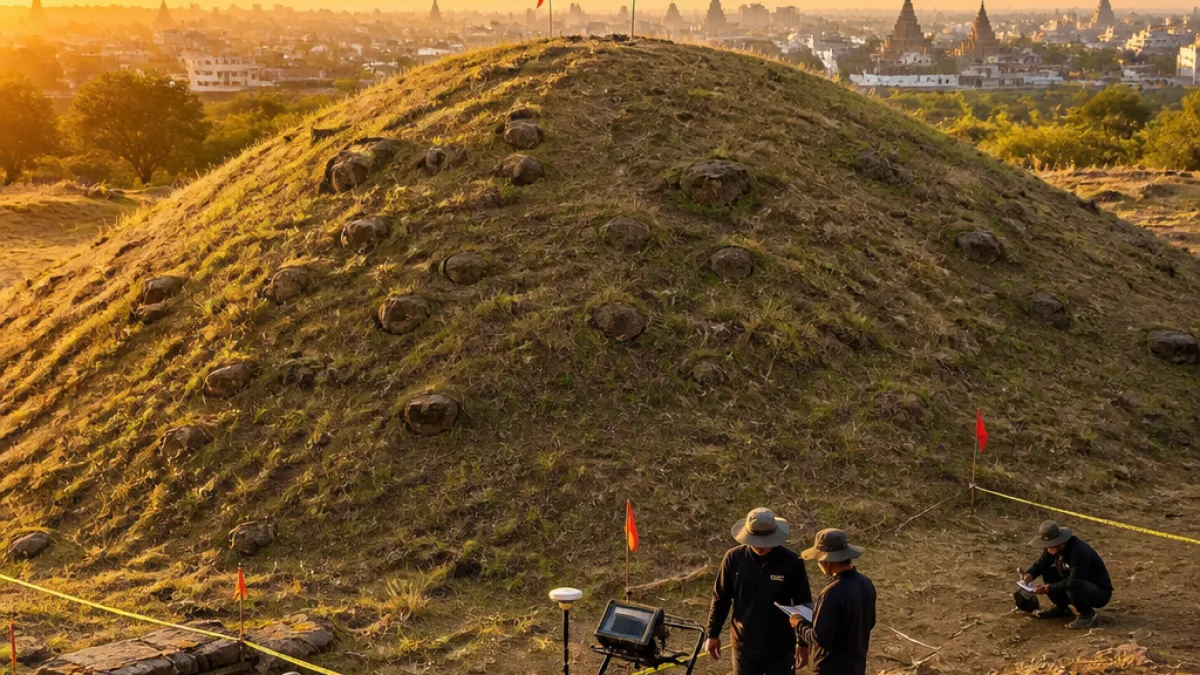
UJJAIN: A large earthen mound on the outskirts of Ujjain that has been a subject of archaeological curiosity for nearly nine decades may contain a Buddhist monument of exceptional scale, possibly dating to the Mauryan period. The Madhya Pradesh government has initiated talks with the Archaeological Survey of India (ASI) to conduct a systematic excavation of Vaishya Tekri, officials and media reports said.
British-era field work carried out in 1938–39 recorded figures that, if confirmed, would make the site significantly larger than the Great Stupa at Sanchi. The earlier report estimated the mound containing the principal structure to be about 350 feet in diameter and at least 100 feet high, compared with Sanchi’s approximately 120 feet in diameter and about 54 feet high.
“The mound, earlier reports and archaeological material from the area do suggest the possibility of a stupa larger than Sanchi. This cannot be stated as a fact until excavation is carried out,”
said Nandini Bhattacharya, Joint Director General of the ASI, according to reporting. The ASI has emphasised that while historical accounts and surface finds point to significant potential, conclusive statements require controlled excavation and scientific study.
Historical links and local context
Scholarly and traditional accounts associate the site with the Mauryan period and with Emperor Ashoka, who is traditionally believed to have had connections with Ujjain prior to his accession. Some versions of the local tradition link the monument to Devi, named in sources as Ashoka’s wife and the daughter of a wealthy merchant of Vidisha. Other researchers have associated the location with the Kanakgiri Vihara known from Buddhist texts and later travellers’ descriptions.
Local residents and historians say Vaishya Tekri has long figured in regional narratives, but systematic investigation stalled after the 1939 work ended abruptly. Renewed official interest could change conservation priorities in and around Ujjain and prompt protective measures for the mound and adjacent land.
- Potential significance: If the British-era measurements are confirmed, Vaishya Tekri would be materially larger than Sanchi’s Great Stupa, altering understandings of Buddhist monumental architecture in central India.
- Official stance: ASI and state authorities require formal excavation and scientific verification before declaring the site’s chronology or function.
- Local implications: Excavation would affect land use, heritage conservation and possibly tourism development in Ujjain.
Data in brief
| Site | Reported diameter | Reported height |
|---|---|---|
| Vaishya Tekri (1938–39 report) | 350 feet | 100 feet |
| Great Stupa, Sanchi (for comparison) | 120 feet | 54 feet |
The ASI's careful public posture reflects the methodological necessity of stratigraphic excavation, dating (for example, radiocarbon or thermoluminescence where applicable) and artefact analysis before integrating Vaishya Tekri into broader interpretations of regional religious and urban history.
For Ujjain, a city already central to Hindu pilgrimage and known for its ancient astronomical and religious associations, confirmation of a major Buddhist monument would add a new dimension to its multilayered past. Authorities will need to balance archaeological research, heritage protection and local livelihoods, especially if excavation and subsequent preservation require temporary restrictions on land around the mound.
State-level discussions, reported to be prompted by Chief Minister Mohan Yadav, are underway with the ASI to decide on a formal excavation plan. Any proposal will have to address technical, conservation and community-engagement elements before work begins.
Residents and scholars in Ujjain are likely to watch developments closely: the outcome could reshape academic narratives about Buddhist architecture in central India and prompt new heritage-management choices for the city and its outskirts.