State moves to reopen long-stalled Mauryan-era site at Vaishya Tekri
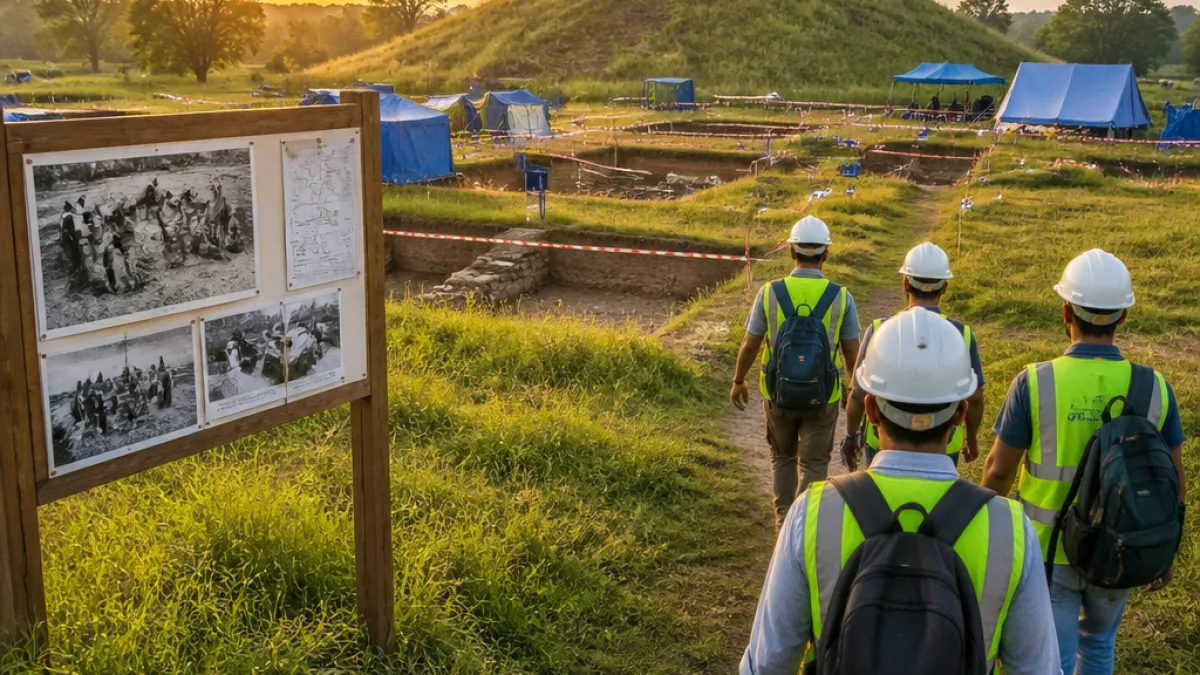
Madhya Pradesh is preparing to resume archaeological exploration at Vaishya Tekri in Ujjain, where a large Buddhist stupa dating to the Mauryan period has remained largely unexplored since partial excavations were suspended in 1939, according to official accounts and archaeological reports.
The state government is coordinating with the Archaeological Survey of India (ASI) to examine the possibility of fresh excavation at the mound. Chief Minister Mohan Yadav has been reported as pressing the project forward, signalling renewed administrative attention on the site and its potential for heritage conservation and study.
- Age and scale: The monument has been dated to around the 3rd century BCE, making it roughly 2,200 years old.
- Dimensions reported: A British-era archaeological report estimated the stupa at about 350 feet in diameter and at least 100 feet high, considerably larger than the Great Stupa at Sanchi.
- Previous work: Partial excavation carried out in 1938–39 exposed the main stupa and remains of two smaller stupas; work was suspended after a gas leak incident affected labourers.
The earlier archaeological account described the site as a large circular mound surrounded by a rectangular depression. Field notes from that period recorded a core built of compacted local murum with large bricks in mud mortar forming the outer facing; bowl-shaped masonry was observed at the base, apparently to resist outward pressure. Much of the brick facing was noted as missing and the upper portion seemed to have been washed away, leaving the original layout and elevation uncertain.
“The monument was described in the earlier report as ‘perhaps the biggest known’ Buddhist stupa at the time,”
The earlier report characterised the construction as “a peculiar construction not met with anywhere else,” a phrase that has drawn renewed scholarly interest. Some historians and archaeologists have suggested a possible link between the site and the period of Emperor Ashoka, though available accounts emphasise that conclusive evidence for a direct Ashokan association has not been established.
| Feature | Vaishya Tekri (reported) | Sanchi Great Stupa |
|---|---|---|
| Diameter | ~350 ft | ~120 ft |
| Height | >=100 ft (estimated) | ~54 ft |
| Period | Mauryan (3rd century BCE) | Post-Mauryan expansions; early historic |
Local consequences of renewed exploration could include increased archaeological activity, potential restrictions or work in adjacent agricultural land, and longer-term options for heritage tourism development. Ujjain’s position as an ancient city with deep historical layers means any major archaeological programme would also involve coordination with local administration, landholders and conservation specialists.
Officials have cited safety concerns from the 1938–39 campaign: excavation was halted after a gas leak reportedly left labourers unconscious. Modern investigations will require comprehensive preparatory surveys, including geophysical prospection, environmental and occupational safety assessments, and a clear conservation plan to preserve exposed structures. The ASI’s involvement is expected to bring technical expertise for such measures.
Experts involved in past reports noted that much of the structure’s brick facing had disappeared and that erosion had removed the upper portions, complicating attempts to reconstruct the original form. Renewed scientific excavation, if undertaken, could clarify construction techniques, chronology and the site’s wider cultural context in early historic central India.
The Ujjain administration and archaeological authorities are in the process of coordinating next steps. Any formal excavation will follow standard archaeological protocols and require detailed documentation, conservation measures and community consultation where operations affect local land use and livelihoods.