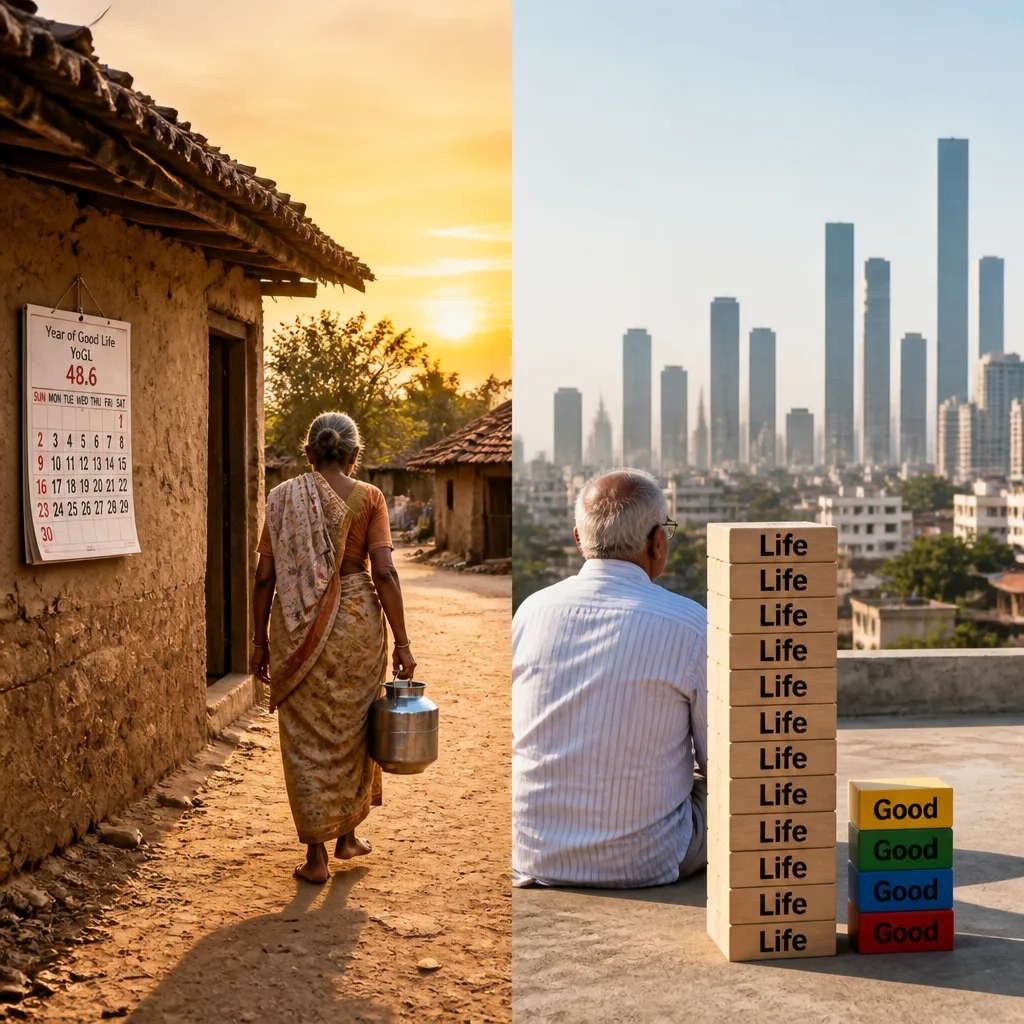
A recent multi‑institution study finds that while life expectancy at older ages in India has risen, the extra years are not necessarily years of good health, financial security or cognitive well‑being. The research, published in Social Indicators Research, introduces a composite measure — Years of Good Life (YoGL) — and reports wide gender and rural–urban disparities among Indians aged 60 and above.
Major findings
The study, conducted by researchers from the International Institute for Population Sciences (IIPS), Princeton University and the University of Vienna, finds that at age 60:
- Men can expect another 17.5 years of life on average, but only 8.2 years of those are likely to be "good years" as measured by YoGL.
- Women can expect another 19 years of life, yet only 5.7 years of those qualify as good years.
- The gap widens by place of residence: an urban man aged 60 can expect 10.2 good years, compared with 4.6 years for a rural woman.
Researchers emphasise that these differences persist despite nearly identical remaining life expectancies for some groups, signalling that longevity gains are not being matched by improvements in the quality of additional years.
"The findings are sobering," the lead researchers Ruchika Chakraborty and Srinivas Goli, both associated with IIPS, said.
What YoGL measures and why it matters
Years of Good Life (YoGL) is a composite indicator that extends beyond conventional metrics such as life expectancy and income. It aims to capture whether older adults can live with a reasonable degree of independence, financial security and cognitive well‑being. The study argues that YoGL offers a more policy‑relevant summary of population ageing because it reflects functional status and social protection rather than mere survival.
Geographic and gender disparities
The researchers report substantial variation across states and between rural and urban areas. National averages mask these differences: older adults in urban areas are estimated to enjoy an average of 9.2 years of good life after 60, whereas those in rural areas average 6.1 years. The study highlights that women, especially those in rural settings, face the steepest disadvantage in terms of healthy, secure years.
| Group | Remaining life expectancy at 60 | YoGL (good years) |
|---|---|---|
| Men | 17.5 years | 8.2 years |
| Women | 19 years | 5.7 years |
| Urban men | — | 10.2 years |
| Rural women | — | 4.6 years |
Policy implications
The report raises immediate questions for public health planners and social protection programmes. If additional years of life are not accompanied by independence and cognitive health, demand for long‑term care, disability support and targeted welfare may increase. The authors suggest that conventional indicators such as life expectancy and per capita income are insufficient to evaluate the gains of an ageing population.
State‑level variation noted in the study implies that one‑size‑fits‑all policies may not address local needs. Programmes aiming to extend life should be complemented by interventions to preserve functional ability, expand access to primary and geriatric care, strengthen pensions and social safety nets, and improve financial inclusion for older women, particularly in rural areas.
Expert caution and public guidance
The study supports a growing consensus among public health agencies that population ageing must be addressed through integrated health and social responses. Readers are reminded that population measures estimate averages and do not predict individual outcomes; those concerned about ageing, chronic disease management or cognitive health should consult a qualified physician. Institutions such as the Indian Council of Medical Research (ICMR) and the World Health Organization (WHO) emphasise prevention, early detection and community‑based support for healthy ageing.
The researchers call for routine use of broader indicators like YoGL to monitor progress and guide resource allocation as India's population continues to age.